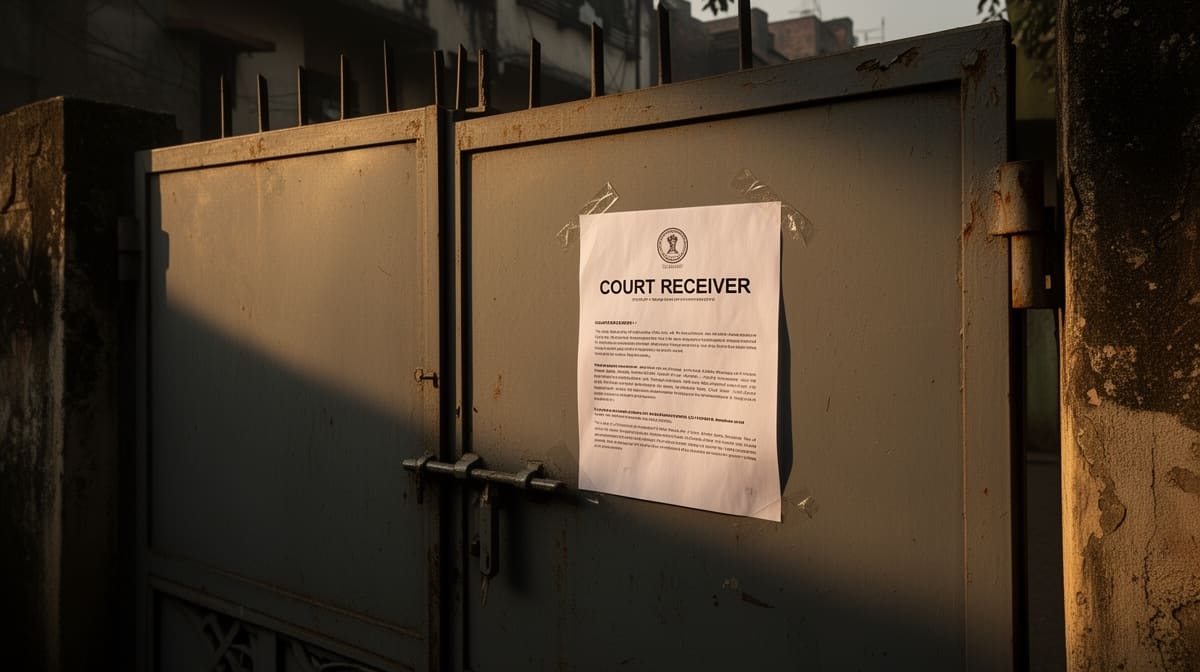
The Bombay High Court has clarified that the enforcement of security interest under the Securitisation Act cannot override prior judicial orders placing a property under the physical possession of a Court Receiver. This ruling reinforces the principle that competing civil court proceedings must be respected, even in the context of fast-tracked recovery mechanisms.
Background & Facts
The Dispute
The petitioner, Sanjoo Kumar Singh, challenged the auction of a secured asset by a bank under the Securitisation and Reconstruction of Financial Assets and Enforcement of Security Interest Act, 2002. The asset had already been placed under the custody of a Court Receiver appointed by the Civil Judge Senior Division, Katihar (Bihar), on 1st August 2025. A public notice issued on 13th August 2025 confirmed the Receiver’s physical possession of the property.
Procedural History
- 1st August 2025: Civil Court, Katihar, appointed a Court Receiver over the same property.
- 13th August 2025: Public notice issued by the Court Receiver asserting physical possession.
- 30th October 2025: Competent Magistrate granted the bank physical possession under Section 14 of the Securitisation Act.
- 20th January 2026: Debts Recovery Tribunal-II, Mumbai, rejected the petitioner’s interim application seeking stay of auction.
- 12th March 2026: Writ petition filed before Bombay High Court, with auction scheduled for 13th March 2026.
Relief Sought
The petitioner sought immediate stay of the auction, arguing that the DRT’s rejection of interim relief was illegal given the prior judicial possession by the Court Receiver. He contended that the bank’s action violated the doctrine of comity between courts and undermined the authority of civil court orders.
The Legal Issue
The central question was whether a secured creditor can proceed with an auction under Section 14 of the Securitisation Act when a civil court has already appointed a Court Receiver with physical possession of the same asset, and whether the High Court can intervene via writ jurisdiction despite the availability of an alternative remedy under the DRAT.
Arguments Presented
For the Petitioner
The petitioner’s counsel relied on State of Maharashtra v. M/s. S. K. Industries and Rajesh Kumar v. Union of India to argue that the DRT’s jurisdiction is subordinate to civil court orders. They emphasized that physical possession by a Court Receiver constitutes a judicial control that cannot be overridden by executive action under the Securitisation Act. The rejection of interim relief by the DRT, they submitted, was a patent error warranting writ intervention.
For the Respondent/Bank
The bank’s counsel contended that the petitioner had an efficacious alternative remedy under Section 18 of the Securitisation Act to approach the DRAT. They argued that writ jurisdiction under Article 226 of the Constitution should not be invoked when statutory remedies exist, citing K. S. Puttaswamy v. Union of India on the principle of exclusivity of statutory remedies. They further noted that the DRT’s order was procedural and not final.
The Court's Analysis
The Court acknowledged the bank’s right to enforce security interest under the Securitisation Act but held that such enforcement cannot occur in defiance of a prior judicial order establishing possession. The Court observed that the appointment of a Court Receiver is not a mere procedural step but a substantive judicial determination of control over the asset.
"The possession of a Court Receiver, duly appointed by a civil court, is not a mere custodial arrangement but a judicial act that binds all parties, including secured creditors operating under special statutes."
The Court distinguished this from ordinary disputes over title or ownership, noting that here the conflict was between two judicial authorities - one civil, one quasi-judicial. While the Securitisation Act grants broad powers, it does not expressly override the authority of civil courts to appoint receivers. The Court further noted that the absence of any bids for the property indicated no third-party interest, reducing the risk of prejudice from deferment.
The Court also rejected the notion that the availability of a DRAT remedy automatically barred writ jurisdiction. It held that where the DRT’s action is patently illegal or violates a prior judicial order, the High Court retains supervisory jurisdiction under Article 226 to prevent irreparable harm.
The Verdict
The petitioner succeeded. The Bombay High Court held that auction under Section 14 of the Securitisation Act cannot proceed while a civil court’s Court Receiver holds physical possession. The Court directed the bank to defer the auction for two weeks and permitted the petitioner to approach the DRAT for full adjudication.
What This Means For Similar Cases
Judicial Possession Trumps Securitisation Enforcement
- Practitioners must verify whether a secured asset is under the custody of a Court Receiver before initiating or proceeding with auction.
- Banks and financial institutions must conduct due diligence on pending civil court proceedings involving the asset.
- DRTs must consider prior civil court orders before rejecting interim applications seeking stay of auction.
Alternative Remedy Does Not Bar Writ Intervention in Cases of Patent Illegality
- Writ petitions under Article 226 remain maintainable when the DRT acts in clear violation of a civil court’s order.
- The existence of DRAT remedies does not preclude High Court intervention where the error is jurisdictional or violates comity between courts.
- Courts should not mechanically dismiss writs on the ground of alternative remedy if the issue involves conflicting judicial orders.
Auctions Require Actual Bidding Interest to Justify Urgency
- The absence of bids or inspections undermines claims of urgency in auction proceedings.
- Practitioners should challenge auction timelines where no market interest exists, as courts may view such urgency as procedurally suspect.