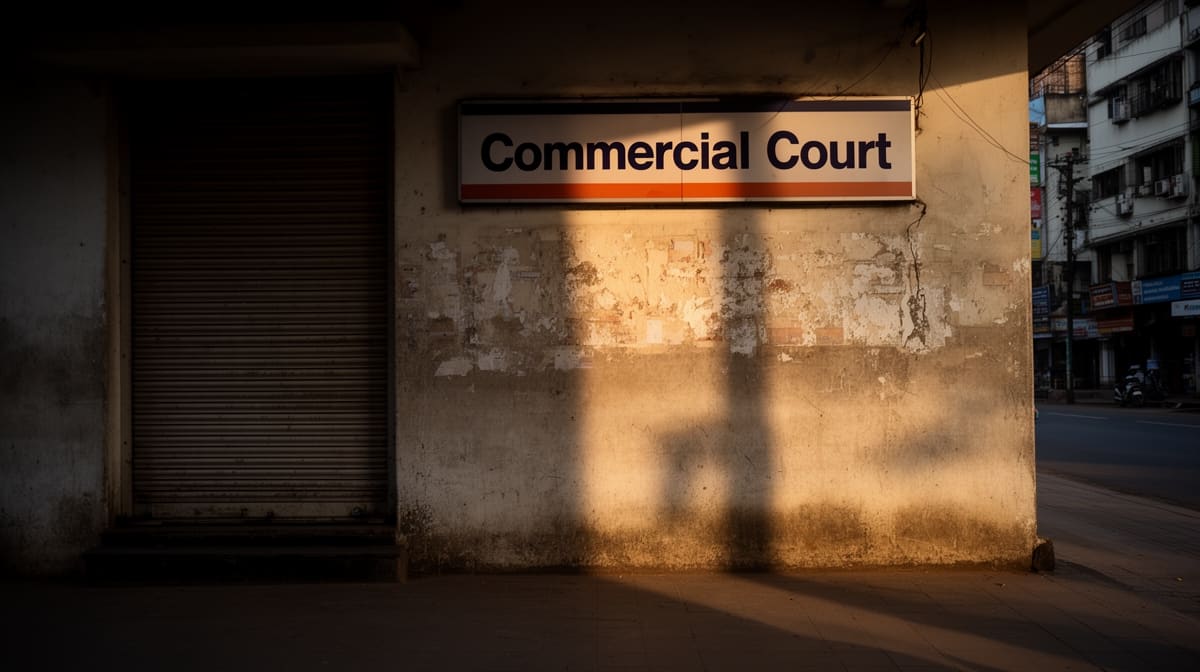
The Karnataka High Court has delivered a significant clarification on the limits of interim relief under Section 9 of the Arbitration and Conciliation Act, 1996, emphasizing that courts cannot issue ex parte orders that effectively shut down a business without a prima facie case and proper balancing of interests. This ruling reinforces the principle that drastic remedies like freezing bank accounts and restraining brand usage demand rigorous judicial scrutiny before grant.
Background & Facts
The Dispute
The dispute arose between M/S Pure Spirits, a partnership firm operating a venue under the 'Playboy' brand at Hyatt Regency, Kolkata, and M/S Rat Enterprises Pvt. Ltd., which claimed to be the franchisee of the 'Playboy' brand and a partner in the appellant firm. The respondent alleged that the appellants were obligated to pay a 7% royalty on gross proceeds - approximately ₹12 - 13 lakhs monthly - and sought to prevent them from changing the brand name or accessing their bank accounts.
Procedural History
- 06.02.2026: The respondent filed an application under Section 9 of the Arbitration and Conciliation Act, 1996 before the Commercial Court, Bengaluru, seeking ex parte interim relief.
- Ex parte order passed: The Commercial Court granted an order restraining the appellants from:
- Changing the brand name 'Playboy' at the Hyatt Regency venue
- Operating, withdrawing, transferring, or dealing with two bank accounts (Bank of Baroda and ICICI Bank)
- 11.02.2026: The appellants filed Commercial Appeal No. 112 of 2026 under Section 37(1)(b) of the A&C Act, challenging the ex parte order.
Relief Sought
The appellants sought to set aside the ex parte interim order, arguing that it was disproportionate, lacked prima facie justification, and would cause irreparable harm to their business operations. They contended that the underlying franchise relationship was in serious doubt, and the respondent’s claim to ownership of the 'Playboy' brand was questionable.
The Legal Issue
The central question was whether an ex parte interim order under Section 9 of the Arbitration and Conciliation Act, 1996 can lawfully freeze bank accounts and restrain a party from using a brand name without a prima facie case, balance of convenience, and irreparable harm being established.
Arguments Presented
For the Appellant
The appellants relied on P. Mohanraj v. M/s. Shah Brothers Ispat Pvt. Ltd. and M/s. S. S. Enterprises v. M/s. S. S. Industries to argue that Section 9 relief must be granted sparingly and only after considering the tripartite test: prima facie case, balance of convenience, and irreparable injury. They submitted that the respondent’s claim to the 'Playboy' brand was uncertain, and the royalty structure was inconsistent with agreements with other parties. Freezing accounts and restraining brand use amounted to a de facto business shutdown without notice or hearing.
For the Respondent
The respondent argued that it had invested ₹1 crore in securing franchise rights and would suffer irreparable loss if the appellants changed the brand name. It contended that the royalty payments were contractual and that the bank accounts were directly linked to revenues generated under the franchise arrangement. It relied on Bharat Aluminium Co. v. Kaiser Aluminium Technical Services to assert that courts must protect the integrity of arbitration agreements.
The Court's Analysis
The Court examined the nature of the relief granted and found it to be disproportionate and procedurally flawed. It noted that the impugned order was ex parte, granted without notice to the appellants, and imposed two severe restrictions: freezing bank accounts and prohibiting brand usage. Such measures, the Court held, are not merely procedural but go to the heart of commercial viability.
"The impugned order has the propensity to bring the business of the appellants to a complete stop."
The Court emphasized that Section 9 is not a substitute for a final adjudication and that interim relief must be narrowly tailored. The mere assertion of a monetary claim, even if substantial, does not justify freezing accounts or restraining brand usage. The Court further observed that the respondent’s dual role - as both franchisee and partner - created a conflict of interest that required full adversarial hearing.
The Court also rejected the notion that the respondent’s alleged investment of ₹1 crore automatically entitled it to injunctive relief. It held that such claims must be weighed against the appellants’ right to carry on lawful business under Article 19(1)(g) of the Constitution. The absence of any evidence establishing a clear, enforceable right to the 'Playboy' brand further undermined the basis for the injunction.
The Verdict
The appellants succeeded. The Karnataka High Court set aside the ex parte interim order, holding that Section 9 relief cannot be granted in an ex parte manner to freeze bank accounts or restrain brand usage without a prima facie case, balance of convenience, and irreparable harm being established. The Court directed the Commercial Court to hear the matter expeditiously on its merits.
What This Means For Similar Cases
Interim Relief Must Be Proportionate
- Practitioners must now demonstrate that the requested interim measure is the least restrictive means to preserve the subject matter of arbitration
- Freezing bank accounts or restraining brand usage will be viewed as extreme remedies requiring compelling justification
- Courts must explicitly record why less intrusive alternatives (e.g., deposit of funds) are inadequate
Ex Parte Orders Under Section 9 Are Exceptional
- Ex parte orders under Section 9 are permissible only in cases of imminent, irreparable harm with no time for notice
- Routine commercial disputes involving royalty disputes or brand usage cannot justify ex parte injunctions
- Failure to provide notice will be grounds for automatic vacation of the order, as seen in this case
Brand Rights Require Clear Chain of Title
- Claims to use a brand name in arbitration proceedings must be supported by documented franchise or licensing agreements
- Ambiguities in ownership or conflicting claims (e.g., partner vs. franchisee) will weigh heavily against granting injunctive relief
- Courts will not presume validity of brand rights based on alleged investment alone