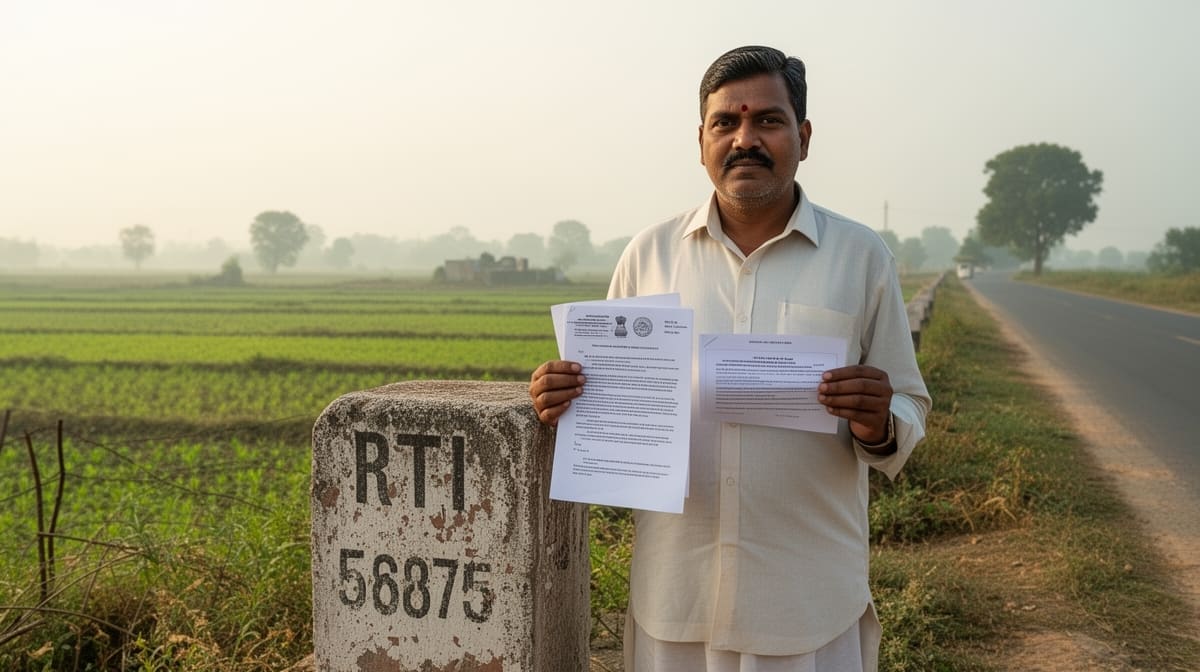
The Bombay High Court has affirmed that interim protection against eviction cannot be denied when landowners demonstrate a clear mismatch between acquisition notices and the legally notified land parcel. This ruling reinforces the principle that state authorities must act with precision under land acquisition statutes, and that possession rights are not to be disturbed on speculative or erroneous grounds.
Background & Facts
The Dispute
The petitioners, successors of the late Bhika Ganpat Kale, are landowners in Village Bramhnoli, Taluka Mawal, District Pune. They received notices dated 12 September 2025 and 17 September 2025 from Respondent No. 7, directing them to remove alleged encroachments on land claimed to be acquired for the Pawana Project approach road. The petitioners contested these notices, asserting that their lands lie within Survey No. 49 but outside the specifically acquired parcel, Survey No. 49/5.
Procedural History
- 2025: Notices issued under Section 14 of the Land Acquisition Act, 1894, demanding removal of encroachment
- December 2025: Petitioners filed RTI queries seeking clarity on the extent of acquisition
- January 2026: Writ petition filed before the Bombay High Court seeking stay of notices and protection of possession
- 26 February 2026: Court heard arguments and granted interim relief
Relief Sought
The petitioners sought:
- An interim injunction restraining respondents from disturbing their peaceful possession
- A stay on the operation of the impugned notices dated 12 and 17 September 2025
- Direction to the State to verify acquisition records before taking coercive action
The Legal Issue
The central question was whether interim relief against eviction can be granted when land acquisition notices are issued for land not formally notified in the acquisition award, and when RTI responses conclusively establish that the notified parcel does not include the petitioners’ holdings.
Arguments Presented
For the Petitioner
Counsel relied on the land acquisition award and the RTI response dated 8 December 2025, which explicitly stated that only Survey No. 49/5 (64 ares) was acquired. They argued that the notices issued to petitioners - whose land lies elsewhere in Survey No. 49 - were legally unsustainable and amounted to arbitrary executive action. The petitioners invoked Article 21 of the Constitution, emphasizing the right to peaceful possession as an essential facet of personal liberty.
For the Respondent
The State, through the Additional Government Pleader, did not dispute the accuracy of the RTI response or the acquisition award. Instead, it sought additional time to verify internal records, conceding that no evidence had been produced to substantiate the claim that petitioners’ land fell within the acquired parcel. No counter-affidavit was filed to challenge the petitioners’ factual assertions.
The Court's Analysis
The Court examined the prima facie case standard applicable to interim relief in writ petitions. It noted that the petitioners had produced authoritative documentary evidence - the acquisition award and the RTI reply - that directly contradicted the basis of the eviction notices. The Court emphasized that possession, even if not titled, is protected under Article 21 and cannot be disturbed without due process.
"The notices issued to the petitioners are based on a fundamental misapprehension of the extent of land acquired. The RTI reply is unambiguous: only Survey No. 49/5 was acquired. The petitioners’ lands, though in Survey No. 49, are not part of it. To permit eviction on such a basis would be a violation of the rule of law."
The Court further held that the State’s failure to file a counter-affidavit or produce any material to rebut the petitioners’ claims rendered the notices legally indefensible. The absence of any evidence linking the petitioners’ land to the notified parcel was fatal to the State’s position. The Court concluded that the petitioners had established a strong prima facie case, irreparable harm, and a balance of convenience in their favor.
The Verdict
The petitioners succeeded. The Court granted interim relief by staying the operation of the eviction notices dated 12 and 17 September 2025 and restraining the State from disturbing the petitioners’ peaceful possession pending final disposal. The Court directed the State to file a reply affidavit by 30 March 2026.
What This Means For Similar Cases
Possession Cannot Be Disrupted Without Documentary Proof
- Practitioners must insist on matching eviction notices with the official acquisition award and survey maps before any coercive action
- RTI responses obtained under the Right to Information Act, 2005 can serve as decisive evidence to challenge unlawful notices
- Courts will not tolerate executive overreach based on vague or unverified claims of encroachment
RTI as a Tool for Challenging Land Acquisition Errors
- RTI replies are admissible as public records under Section 65B of the Indian Evidence Act and carry evidentiary weight
- When authorities fail to rebut RTI disclosures, courts are likely to infer that the petitioner’s version is accurate
- Lawyers should routinely file RTI queries before initiating litigation to secure documentary proof of acquisition boundaries
Prima Facie Case Standard Is Favorable to Possessors
- The prima facie case threshold for interim relief in land matters is lower when possession is peaceful and documentary evidence contradicts state claims
- Courts prioritize procedural fairness over administrative convenience in eviction cases
- This judgment reinforces that possession precedes title in interim relief jurisprudence under Article 21