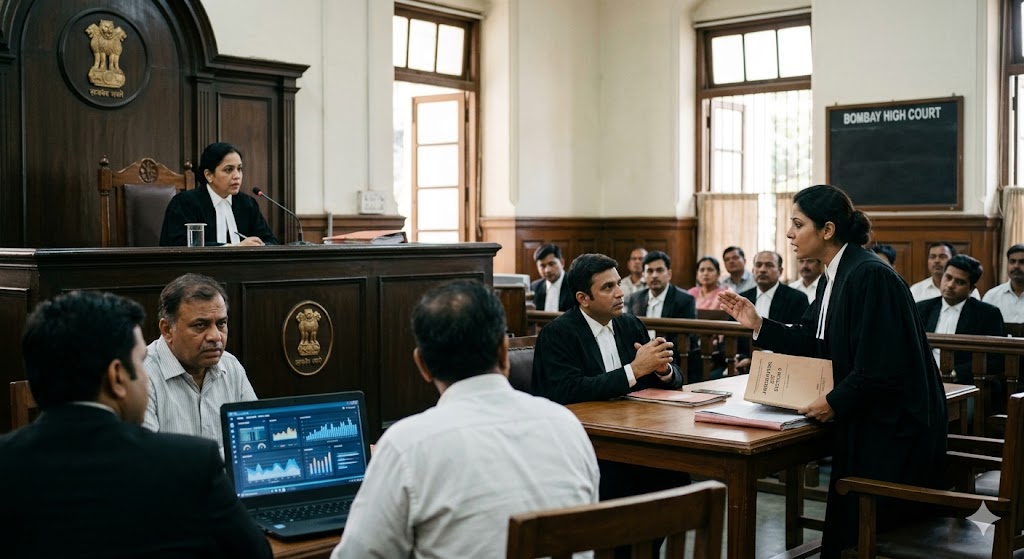
The Bombay High Court has affirmed a critical principle in commercial arbitration: when an interim injunction renders a contract incapable of performance, neither party can be compelled to sustain the agreement indefinitely. The Court upheld the arbitral award that terminated a land transfer agreement after a five-year stalemate, clarifying that silence in the face of legal impediments does not equate to contractual continuity.
Background & Facts
The Dispute
The dispute arose from a Memorandum of Understanding (MOU) dated December 7, 2006, between Jolly Brothers Pvt. Ltd. (the Company) and members of the Jolly Family (Respondents), for the surrender of 4.1 acres of land (Subject Land) in exchange for Rs. 3.90 crores. The MOU was executed after internal family disputes were settled, with the Jollys assuming liability for Rs. 29.5 lakhs previously paid by Jaycee Homes and Hotels Ltd. (Jaycee) to another branch of the family for a separate land transaction.
Procedural History
- December 7, 2006: MOU executed with escrow of Rs. 80 lakhs as earnest money, subject to conditions tied to Jaycee’s potential litigation.
- 2007: Jaycee filed Suit No. 1075 of 2007 seeking specific performance of an alleged oral agreement over the Subject Land; interim injunction granted restraining transfer.
- 2007 - 2012: Status quo orders extended repeatedly; parties mutually postponed performance deadlines.
- July 6, 2012: Respondents issued Termination Notice citing prolonged deadlock.
- October 10, 2015: Arbitral Tribunal dismissed Company’s claim for specific performance and damages, holding the MOU was terminated by operation of Clause 2.2(a).
- 2016: Company filed Section 34 petition to set aside the award.
- 2023: Supreme Court upheld condonation of delay and expedited hearing.
Relief Sought
The Company sought: (1) a declaration that the MOU remained subsisting; (2) an order directing the Respondents to vacate the injunction and hand over possession; (3) damages of Rs. 86.77 crores; and (4) refund of escrow amount with interest. In the alternative, it sought specific performance of the MOU.
The Legal Issue
The central question was whether an interim injunction, which rendered performance of a contract impossible, automatically extinguished the obligation to perform - or whether the parties were bound to wait indefinitely for the litigation to conclude, absent an express provision in the contract.
Arguments Presented
For the Petitioner
The Company contended that the MOU was not a contingent contract but a binding agreement with an optional right to terminate. It argued that Clause 2.2(a) merely granted it a right to terminate upon injunction, not an automatic termination clause. It further claimed that the term "injunction" must be read as a permanent injunction, not an interim one, and that the Arbitral Tribunal erred in treating the status quo order as triggering termination. The Company relied on Satyabrata Ghose v. Mugneeram Bangur to argue that frustration of contract requires impossibility beyond mere litigation, and that the Tribunal misapplied Section 31 of the Indian Contract Act.
For the Respondent
The Respondents argued that the MOU was structured as a conditional contract with a clear contingency: if Jaycee obtained an injunction before June 30, 2007, the MOU would be cancelled - regardless of whether the Company exercised its termination right. They emphasized that the escrow mechanism was designed to return funds to the Company if the injunction occurred, even without notice. The Respondents cited the prolonged delay (five years) and the absence of any provision for indefinite continuation as evidence that the contract had become unworkable. They relied on Mulla & Pollock on unreasonable postponement and argued that the Tribunal correctly interpreted the contract’s commercial intent.
The Court's Analysis
The Court emphasized that Section 34 of the Arbitration and Conciliation Act does not permit appellate review of factual or contractual interpretations unless the award is perverse or shocks the conscience. It undertook a close reading of Clause 2.2(a) of the MOU, which provided that if Jaycee obtained an injunction by June 30, 2007, the Company could terminate the MOU within 30 days - and if it failed to do so, the escrow amount would be returned to the Company and the MOU would stand cancelled.
"If the Company fails to intimate its non acceptance of Surrender under the Memorandum of Understanding within the stipulated period of 30 days from the date of service of copy of injunction order, on the Company, then the Escrow Agents shall hand over Escrow Amount to the Company without any intimation to S. N. Jolly Group and this Memorandum of Understanding shall stand cancelled."
The Court held that this double-negative clause was not a mere option but a mechanism to ensure automatic cancellation if the Company remained passive. The Arbitral Tribunal’s conclusion that the injunction created a condition subsequent - not a mere contingency - was legally sound. The Court agreed that the parties had not provided for continuation of the MOU despite the injunction, and therefore, the doctrine of frustration under Section 56 of the Contract Act was not applicable; rather, the contract was governed by its own express terms.
The Court rejected the Company’s argument that "injunction" meant only a permanent injunction, noting the absence of any qualifying language in the MOU. The interim order of July 27, 2007, which restrained the Respondents from surrendering possession, was functionally equivalent to an injunction under the MOU’s terms. The Court also dismissed claims of contradiction in the award, finding that the Tribunal’s analysis of time being of the essence was incidental and did not undermine its core reasoning.
The Court further noted that the Company never offered to pay the balance consideration or accept the land subject to the injunction. Its insistence that the Respondents must first defeat Jaycee’s suit before performance was due amounted to an admission that performance was impossible under the existing legal constraints. The Tribunal’s finding that both parties were incapacitated - not in default - was therefore correct.
The Verdict
The Petitioner’s challenge failed. The Bombay High Court upheld the Arbitral Tribunal’s award, holding that the MOU was lawfully terminated upon the occurrence of the contemplated contingency - the interim injunction - and that the Respondents were entitled to terminate the agreement after a reasonable waiting period of five years. The Court found no perversity, illegality, or error in the award’s interpretation of the contract.
What This Means For Similar Cases
Injunctions Trigger Contractual Termination Clauses Automatically
- Practitioners must draft contracts with explicit terms for handling interim injunctions; silence will be construed as acceptance of automatic termination.
- If a contract provides for cancellation upon injunction, the mere issuance of an interim order - not a final decree - suffices to trigger the clause.
- Parties cannot rely on judicial delay to indefinitely bind counterparties to unworkable agreements.
Reasonable Waiting Period Is Implied in Commercial Contracts
- Even without an express deadline, courts will imply a reasonable period for performance when legal impediments arise.
- Five years of inaction, coupled with no offer to perform, constitutes abandonment of contractual intent.
- Arbitral tribunals may terminate contracts based on commercial reality, even if parties claim they are "willing to wait."
Escrow Mechanisms Are Binding, Not Just Security
- Escrow deposits tied to contingencies are not mere security; they are operational triggers for contract termination.
- The return of escrow funds without notice, as stipulated, constitutes automatic cancellation - not a mere refund.
- Parties must act affirmatively to preserve contractual rights; passive conduct will be interpreted as acquiescence.