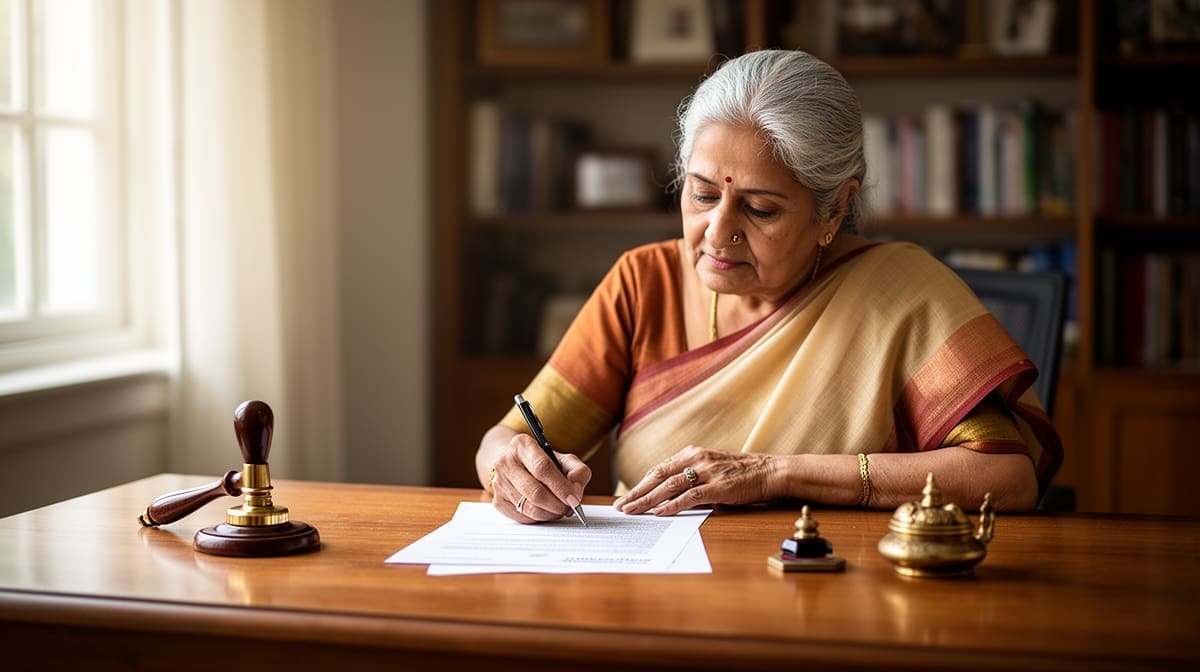
The Calcutta High Court has reaffirmed that mere allegations of suspicious circumstances in a Will, without concrete proof or legitimate basis, cannot defeat probate. The judgment underscores that testamentary freedom, even when it deviates from natural succession, is protected if the Will is properly executed and the testator’s mental capacity is unchallenged by cogent evidence.
Background & Facts
The Dispute
The present appeal challenges the grant of probate of the last Will and Testament dated 29.12.2025 executed by Sujit Guha, deceased. The Will bequeathed the three-storied residential property at Premise No. 1/397A, Gariahat Road (South), Kolkata - 700 068, with specific divisions: the second floor, including car-parking space, roof, and proportionate undivided share in land, was granted in absolute ownership to Smt. Narayani C. Guha, the second wife and Executrix. Upon her demise, the ground and first floors were to devolve absolutely upon the appellants, the two children from Sujit Guha’s first marriage.
Key Facts
- Sujit Guha died on 15.12.2025 after a prolonged illness, reportedly due to cancer.
- The Will was executed on 29.12.2025, approximately two weeks before his death.
- The Will was attested by two witnesses: P.W.1 Jayanta Kumar Bose (business partner of Narayani) and an unnamed Yoga instructor (who did not testify).
- The scribe of the Will, Sri Animesh Das, Advocate, was not examined.
- Narayani C. Guha married Sujit Guha in May 1993, after the death of his first wife in 1991.
- The appellants, D.W.1 and D.W.2, admitted in their written statement that Narayani had an intimate relationship with Sujit Guha from 1993 onwards and resided with him in Kolkata.
- P.W.3, the Testator’s driver, deposed that Sujit Guha was physically active, driving himself to the nursing home until one week before his death.
- Narayani did not produce her marriage certificate in court, but the appellants’ own pleadings confirmed the marriage.
- Narayani and P.W.1 are business partners in a current enterprise.
Procedural History
- 16.01.2010: Original Suit No. 16 of 2010 filed by Narayani C. Guha for probate of the Will.
- 20.05.2024: Additional District Judge, Ninth Court, Alipore, South 24 Parganas, granted probate.
- 15.07.2024: Appellants filed appeal before the Calcutta High Court as FA No. 98 of 2025.
- 19.02.2026, 26.02.2026, 12.03.2026, 17.03.2026: Hearings conducted.
- 17.03.2026: Case reserved.
- 23.03.2026: Judgment delivered.
The Parties' Positions
- Appellants (Sri Supratik Guha and Another): Argued that the Will was vitiated by undue influence, suspicious circumstances, and lack of testamentary capacity. Contended that Narayani was not legally married, witnesses were not close acquaintances, and the Will’s structure indicated mental incapacity.
- Respondent (Smt. Narayani C. Guha): Maintained that the Will was duly executed under Section 63 of the Indian Succession Act, 1925, with no suspicious circumstances. Emphasized that the bequest was equitable and the Testator’s mental state was unimpaired.
Relief Sought
The appellants sought revocation of the probate order dated 20.05.2024 and dismissal of the Will as invalid. They also sought costs.
The Legal Issue
The central question was whether the alleged suspicious circumstances surrounding the execution of the Will - including the relationship between the Executrix and the Testator, the nature of the attesting witnesses, and the Testator’s medical condition - were sufficient to raise a legitimate doubt requiring the propounder to dispel them, and whether the burden of proving lack of testamentary capacity or undue influence had been discharged by the appellants.
Arguments Presented
For the Appellant
The appellants contended that the Will was surrounded by suspicious circumstances under H. Venkatachala Iyengar v. B.N. Thimmajamma and Kavita Kanwar v. Pamela Mehta. They argued: (1) Narayani failed to prove her marriage, undermining her credibility; (2) P.W.1, an attesting witness, gave inconsistent testimony on the Testator’s health, residence, and presence of Narayani; (3) the witnesses were not close friends but business associates or instructors; (4) the Will’s complex structure suggested mental incapacity; (5) the Testator’s cancer diagnosis rendered him incapable; and (6) Narayani’s presence during execution raised a presumption of undue influence.
For the Respondent
The respondent countered that: (1) the appellants themselves admitted the marriage in their written statement, making the issue irrelevant; (2) Section 63 of the Indian Succession Act was satisfied by P.W.1’s testimony; (3) mere presence of the beneficiary does not constitute undue influence; (4) cancer alone does not negate testamentary capacity; (5) the bequest was fair - two out of three floors went to the children, and only the second floor with alienation rights went to Narayani; (6) no active participation by Narayani in drafting the Will was proven; and (7) the principles in Pentakota Satyanarayana and Mahesh Kumar confirm that deviation from natural succession is not suspicious if the Will is fair and properly executed.
The Court's Analysis
The Court undertook a meticulous review of the evidence and the legal framework governing probate proceedings under the Indian Succession Act, 1925. It emphasized that the burden lies on the propounder to establish the Will’s validity, but the onus to raise legitimate suspicion rests on the objector.
"The general rule is, it was observed, that the onus probandi lies in every case upon the party propounding a Will and he must satisfy the conscience of the Court that the instrument so propounded is the last Will of a free and capable Testator."
The Court found that the appellants’ allegations were not suspicious in the legal sense. Their own pleadings confirmed the marriage between Narayani and Sujit Guha, thereby negating any claim of illegitimacy in her status. The Court held that the Testator’s decision to benefit his wife, with whom he had a long-standing relationship and marriage, was not unnatural but entirely justifiable.
Regarding the attesting witnesses, the Court noted that P.W.1’s testimony was consistent when read contextually. His statement that Narayani was present at the time of execution was not contradictory to her testimony that she was not in the room - the former referred to the residential premises, the latter to the specific room of signing. The Court rejected the notion that a business partner or yoga instructor cannot be a valid attesting witness.
On testamentary capacity, the Court observed that P.W.3’s evidence - that the Testator drove himself to the nursing home until a week before death - was unchallenged. The Court held that suffering from cancer does not, by itself, impair mental capacity. The appellants failed to produce any medical evidence or expert testimony to prove incapacity.
The Court further cited H. Venkatachala Iyengar to stress that judicial skepticism must be reasonable, not obdurate. It distinguished the present case from those involving shaky signatures, unnatural dispositions, or clear coercion. Here, the bequest was equitable: the children received two floors outright, while the wife received one floor with full alienation rights and life interest in the rest.
"Mere deviation from the line of succession is not per se a suspicious circumstance, since the very purpose of a Will is to deviate from the natural line of succession."
The Court concluded that no suspicious circumstance of a legitimate nature was established. The appellants’ allegations were speculative, inconsistent, and contradicted by their own pleadings.
The Verdict
The appeal was dismissed. The Calcutta High Court affirmed the probate order dated 20.05.2024 passed by the Additional District Judge, Alipore. The Will dated 29.12.2025 stands duly proved and probate is confirmed. The Court held that the bequest was fair, the Testator had testamentary capacity, and no undue influence or suspicious circumstance was proven. There will be no order as to costs.
What This Means For Similar Cases
Suspicious Circumstances Must Be Legitimate and Plead with Specificity
- Practitioners must avoid vague allegations of undue influence; courts require concrete, specific facts, not innuendo.
- Admissions in pleadings by objectors cannot be later retracted to create suspicion - estoppel applies.
- Mere association between beneficiary and witness (e.g., business partnership) does not invalidate attestation unless active participation in drafting is shown.
Testamentary Capacity Is Not Presumed Lost Due to Illness
- Chronic illness, including cancer, does not automatically negate mental capacity.
- Evidence of physical activity, decision-making, and daily functioning prior to execution is decisive.
- The burden to prove incapacity lies squarely on the objector; medical records or expert testimony are essential.
Fair Bequest Defeats Claims of Unnatural Disposition
- A Will that provides for all heirs, even if unequally, is not inherently suspicious.
- Courts recognize testamentary freedom; deviating from natural succession is lawful if rational and documented.
- Life interests coupled with absolute bequests to children are recognized as equitable arrangements.
Probate Proceedings Are Not Marriage Verification Forums
- The validity of marriage is irrelevant if the relationship is admitted and the bequest is justified.
- Courts focus on the execution of the Will, not the moral legitimacy of the beneficiary’s relationship.
- Failure to produce a marriage certificate is not fatal if the fact of marriage is otherwise established by admission.