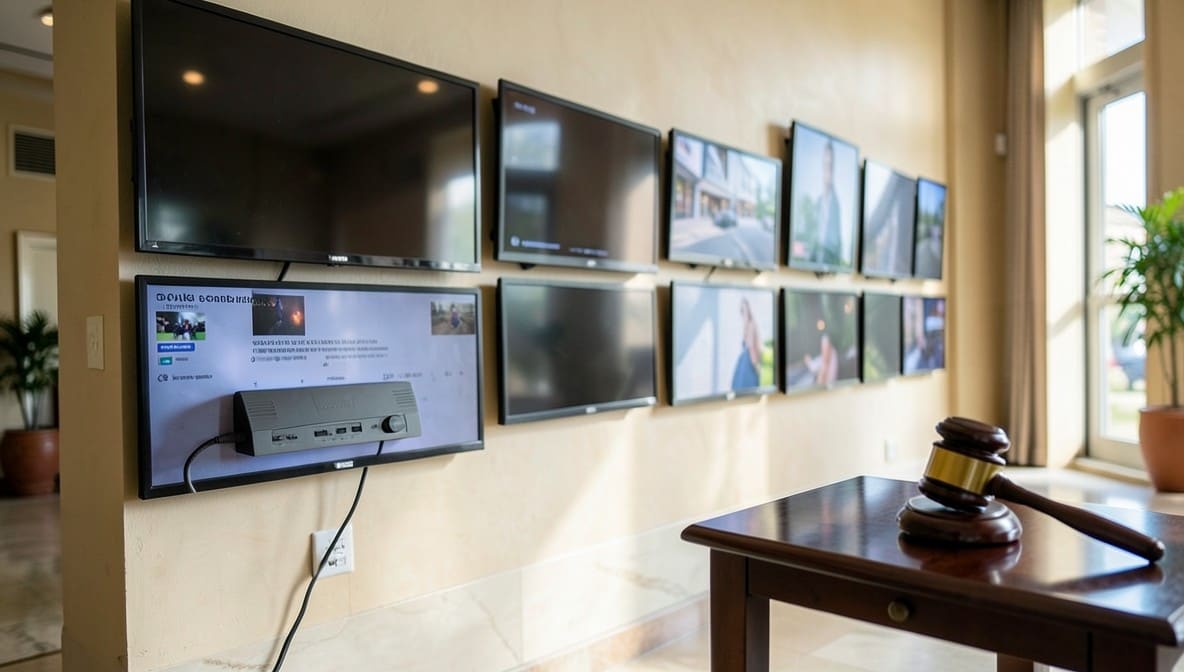
The Calcutta High Court affirmed that a hotel providing cable-TV services in guest rooms must secure its own licence for the literary and musical works it transmits, rejecting the argument that a cable operator’s licence suffices. The judgment clarifies the scope of "communication to the public" under the Copyright Act, 1957 and reinstates the appellant’s right to a permanent injunction.
Background & Facts
The Dispute
The Indian Performing Right Society Limited (the appellant) alleged that Hotel Appolo & Tours Private Limited (the respondent) publicly performed and communicated literary and musical works owned by the society’s members in hotel rooms via cable-TV connections without obtaining a licence from the society. The appellant claimed this constituted infringement of copyright.
Key Facts
- The appellant is a limited liability company registered under the Companies Act, 1996 and a non-profit body of copyright owners.
- The respondent is a private limited company operating the Appolo Hotel.
- The hotel installed television sets in each guest room and subscribed to cable-TV services from a cable operator.
- The cable operator had obtained a licence from the appellant for the works.
- The appellant sent letters to the hotel requesting a licence and royalty payment; the hotel refused.
- The appellant filed O.C. Suit No. 9 of 2023 seeking permanent injunction, damages of Rs 9,00,000 and account of profits.
- An application under Order XXXIX Rules 1 & 2 of the CPC and Section 151 CPC was filed on 18 May 2023 for an ad-interim injunction.
Procedural History
- 09 May 2023: O.C. Suit No. 9 of 2023 filed by the appellant.
- 18 May 2023: Application under Order XXXIX Rules 1 & 2 and Section 151 CPC filed.
- 20 September 2024: District Judge, Darjeeling, dismissed the injunction application and ordered refusal of temporary injunction (Order No. 18).
- 01 July 2026: Hearing concluded before the Calcutta High Court.
- 04 August 2026: Judgment delivered.
Parties' Positions
- Appellant: Asserted that the hotel’s transmission of copyrighted works to guests constitutes "communication to the public" under Section 2(ff) of the Copyright Act, 1957 and that a separate licence from the appellant is mandatory. Relied on Supercassette Industries Ltd. v. Nirula Corner House (P) Ltd. (2008) and Vodafone Idea Ltd. v. Indian Performing Right Society Ltd. (2026).
- Respondent: Contended that the cable operator’s licence covered the transmission and that the hotel, as a mere subscriber, was not liable for royalty. Cited the definition of “subscriber” under the Cable Television Networks (Regulation) Act, 1995 and argued that the hotel’s use did not amount to “broadcast” or “communication to the public”.
Relief Sought
- Permanent injunction restraining the hotel from any public performance or communication of the appellant’s works without a licence.
- Permanent injunction restraining the hotel from paying royalty to any other party.
- Account of profits earned from the alleged infringement.
- Damages of Rs 9,00,000 (compensatory and exemplary) and costs of proceedings.
The Legal Issue
The central question was whether a hotel that subscribes to cable-TV services, where the cable operator holds a licence for copyrighted works, must obtain a separate licence from the copyright owner for the transmission of those works to hotel guests, and whether such transmission falls within the meaning of “communication to the public” under Section 2(ff) of the Copyright Act, 1957.
Arguments Presented
For the Appellant
- The hotel’s transmission of works to multiple rooms constitutes “communication to the public” under Section 2(ff), which includes simultaneous communication to more than one household.
- The licence obtained by the cable operator does not extend to the hotel, as the hotel is not the “subscriber” contemplated by the Cable TV Act; the guests are separate end-users.
- Cited Supercassette Industries and Vodafone Idea to support that copyright owners retain royalty rights even when works are broadcast via cable.
- Emphasised that Section 51 makes it infringement to communicate a work without a licence, irrespective of the cable operator’s licence.
For the Respondent
- Argued that the cable operator’s licence covered the transmission and that the hotel merely paid for cable service, analogous to a subscriber under the Cable TV Networks (Regulation) Act, 1995.
- Claimed that the hotel’s use does not amount to “broadcast” under Section 2(dd) and therefore does not trigger infringement.
- Relied on the definition of “subscriber” in Section 2(i) of the 1995 Act, asserting that the hotel’s guests are not separate subscribers.
- Maintained that granting an injunction would be excessive where the cable operator already holds a licence.
The Court's Analysis
The Court began by interpreting the statutory definitions relevant to the dispute. It noted that Section 2(ff) expressly defines “communication to the public” to include “communication through satellite or cable or any other means of simultaneous communication to more than one household or place of residence, including residential rooms of any hotel or hostel.” The Court emphasized that the legislative intent was to capture commercial exploitation of works in hotels, distinguishing such premises from private residences.
"In view of the discussions made hereinabove, we are of the opinion that the respondent was guilty of infringement of copyright of literary and musical works owned by the members of the appellant society in view of the provisions contained in Section 51 of the Copyrights Act, 1957."
The Court distinguished the “broadcasting right” under Section 14 and Section 37 from the right of “communication to the public”. While the former pertains to entities that hold broadcast licences, the appellant’s claim was based on the latter, which does not require the defendant to be a broadcaster. The Court held that the hotel, by making the works available to guests in multiple rooms, exercised a “communication to the public” right and therefore required a separate licence from the copyright owner.
The Court examined the Cable Television Networks (Regulation) Act, 1995, particularly the definition of “subscriber” in Section 2(i), which limits the subscriber’s right to the reception of signals at a single premises without further transmission. The Court found that the hotel’s guests constitute “other persons” beyond the subscriber (the hotel itself), and thus the hotel cannot rely on the cable operator’s licence.
Reference was made to Supercassette Industries where the Supreme Court warned against extending statutory protection beyond its clear language. Similarly, the Court rejected the respondent’s argument that the licence obtained by the cable operator automatically covered the hotel’s use, noting that the licence is granted to the operator for its own transmission, not to downstream commercial establishments.
The Court also considered the precedent set in Vodafone Idea Ltd. v. Indian Performing Right Society Ltd. which affirmed that authors retain royalty rights for commercial exploitation of their works even when the works are part of a sound recording broadcast.
Having established that the appellant made out a prima facie case of infringement, the Court applied the balance of convenience test, finding that the appellant would suffer irreparable loss if the hotel continued its unauthorised use, whereas the hotel could obtain a licence without undue hardship.
Consequently, the Court set aside the District Judge’s order refusing injunction and allowed the application under Order XXXIX Rules 1 & 2 read with Section 151 CPC, granting a permanent injunction in favour of the appellant.
The Verdict
The appeal was allowed. The Court set aside the order dated 20 September 2024 and granted a permanent injunction restraining Hotel Appolo & Tours Private Limited from publicly performing or communicating any literary or musical works of the Indian Performing Right Society without a valid licence. No costs were awarded. The decree under the application filed on 18 May 2023 stands approved.
What This Means For Similar Cases
Hotel Licencing Obligations
- Hotels must treat the provision of cable-TV services as a commercial exploitation of copyrighted works and obtain a direct licence from the copyright owner.
- Reliance on a cable operator’s licence is insufficient where the transmission reaches multiple guest rooms.
- Failure to secure such a licence exposes the hotel to injunctions and potential damages under Section 51 of the Copyright Act.
Definition of “Subscriber” Is Narrow
- The term “subscriber” under the Cable TV Act, 1995, applies only to the entity receiving the signal for its own use, not to downstream users such as hotel guests.
- Practitioners should advise commercial establishments that guests constitute “other persons” and trigger the broader “communication to the public” definition.
- Contracts with cable operators should expressly address downstream licensing obligations.
Infringement Claims Remain Viable
- Copyright owners can pursue injunctions even when the alleged infringer argues that a third-party licence exists.
- Courts will examine the nature of the commercial activity and the statutory definition rather than merely the existence of a licence with a cable operator.
- Litigants should be prepared to demonstrate the commercial value added by the unauthorised transmission to satisfy the irreparable loss test.