The Income Tax Appellate Tribunal clarified that payments for headquarters support services and IT recharge, when structured as cost-to-cost reimbursements, fail the "make available" test under Article 12 of the India-Netherlands Double Taxation Avoidance Agreement and cannot be taxed as royalty or fees for technical services.
Background & Facts
The Dispute
Arcadis N.V., a Netherlands-registered limited liability company, filed an appeal against the assessment order dated 15 January 2025 issued by the Deputy Commissioner of Income Tax, International Taxation, Circle-1(1), Bengaluru. The assessment added ₹81,25,385 as fees for technical services, ₹28,64,39,055 as royalty on IT recharge, and ₹2,26,158 as interest income, raising the total taxable income to ₹29,71,66,214 against the declared income of ₹23,75,616.
Key Facts
- Return of Income: Filed on 14 November 2022, declaring income of ₹23,75,616.
- IT Recharge Claim: ₹28,64,39,056 claimed as non-taxable under the DTAA.
- Managerial Fees Claim: ₹81,25,385 claimed as non-taxable under the DTAA.
- Interest Income Claim: The assessee denied receipt of ₹2,26,158 shown in TDS statements.
- Agreement Dates:
- Headquarters support services agreement dated 1 January 2019.
- Assessee’s reply to the AO dated 23 February 2024.
- Assessment Process:
- Draft assessment order issued on 16 March 2024.
- Objections filed before the Dispute Resolution Panel on 12 April 2024.
- DRP decision rejecting objections dated 12 December 2024.
- Final assessment order passed on 15 January 2025.
- Appeal: Heard on 7 May 2026; judgment pronounced on 3 August 2026.
Procedural History
- 15 November 2022: Return of income filed.
- 16 March 2024: Draft assessment order issued.
- 12 April 2024: Objections filed before DRP-1, Bengaluru.
- 12 December 2024: DRP-1 rejected all objections and confirmed additions.
- 15 January 2025: Final assessment order passed, adding ₹81,25,385, ₹28,64,39,055 and ₹2,26,158.
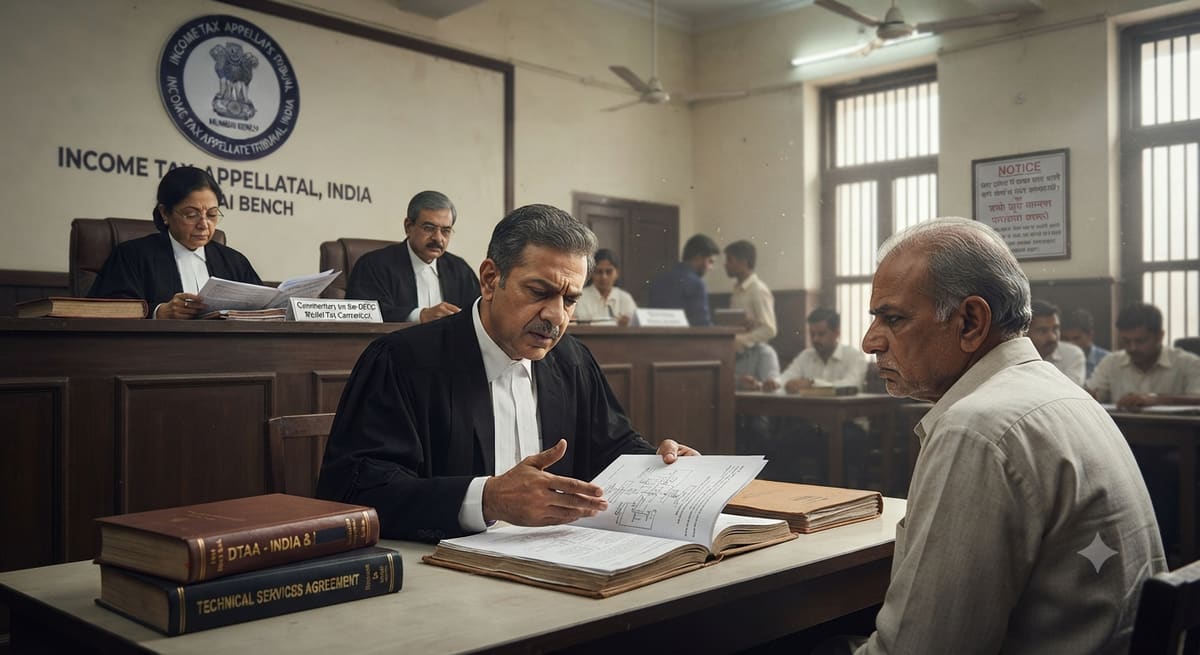
- 07 May 2026: Appeal heard before Vice-President Prashant Maharishi and Judicial Member Keshav Dubey, ITAT, Bangalore.
- 03 August 2026: Judgment delivered.
The Parties' Positions
- Appellant (Arcadis N.V.): Asserted that the IT recharge amounts are pure cost reimbursements without any income element and that the headquarters support services do not satisfy the "make available" condition of Article 12(5)(b) of the DTAA. Relied on Supreme Court’s Engineering Analysis Centre of Excellence Pvt. Ltd. v. CIT and various taxmann precedents.
- Respondent (Deputy Commissioner, Bengaluru): Held that the IT recharge constituted royalty under Article 12(1) and that the managerial fees were fees for technical services under Section 9(1)(vii) of the Income Tax Act and Article 12 of the DTAA. Treated the interest shown in Form 26AS as taxable.
Relief Sought
Arcadis N.V. sought reversal of the additions of ₹81,25,385 and ₹28,64,39,055, and a direction to verify the alleged interest income of ₹2,26,158 before any tax is levied.
The Legal Issue
The central question was whether (i) the headquarters support services amounting to ₹81,25,385 and (ii) the IT recharge amount of ₹28,64,39,055 satisfy the "make available" test under Article 12 of the India-Netherlands Double Taxation Avoidance Agreement, thereby attracting tax as fees for technical services or royalty, and whether the addition of ₹2,26,158 as interest income is justified.
Arguments Presented
For the Appellant
- Contended that the IT recharge is a cost-to-cost reimbursement with no income element, relying on the Supreme Court’s definition of "reimbursement" in 105 ITR 133.
- Argued that the headquarters support services do not transfer technical knowledge, skill or know-how, thus failing the "make available" test under Article 12(5)(b).
- Cited Engineering Analysis Centre and taxmann authorities (e.g., 153 taxmann.com 494) to support that pure reimbursements are not taxable.
- Submitted that Section 90(2) of the Income Tax Act allows the more beneficial provision of the DTAA to apply.
For the Respondent
- Maintained that the IT recharge amount represents royalty for the use of highly customizable software, invoking Article 12(1) and (2) of the DTAA.
- Asserted that the headquarters support services constitute fees for technical services because they involve advisory and managerial assistance that makes technical knowledge available to the Indian entity.
- Relied on the Assessing Officer’s detailed reasoning that the services enabled the recipient to benefit from the assessee’s brand and expertise.
- Stated that the interest shown in Form 26AS and TDS statements is verifiable and therefore taxable.
The Court's Analysis
The Tribunal first examined the definition of "royalty" under Article 12(1) of the India-Netherlands DTAA, noting that royalty pertains to payments for the right to use or enjoy a copyright, patent or similar right. It observed that the IT recharge agreement expressly provided for a cost-to-cost allocation without any markup, and that the payments were made to recover expenses incurred in procuring third-party software licences. The Tribunal held that the Supreme Court’s Engineering Analysis decision, which treats pure reimbursements as non-taxable, was directly applicable.
"We therefore hold that the payment made by the Indian entity to the Assessee was a cost-to-cost reimbursement, contained no income element, and is not chargeable to tax in India."
The Tribunal then turned to the "make available" test under Article 12(5)(b). It reiterated that the test is satisfied only when the recipient can independently apply the transferred knowledge, skill or know-how without further assistance. While the Assessing Officer had listed fifteen categories of services, the Tribunal found no evidence that the Indian entity could perform these functions autonomously after the contract ended. The services were characterised as general managerial and support functions, not as the transfer of technical expertise.
The Tribunal also addressed the burden of proof, emphasizing that the assessee must demonstrate a direct correlation between outflow and inflow and that the amounts are identical - both conditions were met under the agreement’s clauses. Consequently, the Tribunal concluded that the "make available" condition was not satisfied for the ₹81,25,385 headquarters support fees.
Regarding the interest income, the Tribunal noted that the Assessing Officer relied solely on the TDS statement. It directed verification of the payer’s records under Section 133(6) of the Income Tax Act and required a fresh hearing to the assessee before any tax could be imposed.
In sum, the Tribunal found the Assessing Officer’s findings on both the royalty and technical services additions to be unsupported by the factual matrix and the treaty provisions.
The Verdict
The Income Tax Appellate Tribunal allowed the appeal. It set aside the addition of ₹81,25,385 as fees for technical services and the addition of ₹28,64,39,055 as royalty, holding both amounts to be cost-to-cost reimbursements not chargeable to tax. It directed the Assessing Officer to verify the alleged interest income of ₹2,26,158 under Section 133(6) of the Act and to afford the assessee a reasonable opportunity of being heard before any fresh determination. All other grounds were dismissed.
What This Means For Similar Cases
Cost-to-Cost Reimbursements Are Not Royalty
- Practitioners must examine the contractual language to confirm that payments are strictly reimbursements of incurred costs without any markup.
- If the agreement evidences a direct one-to-one correlation between outflow and inflow, the payment will likely be treated as non-taxable under the DTAA.
The "Make Available" Test Requires Demonstrable Transfer of Knowledge
- Merely providing advisory or managerial assistance does not satisfy the test; the recipient must be able to apply the knowledge independently.
- Parties should document any technical training, transfer of know-how, or development of a technical plan to substantiate a claim of taxable technical services.
Interest Income Must Be Substantiated by Independent Evidence
- Tax authorities cannot rely solely on TDS statements; they must obtain confirmation from the payer.
- Taxpayers should retain bank statements and correspondence to rebut erroneous interest claims.
Practical Checklist for DTAA-Related Disputes
- Verify that the agreement contains a cost-recovery clause with no markup.
- Assess whether the services involve transfer of technical knowledge, skill or know-how.
- Prepare documentary evidence (invoices, allocation keys, usage data) to support the nature of the payment.
- Anticipate the need for verification of TDS-reported interest and be ready to produce counter-evidence.