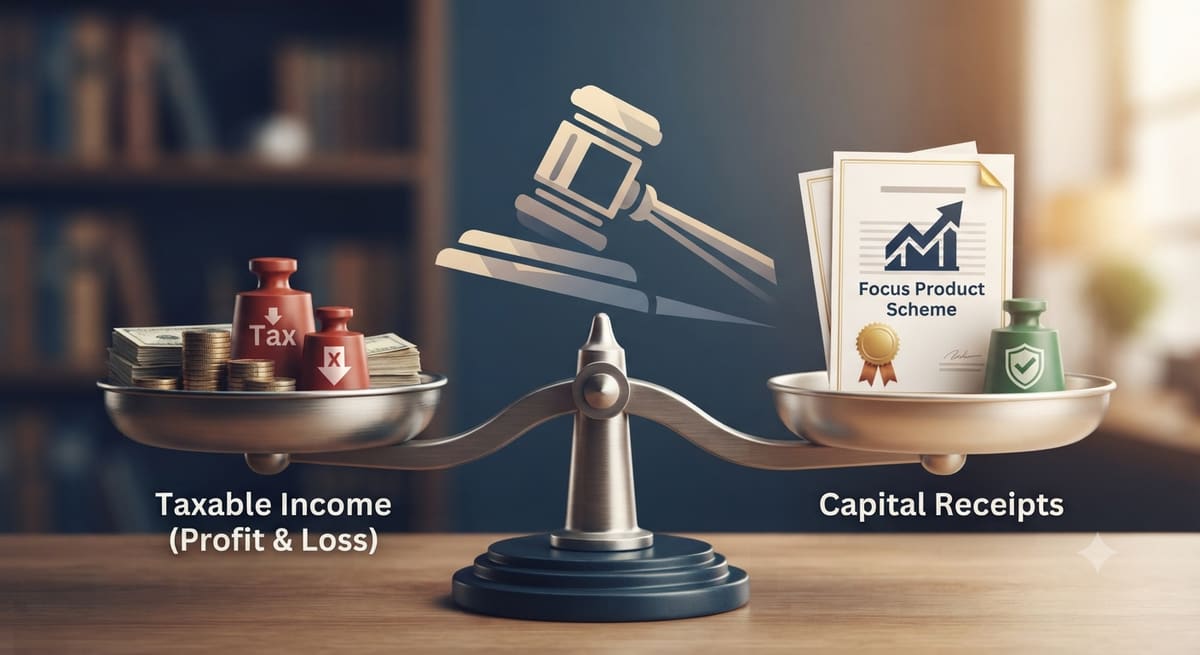
The Customs, Excise & Service Tax Appellate Tribunal has delivered a definitive ruling that government grant-in-aid, when strictly reimbursing capital expenditure incurred by a taxpayer, does not constitute consideration for a taxable service under the Finance Act, 1994. This judgment clarifies a long-standing ambiguity in the application of service tax to public funding schemes and reinforces the principle that reimbursement without surplus cannot trigger tax liability.
Background & Facts
The Dispute
The appellant, Daawat Foods Limited, is a food processing company engaged in the production and supply of Basmati rice, rice flour, and other staples. It received two grants-in-aid from the Ministry of Food Processing Industries (MOFPI) under the Central Sector Scheme for Creation/Expansion of Food Processing and Preservation Capacities, part of the Pradhan Mantri Kisan Sampada Yojana. The grants were intended to support the establishment of a rice milling unit at Mandideep, Madhya Pradesh.
Key Facts
- The first grant-in-aid of Rs. 4,20,000 was sanctioned on 12.09.2013 under Order No. M-19012/14/10-11(RM)
- The second grant-in-aid of Rs. 2,39,000 was sanctioned on 18.06.2015 under the same scheme
- Both grants were explicitly described as reimbursement of expenditure already incurred on plant and machinery acquisition
- The sanction orders required execution of a bond with sureties to ensure compliance with project timelines and non-diversion of funds
- The bond included a clause requiring the grantee to surrender any Intellectual Property Rights (IPR) generated under the project to the Government
- The appellant did not charge or pay service tax on the receipt of these grants
- The Department alleged that the IPR surrender clause created a counter-obligation, making the grant consideration for a taxable service under Section 66E(e) of the Finance Act, 1994
- A Show Cause Notice (SCN) dated 15.04.2019 was issued for the financial years 2013-14 and 2015-16, proposing a service tax demand of Rs. 6,59,000 along with interest and penalty
- The Deputy Commissioner confirmed the entire demand in Order-in-Original dated 10.02.2021
- The Commissioner (Appeals) upheld the demand in Order-in-Appeal dated 30.03.2022
Procedural History
- 12.09.2013: First grant-in-aid sanctioned by MOFPI
- 18.06.2015: Second grant-in-aid sanctioned by MOFPI
- 15.04.2019: Show Cause Notice issued by Department proposing service tax demand of Rs. 6,59,000
- 10.02.2021: Deputy Commissioner confirmed demand in Order-in-Original No. 23/DC/ST/DIV. III/ADJ/2021
- 30.03.2022: Commissioner (Appeals) upheld the demand in Order-in-Appeal No. BHO-EXCUS-001-APP-243-21-22
- 09.03.2026: Hearing before CESTAT
- 07.04.2026: Final Order passed by CESTAT
Relief Sought
The appellant sought quashing of the demand of Rs. 6,59,000, cancellation of interest and penalty, and relief on the ground that the SCN was time-barred for the period 01.04.2013 to 30.09.2013 under Section 73(1) of the Finance Act, 1994.
The Legal Issue
The central question was whether receipt of government grant-in-aid, solely as reimbursement of capital expenditure incurred by a taxpayer, constitutes consideration for a taxable service under Section 65B(44) and Section 66E(e) of the Finance Act, 1994, particularly when the grant conditions include a general obligation to surrender IPR generated during the project.
Arguments Presented
For the Appellant
The appellant’s counsel argued that the grant-in-aid was purely a reimbursement of expenses incurred for setting up the rice milling unit, with no surplus received. The IPR clause in the sanction order was a standard, non-specific condition applicable to all grantees and did not create a contractual obligation to provide any service to the Government. The appellant had not generated any IPR, nor was there any evidence that it had rendered any technical or scientific consultancy. Reliance was placed on M/s ILFS Clusters Development Initiative Ltd. v. Commissioner, Apitco Ltd. v. Commissioner of Service Tax, and Checkmate Facility and Management Solutions Pvt. Ltd. v. CIT, all of which held that grant-in-aid received for implementing welfare schemes is not consideration for a service. The appellant had filed all returns and maintained audited accounts, negating any allegation of suppression.
For the Respondent
The Department’s representative contended that the obligation to surrender IPR to the Government constituted a counter-obligation under Section 66E(e), which treats "agreeing to do an act" as a taxable service. The grant enabled the appellant to modernize its unit and thereby gain commercial advantage, making the grant a revenue receipt rather than a capital receipt. The Department relied on Commissioner of Central Excise v. Mehta & Company and Checkmate Facility v. CIT to argue that the extended period of limitation applied due to suppression of facts, as the appellant had not responded to preliminary inquiries and had failed to file ST-3 returns for the relevant period.
The Court's Analysis
The Tribunal conducted a detailed examination of the nature of the grant-in-aid, the terms of the sanction orders, and the precedents cited. It emphasized that for service tax to be leviable, there must be a clear nexus between the consideration received and a taxable service rendered. The Tribunal noted that the grant was explicitly described as reimbursement of expenditure already incurred, and no amount was received over and above the actual cost of the plant and machinery.
"The grant-in-aid was a reimbursement of expenses already incurred... Consequently, there was no consideration flowing from the Government to the appellant."
The Tribunal rejected the Department’s argument that the IPR clause created a taxable service. It held that the clause was a general condition applicable to all grantees under the scheme and did not impose any specific obligation on the appellant to generate or transfer IPR. No evidence was produced to show that the appellant had developed any intellectual property or rendered any technical consultancy.
The Tribunal further relied on the binding precedent in Apitco Ltd. v. Union of India, affirmed by the Supreme Court, which held that when a grantee receives funds solely as reimbursement and uses them entirely for implementing government schemes, no service provider-client relationship exists. The Tribunal also cited Circular No. 127/9/2010-ST, which clarifies that grants-in-aid are not linked to specific services and therefore cannot be treated as consideration.
Regarding limitation, the Tribunal observed that while the appellant had raised the limitation plea before it, the Department had not established suppression of facts. The appellant had filed returns and maintained proper records, and the Department’s reliance on third-party income tax data did not constitute suppression under the proviso to Section 73(1).
The Verdict
The appellant succeeded. The Tribunal set aside the impugned order dated 30.03.2022 and quashed the entire service tax demand of Rs. 6,59,000 along with interest and penalty. The Tribunal held that the grant-in-aid was not consideration for any taxable service and that the SCN was time-barred for the period 01.04.2013 to 30.09.2013. No further action was directed.
What This Means For Similar Cases
Grant-in-Aid Is Not Automatically Taxable
- Practitioners must now argue that any government grant labeled as reimbursement of expenditure cannot be taxed as consideration unless there is clear evidence of a quid pro quo for a specific service
- The burden shifts to the Department to prove a direct nexus between the grant and a taxable service, not merely the existence of general conditions
- Standard clauses requiring surrender of IPR or compliance with project timelines do not, by themselves, create taxable obligations
Limitation Applies Even in Complex Cases
- The Tribunal reaffirmed that the five-year limitation under Section 73(1) is absolute unless suppression of facts is proven with concrete evidence
- Mere non-filing of returns or lack of response to preliminary inquiries does not constitute suppression if the taxpayer has maintained audited books and filed returns for other periods
- Third-party data discovery by the Department does not automatically justify invoking the extended period
Precedents on Welfare Schemes Are Binding
- Decisions in Apitco Ltd., ILFS Clusters, and Checkmate Services are now firmly established as binding on all adjudicating authorities
- The principle that "no consideration, no service" applies uniformly across sectors, whether in food processing, skill development, or mineral exploration
- Taxpayers receiving grants under central schemes should retain all sanction orders and expenditure records to substantiate the reimbursement nature of the funds