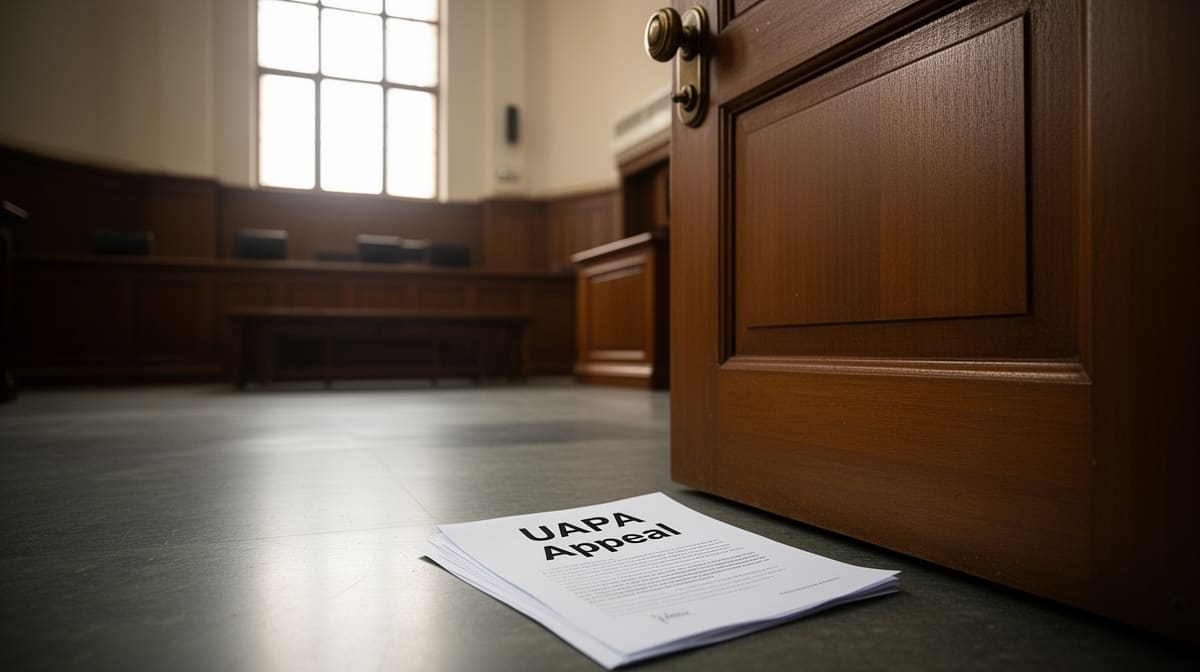
The Delhi High Court clarified that an order granting extension of investigation time under Section 43D(2)(b) of the UAPA does not constitute a final order for purposes of Section 21 of the National Investigation Agency Act, 2008. Consequently, the appeal filed under that provision was dismissed and the matter was converted into a writ petition under Section 482 of the CrPC.
Background & Facts
The Dispute
The appellants, six Ukrainian nationals including Hurba Petro, were arrested on 13 March 2026 under FIR No. RC No.07/2026/NIA/DLI for alleged conspiracy with ethnic armed groups to threaten national security. They were produced before the magistrate on 14 March 2026 and remanded to police and then judicial custody.
Key Facts
- 13 March 2026: FIR registered under Section 18 UAPA.
- 14 March 2026: Accused produced before the magistrate and remanded.
- 3 June 2026: NIA filed an application under Section 43D(2)(b) (read with Section 187 BNSS) seeking extension of investigation period to 180 days.
- 4 June 2026: Special Court heard the application, considered the Public Prosecutor’s report, and allowed the extension.
- 10 June 2026: The original 90-day period elapsed; the extension meant the appellants could not seek default bail on the 91st day.
- 4 June 2026: Impugned order granting extension was passed.
- 30 July 2026: Arguments on maintainability of the appeal were heard; judgment reserved.
- 4 August 2026: Final judgment delivered.
Procedural History
- 13 March 2026: FIR filed (RC No.07/2026/NIA/DLI).
- 3 June 2026: Application for extension filed before Special Court, Patiala House, New Delhi.
- 4 June 2026: Special Court ordered extension of custody to 180 days.
- 10 July 2026: NIA counsel raised preliminary objection that the order was interlocutory and not appealable under Section 21 NIA Act.
- 30 July 2026: Both parties argued on the maintainability of the appeal.
- 4 August 2026: Delhi High Court delivered its judgment.
Parties' Positions
- Appellants (Hurba Petro & others): Contended that the extension order effectively denied their right to default bail and therefore possessed finality; relied on State (NCT of Delhi) v. Anamul Ansari (2024) to argue that such orders are appealable.
- Respondents (Union of India, NIA): Asserted the order was merely interlocutory, not a final determination, and thus outside the ambit of Section 21; cited National Investigation Agency v. Akhil Gogoi (2022), Jai Kishan Sharma v. Union of India (2019), and Syed Shahid Yousuf v. National Investigation Agency (2018).
Relief Sought
The appellants sought dismissal of the Special Court’s order and restoration of their right to default bail, alternatively requesting that the appeal be entertained under Section 21 of the NIA Act.
The Legal Issue
Whether an order granting extension of the investigation period under Section 43D(2)(b) of the UAPA is a final or intermediate order that can be appealed under Section 21 of the National Investigation Agency Act, 2008, or whether it remains interlocutory and only reviewable under Section 482 of the CrPC.
Arguments Presented
For the Appellant
- The extension order defeats the appellants’ entitlement to default bail, creating irreversible consequences; therefore it should be treated as a final order.
- Relied on State (NCT of Delhi) v. Anamul Ansari where the Court held that an order refusing extension of time was appealable.
- Submitted that the three-prong test (finality, termination of proceedings, intermediary nature) favours classification as appealable.
For the Respondent
- Cited the language of Section 21(3) which excludes interlocutory orders from appeal.
- Emphasised that the order merely extends custody pending investigation and does not finally determine the rights of the parties.
- Relied on Syed Shahid Yousuf v. NIA and Madhu Limaye v. State of Maharashtra to argue that such extensions are interlocutory and only subject to judicial review under Section 482 CrPC.
The Court's Analysis
The Court began by extracting the relevant provisions of Section 21 NIA Act, noting that an appeal lies from any judgment, sentence or order not being an interlocutory order and that bail orders are expressly appealable. It then examined Section 43D(2)(b) UAPA, which permits the trial court to extend the investigation period up to 180 days upon satisfaction of the Public Prosecutor’s report.
"The order granting extension of time for investigation under Section 43D(2)(b) of the UAPA has a clear consequence for the accused i.e., that at the expiry of 90 days the Appellant would not be entitled to default bail. However, this right to default bail is a right which is governed by the statute itself… The intention of the legislature is not to make such an order an appealable order under Section 21 of the NIA Act."
The Court applied the three-prong test articulated in Madhu Limaye:
- Conclusion of proceedings - The extension does not conclude the investigation; it merely prolongs it.
- Termination of rights - The right to default bail is postponed, not terminated; the accused may seek bail on the 181st day.
- Intermediary nature - The order is an intermediate, discretionary measure, lacking the irretrievable consequences characteristic of final orders.
The Court distinguished Anamul Ansari, observing that the latter dealt with a refusal to extend time, which carries a different legal effect than a grant of extension. It also noted that subsequent decisions, such as Syed Shahid Yousuf and the Guwahati High Court judgments, treated similar extensions as interlocutory.
Consequently, the Court held that the extension order is interlocutory and not appealable under Section 21. However, to avoid multiplicity of proceedings, the Court exercised its inherent jurisdiction under Section 482 CrPC (and Section 528 BNSS) and directed that the matter be proceeded with as a writ petition.
The Verdict
The appeal under Section 21 NIA Act was dismissed as non-maintainable. The Court ordered that the proceedings be renumbered as a writ petition under Section 482 CrPC/Section 528 BNSS and listed before the appropriate roster bench. No monetary relief or custodial sentence was altered.
What This Means For Similar Cases
Interlocutory Orders Remain Non-Appealable
- Practitioners must assess whether an order merely extends investigation or imposes a procedural step before final determination.
- Appeals under Section 21 should be avoided for such orders; instead, seek review under Section 482 CrPC.
Use of the Three-Prong Test
- Evaluate (i) finality of the order, (ii) termination of any party’s rights, and (iii) whether the order is intermediate.
- If any prong is unsatisfied, classify the order as interlocutory.
Strategic Filing of Writ Petitions
-
When an interlocutory order adversely affects liberty, file a writ petition under Section 482 CrPC to obtain timely relief.
-
This avoids the procedural delay inherent in a separate appeal under Section 21.
-
Actionable takeaways:
- Scrutinise the statutory language of the order before invoking appeal rights.
- Cite Madhu Limaye and the three-prong test in submissions.
- Prepare for Section 482 writ petitions where liberty is at stake.