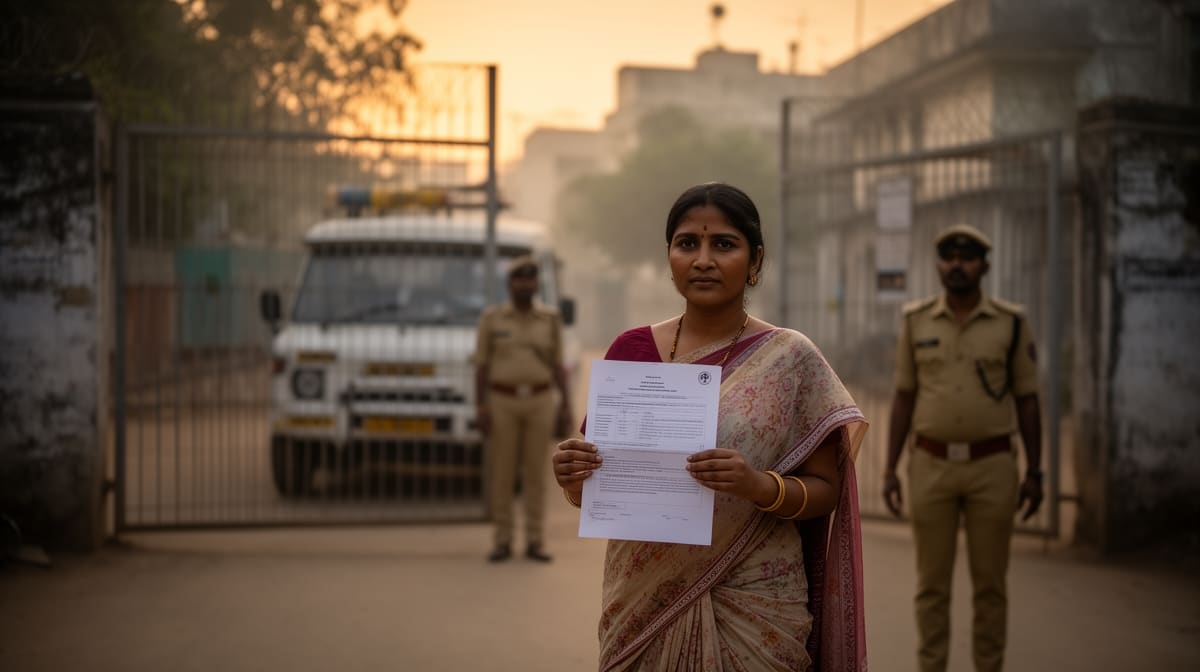
A landmark ruling by the Madras High Court has affirmed that the medical necessity of assisted reproductive treatment can justify temporary release of a convict, even for serious offenses under the NDPS Act. This decision redefines the scope of humanitarian considerations within prison administration and sets a precedent for balancing penological goals with fundamental rights.
Background & Facts
The Dispute
The petitioner, wife of convict Malaisami S/o Ramu, sought emergency leave for her husband to participate in IVF treatment essential for their joint fertility journey. The convict, serving a 20-year sentence under Section 8(c) read with Section 20(b)(ii)(c) and Section 29(1) of the NDPS Act, had been incarcerated for over nine months. The prison authorities rejected the request on the ground that he faced four additional pending NDPS cases.
Procedural History
- 2021: Convict sentenced to 20 years imprisonment by I Additional Special Court, Madurai
- 2025: Petitioner began IVF medical treatment requiring spousal participation
- 22.01.2026: First respondent (Deputy Inspector General of Prisons) rejected emergency leave application
- 06.02.2026: Writ petition filed under Article 226 of the Constitution
- 10.02.2026: Madras High Court heard and disposed of the petition
Relief Sought
The petitioner sought a writ of certiorari to quash the rejection order and a mandamus directing prison authorities to grant 10 days of emergency leave with escort to enable the convict to participate in couple therapy essential for IVF success.
The Legal Issue
The central question was whether the right to reproductive autonomy and medical necessity in the context of IVF treatment can override the general prohibition on granting extended leave to convicts facing multiple pending trials.
Arguments Presented
For the Petitioner
The petitioner’s counsel, Dr. Lakshmi Prasanna Komara, argued that the right to procreate is an essential facet of Article 21 as recognized in Puttaswamy v. Union of India. She emphasized that IVF is a time-sensitive medical procedure requiring physical and emotional presence of both partners, and that denial of leave would irreparably harm the petitioner’s reproductive rights. Reliance was placed on State of Haryana v. Bhagwan Das where temporary release was granted for medical emergencies.
For the Respondent
The Additional Public Prosecutor contended that the convict’s involvement in multiple NDPS cases indicated a high risk of reoffending and flight. He cited Rule 57 of the Tamil Nadu Prison Rules which restricts leave to convicts with no pending cases. He argued that humanitarian exceptions must not undermine public safety or institutional discipline.
The Court's Analysis
The Court acknowledged the seriousness of the offense but emphasized that penal incarceration does not extinguish fundamental rights. It held that the denial of leave was disproportionate to the stated objective of public safety, particularly since the leave was limited, escorted, and time-bound.
"The right to procreate is not a privilege reserved for the free; it is a human right that survives incarceration, especially when its exercise is medically time-bound and dependent on spousal participation."
The Court distinguished State of Haryana v. Bhagwan Das as analogous, where temporary release was permitted for critical medical treatment. It further noted that the convict had served a substantial portion of his sentence and was not a flight risk given the escort condition. The Court rejected the argument that pending trials automatically disqualify a convict from humanitarian leave, holding that each case must be evaluated on its unique medical and factual matrix.
The Court also affirmed that prison authorities retain discretion to impose conditions, including financial liability for escort costs and strict adherence to the Jail Manual.
The Verdict
The petitioner succeeded. The Court set aside the rejection order and directed the prison authorities to grant two days of emergency leave with escort to the convict on 11 - 12 February 2026. The leave was conditioned on the petitioner bearing escort costs, compliance with Jail Manual, and timely return.
What This Means For Similar Cases
Medical Necessity Overrides Blanket Restrictions
- Practitioners may now invoke Article 21 to seek temporary release for time-sensitive medical procedures like IVF, organ transplant coordination, or critical psychiatric care
- Blanket denials based solely on pending charges are legally unsustainable
- Courts will assess proportionality: duration, escort, medical documentation, and risk assessment
Escort Conditions Are Lawful and Necessary
- Petitioners must be prepared to bear escort costs, which may be recovered from the convict’s prison earnings
- Jail authorities may impose GPS monitoring or police escort as reasonable safeguards
- Non-compliance with conditions renders the leave void and may bar future applications
IVF and Reproductive Rights Are Constitutionally Protected
- This judgment establishes that reproductive autonomy is not suspended upon conviction
- Future applications must include certified medical reports from registered fertility specialists
- Denial without individualized assessment violates Puttaswamy and Shakti Vahini v. Union of India