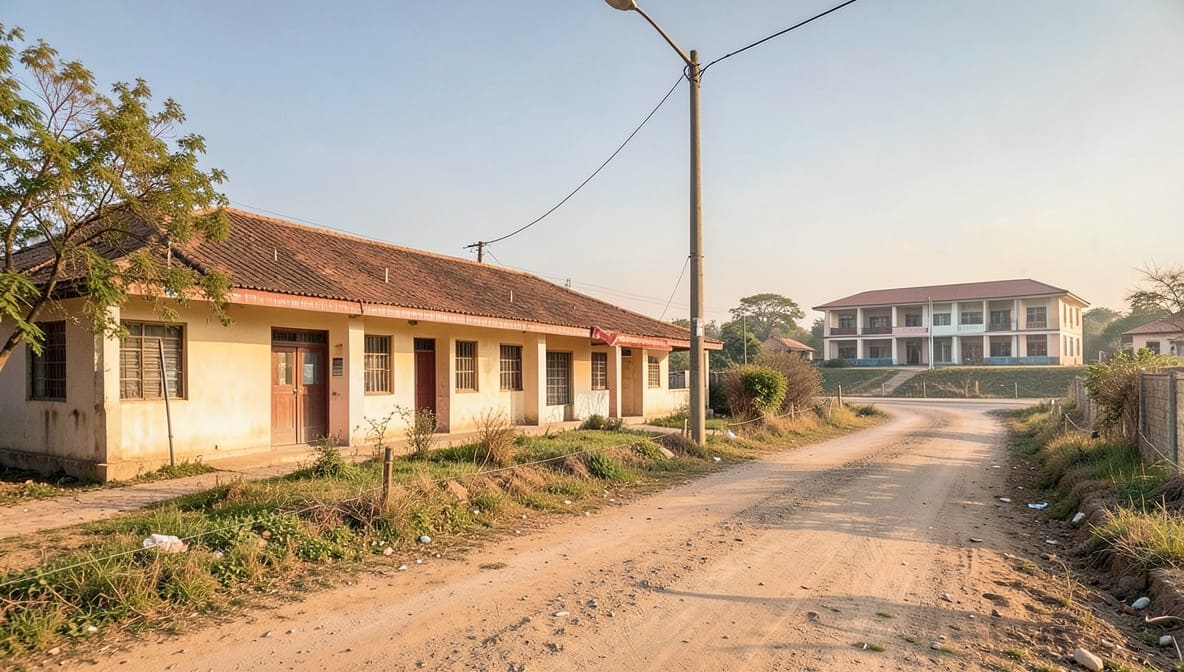
The Madhya Pradesh High Court has intervened to enforce compliance with a state policy mandating the merger of government primary schools only if located within two kilometers of newly established Saandipani Schools. The judgment underscores the necessity of strict adherence to administrative directives and provides a procedural safeguard against arbitrary executive action.
Background & Facts
The Dispute
The dispute arises from the implementation of a state policy issued by the Lok Sikshak Sanchanalay, Madhya Pradesh, Bhopal, on 01.08.2025. The policy directed all District Education Officers to merge students, teachers, and staff of existing government primary schools into newly opened Saandipani Schools, but only if the existing school was situated within a two-kilometer radius of the new institution. The petitioner, Banna Nath, challenged the order issued by the District Education Officer, Indore, dated 14.05.2026, which directed the merger of the Government Primary School, Tamalpur, Tahsil Depalpur, District Indore, into the newly opened Saandipani School in the same area. The petitioner contends that the Government Primary School at Tamalpur is approximately five kilometers away from the Saandipani School, thereby falling outside the scope of the state’s policy.
Key Facts
- The State Government issued policy directive on 01.08.2025 via letter No./Saandipani/Akadmik-105/2025-26/435, restricting mergers to schools within 2 km of Saandipani Schools.
- The Government Primary School, Tamalpur, is located approximately 5 km from the newly established Saandipani School, Depalpur, District Indore.
- The District Education Officer, Indore, issued order dated 14.05.2026 (letter No. कमांक/ ज.िश./आिघ. / सांद पन / वलय/2026/2602) directing merger despite the distance exceeding the stipulated limit.
- The petitioner submitted a representation against the order, which remained unaddressed.
- The petitioner is a concerned party, likely a parent, teacher, or local representative, aggrieved by the potential disruption to educational access and institutional continuity.
Procedural History
- 01.08.2025: State Government issues policy directive limiting mergers to schools within 2 km of Saandipani Schools.
- 14.05.2026: District Education Officer, Indore, issues order directing merger of Government Primary School, Tamalpur, into Saandipani School, despite 5 km distance.
- Before 08.06.2026: Petitioner files Writ Petition No. 19848 of 2026 under Article 226 of the Constitution.
- 08.06.2026: Hearing before the High Court of Madhya Pradesh, Indore Bench.
The Parties' Positions
For the Petitioner
The petitioner argues that the District Education Officer’s order is ultra vires the state policy dated 01.08.2025, as the Government Primary School at Tamalpur lies beyond the 2 km radius. The order, therefore, constitutes an arbitrary and illegal exercise of power, violating the principle of legitimate expectation and procedural fairness.
For the Respondent/State
The State, through the Government Advocate, did not contest the factual assertion that the distance exceeds 2 km. No justification was offered for the deviation from the state policy, nor was any legal basis cited for the merger order.
Relief Sought
The petitioner sought quashing of the District Education Officer’s order dated 14.05.2026 and a direction to maintain the status quo until a lawful decision is taken in accordance with the state policy.
The Legal Issue
The central question was whether an administrative order directing the merger of a government primary school located more than two kilometers from a Saandipani School violates the express policy directive issued by the State Government, and whether such deviation constitutes an illegal exercise of power.
Arguments Presented
For the Petitioner
The petitioner’s counsel, Shri Imityaz Ahmad Behna, submitted that the District Education Officer’s order is in direct conflict with the State Government’s policy dated 01.08.2025, which explicitly limits mergers to schools within a two-kilometer radius. He relied on the doctrine of legitimate expectation and the principle of audi alteram partem, arguing that the petitioner was denied any opportunity to be heard before the order was passed. He further contended that the order, being contrary to a publicly notified policy, lacks legal foundation and is liable to be set aside.
For the Respondent/State
The Government Advocate, Ms. Drishti Rawal, did not dispute the factual position that the distance exceeds two kilometers. No counter-arguments were presented to justify the deviation from the policy. The State’s silence amounted to an admission that the order was issued without legal basis.
The Court's Analysis
The Court observed that the State Government had laid down a clear, objective criterion for school mergers: proximity within two kilometers. The District Education Officer’s order, by merging a school located five kilometers away, directly contravened this policy. The Court emphasized that administrative authorities are bound by their own policies unless a valid, documented reason for deviation is provided and approved at the appropriate level. The absence of any justification or reasoning in the impugned order rendered it arbitrary and violative of Article 14 of the Constitution.
"The policy was issued with clarity and specificity. To ignore its parameters without any rationale is to act in excess of delegated authority."
The Court further noted that the petitioner had made a prior representation, which remained unaddressed. This failure to afford a hearing compounded the illegality. The Court declined to directly quash the order, recognizing that the District Education Officer may possess additional contextual information not before the Court. Instead, it granted the petitioner an opportunity to submit a detailed representation, ensuring procedural fairness while preserving administrative discretion within policy bounds.
The Verdict
The petition was disposed of with directions: the petitioner must file a detailed and comprehensive representation before the District Education Officer, Indore, within seven days from the date of the order. The District Education Officer shall consider the representation and pass a reasoned, speaking order within fifteen days of receipt, after affording the petitioner an opportunity of hearing. The status quo as of 08.06.2026 shall be maintained until the representation is decided. If the representation is not filed within seven days, the interim protection shall lapse automatically.
What This Means For Similar Cases
Administrative Orders Must Align with Published Policies
- Practitioners must challenge any administrative action that contradicts a publicly notified policy without documented justification.
- The burden shifts to the authority to prove that deviation from policy was lawful, reasonable, and procedurally fair.
Procedural Fairness Is Non-Negotiable in Education Administration
- Even in routine administrative decisions like school mergers, the right to be heard under audi alteram partem is mandatory.
- Failure to consider representations or provide reasons renders orders vulnerable to judicial review.
Distance-Based Criteria Are Legally Binding Unless Modified
-
Quantified thresholds (e.g., 2 km radius) in policy documents are not advisory but operational.
-
Courts will enforce such objective criteria strictly, especially where they protect access to education and institutional stability.
-
Always verify policy documents before challenging or implementing administrative orders.
-
Representations must be formally submitted and documented to preserve the right to a hearing.
-
Maintain records of distances, policy dates, and correspondence to substantiate claims of non-compliance.