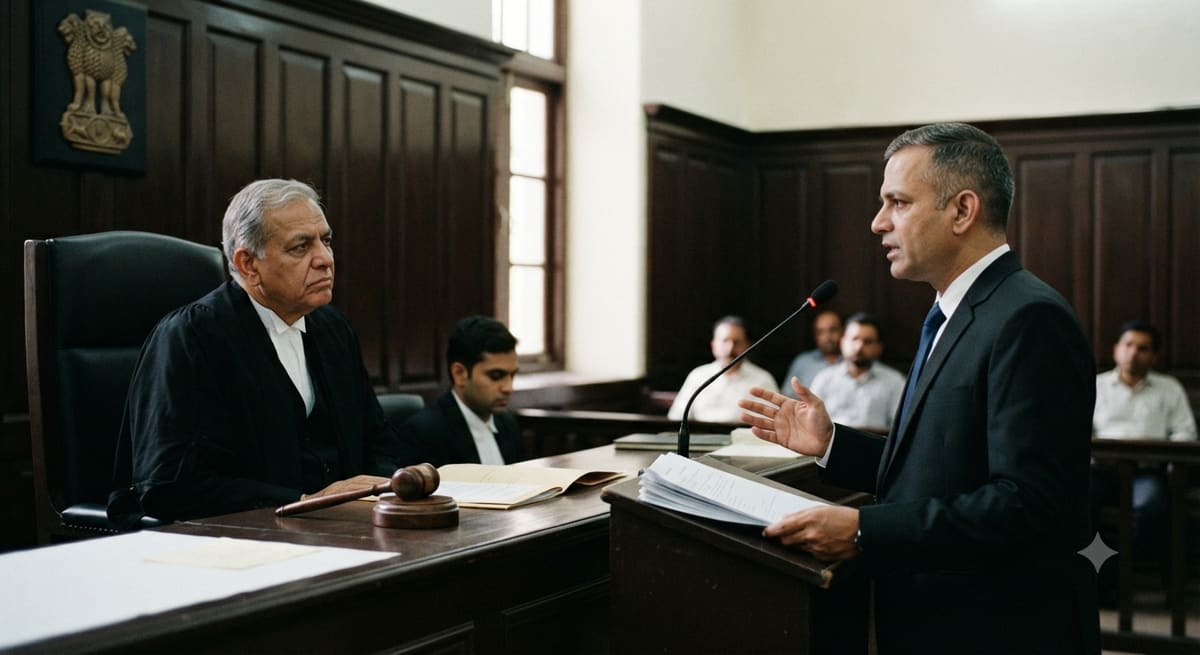
The Rajasthan High Court has underscored a critical safeguard in criminal procedure: arrest warrants cannot be issued merely because a defendant's counsel obtained certified copies of proceedings. This judgment reinforces that procedural compliance, including proper service of summons or bailable warrants, is mandatory before resorting to coercive measures like arrest warrants.
Background & Facts
The Dispute
The petitioner, Kamlesh Kumar Lohar, is an accused in a criminal case pending before the trial court in Dungarpur, Rajasthan. The dispute arose when the trial court issued arrest warrants against him without ensuring prior service of summons or bailable warrants. The petitioner contended that he was never served with any summons or bailable warrants, and the arrest warrant was issued solely because his counsel had obtained certified copies of the proceedings.
Key Facts
The petitioner is accused in a criminal case before the trial court in Dungarpur
The trial court issued arrest warrants against the petitioner without prior service of summons or bailable warrants
The petitioner’s counsel had obtained certified copies of the proceedings, which was cited as the sole ground for issuing arrest warrants
The petitioner was neither served with summons nor bailable warrants before the issuance of arrest warrants
The petitioner expressed readiness to participate in trial proceedings and undertook to appear before the trial court
Procedural History
Date of Issuance of Arrest Warrants: The trial court issued arrest warrants against the petitioner without prior service of summons or bailable warrants
06.07.2026: The petitioner filed S.B. Criminal Miscellaneous (Petition) No. 4078/2026 before the Rajasthan High Court challenging the issuance of arrest warrants
The petitioner relied on the judgment in Inder Mohan Goswami & Another v. State of Uttaranchal & Others, reported in AIR 2008 SC 251, to argue against the arbitrary issuance of arrest warrants
Relief Sought
The petitioner sought conversion of the arrest warrant into a bailable warrant and an opportunity to appear before the trial court to submit a bail bond. He also sought directions to the trial court to ensure compliance with procedural safeguards before issuing coercive measures.
The Legal Issue
The central question before the court was whether arrest warrants can be issued straightaway merely because the defendant’s counsel obtained certified copies of the proceedings, without prior service of summons or bailable warrants.
Arguments Presented
For the Petitioner
The petitioner’s counsel argued that the trial court erred in issuing arrest warrants without ensuring prior service of summons or bailable warrants. He relied on the Supreme Court’s judgment in Inder Mohan Goswami v. State of Uttaranchal, which emphasizes that arrest warrants should not be issued arbitrarily and must follow procedural safeguards. The petitioner contended that he was ready and willing to participate in the trial proceedings and should not be subjected to coercive measures without due process.
For the Respondent
The respondent, represented by the Public Prosecutor, did not present substantive counter-arguments in the judgment text. The focus remained on the procedural lapse by the trial court.
The Court's Analysis
The High Court examined the procedural requirements for issuing arrest warrants under the Code of Criminal Procedure, 1973 (CrPC). It noted that the trial court had failed to comply with the mandatory requirement of serving summons or bailable warrants before resorting to arrest warrants. The court observed:
"Merely because the learned counsel for the petitioner had obtained certified copies of the proceedings, arrest warrants could not have been issued straightaway."
The court relied on the principles laid down in Inder Mohan Goswami v. State of Uttaranchal, which holds that arrest warrants must be issued judiciously and only after ensuring compliance with procedural safeguards. The judgment underscores that coercive measures like arrest warrants should not be used as a tool to bypass due process.
The court also took note of the petitioner’s undertaking to appear before the trial court, which further justified the conversion of the arrest warrant into a bailable warrant.
The Verdict
The Rajasthan High Court allowed the petition in part. It converted the arrest warrant issued against the petitioner into a bailable warrant of Rs. 25,000. The petitioner was directed to appear before the trial court on the next date and submit the bail bond. The court clarified that if the petitioner failed to appear within the stipulated period, the trial court would be at liberty to issue fresh arrest warrants against him. The criminal miscellaneous petition and the stay petition were decided accordingly.
What This Means For Similar Cases
Procedural Compliance Is Non-Negotiable
This judgment reinforces that trial courts must adhere strictly to procedural requirements before issuing arrest warrants. Practitioners should emphasize:
Service of Summons or Bailable Warrants: Courts cannot bypass the requirement of serving summons or bailable warrants before issuing arrest warrants
Judicious Use of Coercive Measures: Arrest warrants must be issued only after ensuring that the defendant has been given a fair opportunity to appear, and not as a punitive measure for procedural actions like obtaining certified copies
Safeguards Against Arbitrary Arrests
Reliance on Precedents: The judgment reaffirms the principles laid down in Inder Mohan Goswami v. State of Uttaranchal, which serves as a binding precedent for lower courts. Practitioners should cite this case to challenge arbitrary issuance of arrest warrants
Undertaking to Appear: Defendants who express willingness to participate in trial proceedings and undertake to appear before the court are less likely to face coercive measures like arrest warrants
Practical Implications for Defense Counsel
Obtaining Certified Copies: Defense counsel should not hesitate to obtain certified copies of proceedings, as this action alone cannot justify the issuance of arrest warrants
Challenging Procedural Lapses: If arrest warrants are issued without prior service of summons or bailable warrants, defense counsel can challenge such orders by filing criminal miscellaneous petitions before the High Court, relying on this judgment and Inder Mohan Goswami
This judgment serves as a critical reminder that procedural safeguards are not mere formalities but essential protections against arbitrary state action.