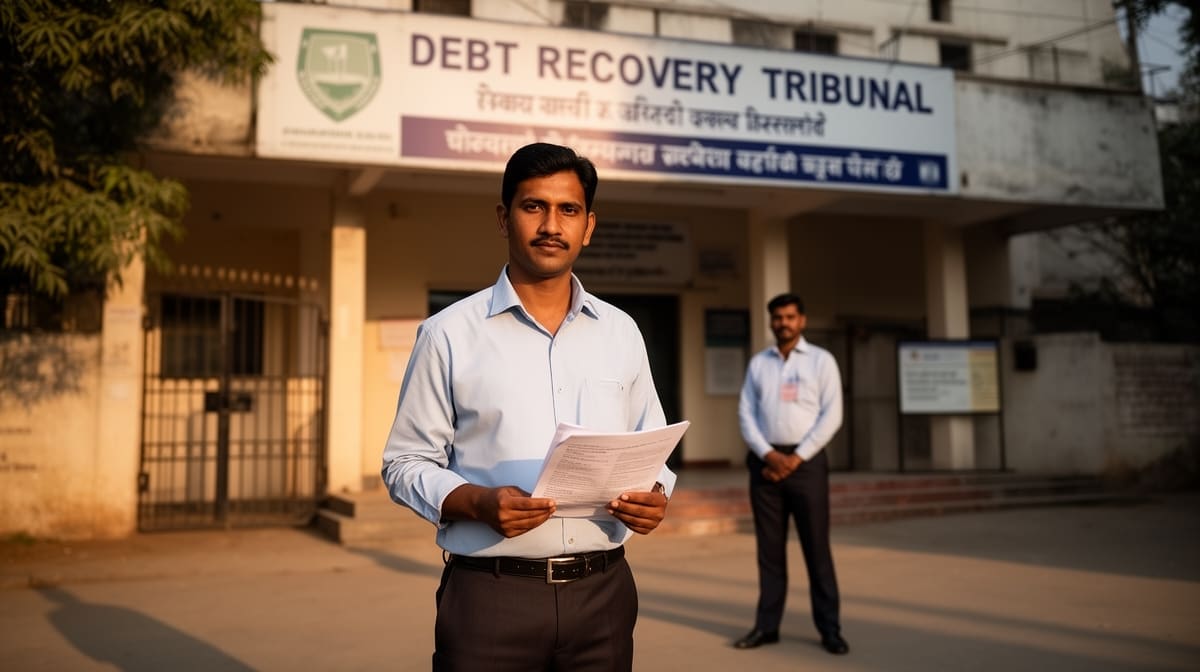
The Punjab and Haryana High Court has delivered a pivotal clarification on the limited jurisdiction of Debt Recovery Tribunals, holding that they cannot initiate contempt proceedings or impose operational directives on banks beyond adjudicating SARFAESI Act violations. This ruling reinforces the statutory boundaries of tribunals in financial recovery matters and curtails overreach in borrower-bank disputes.
Background & Facts
The Dispute
The dispute arose from a credit facility extended by Union Bank of India to M/s Brijwasi Cycle Store, secured by hypothecation of inventory and a commercial property. The Bank obtained an insurance policy on the mortgaged assets. On 29.11.2019, a major fire destroyed the property, stock, and documents. The Bank had incorrectly declared the risk location as the ground floor, whereas the inventory was stored in the basement. The insurance company repudiated the claim on this ground. The Bank, citing non-payment of dues, classified the account as a Non-Performing Asset (NPA) in 2020. The borrower, affected by the fire and the subsequent Covid-19 lockdown, challenged the NPA classification before the Debt Recovery Tribunal-II, Chandigarh.
Key Facts
- The borrower availed a cash credit limit of Rs. 30,00,000 from Union Bank of India.
- Insurance policy was procured by the Bank on 15.04.2018, with risk location erroneously stated as ground floor.
- Fire incident occurred on 29.11.2019; claim lodged with insurer on 05.12.2019.
- Insurance claim repudiated on 18.03.2020 due to incorrect risk location.
- Account declared NPA on 01.07.2020.
- Borrower filed Securitisation Application (SA No. 23 of 2022) under Section 17 of SARFAESI Act on 10.08.2022.
- DRT-II, Chandigarh passed order dated 06.06.2025 quashing the NPA classification and directing the Bank to pay Rs. 5,00,000 as compensation.
- The Bank filed an appeal before the Debt Recovery Appellate Tribunal, Delhi, which remains pending due to non-availability of a bench.
- Borrower filed Miscellaneous Application MA No. 87 of 2025 seeking implementation of the 06.06.2025 order.
Procedural History
- 06.06.2025: DRT-II, Chandigarh allowed SA No. 23 of 2022, quashed NPA classification, ordered compensation of Rs. 5,00,000.
- 11.11.2025: DRT-II issued order (Annexure P-8) directing Bank to allow cash credit limit of Rs. 30,00,000.
- 16.12.2025: High Court stayed contempt proceedings initiated by DRT-II and clarified borrower may invoke Section 19(25) of the 1993 Act.
- 04.10.2025: DRT-II issued notice to Bank officials to show cause why contempt proceedings should not be initiated for non-compliance with 06.06.2025 order (Annexure P-6).
- 27.10.2025: DRT-II directed Bank to permit operation of cash credit limit up to Rs. 30,00,000 (Annexure P-9).
- 20.12.2025: DRT-II ordered General Manager (Recovery) of Bank to appear in person on 30.01.2026 without stating reasons (Annexure P-10).
- 12.01.2026: CWP-30496-2025 and CWP-39123-2025 filed by Bank challenging the above orders.
- 15.01.2026: CWP-35397-2025 filed by borrower seeking implementation of 06.06.2025 order.
- 30.01.2026: Arguments concluded.
- 20.03.2026: Judgment pronounced.
The Parties' Positions
For the Petitioner-Bank (Union Bank of India)
- Argued that DRT is not a Court and lacks inherent or statutory power to initiate contempt proceedings.
- Contended that directing reinstatement of cash credit limit exceeds DRT’s jurisdiction under SARFAESI Act.
- Asserted that the 06.06.2025 order is ambiguous and does not absolve borrower of repayment liability.
- Stated that no court has yet adjudicated fault in insurance misrepresentation, and compensation was awarded without legal basis.
- Highlighted that the appeal against 06.06.2025 order is pending before DRAT, Delhi.
For the Respondent (M/s Brijwasi Cycle Store)
- Argued that the Bank’s fraudulent misrepresentation caused the insurance repudiation and NPA declaration.
- Contended that the 06.06.2025 order quashing NPA status inherently requires reinstatement of credit facilities.
- Invoked Section 19(25) of the 1993 Act to seek enforcement of the DRT’s order.
- Claimed that the Bank’s refusal to restore credit limit is a deliberate evasion of the DRT’s directive.
Relief Sought
- Petitioner-Bank sought quashing of orders dated 04.10.2025 (contempt notice), 27.10.2025 (credit limit direction), and 20.12.2025 (summons to GM).
- Respondent sought enforcement of the 06.06.2025 order, including reinstatement of Rs. 30,00,000 cash credit limit and compliance with compensation direction.
The Legal Issue
The central questions were: (1) Whether a Debt Recovery Tribunal possesses the statutory authority to initiate contempt proceedings for non-compliance with its orders under the SARFAESI Act or the 1993 Act; (2) Whether a DRT can direct a bank to reinstate a cash credit limit as part of implementing an order quashing an NPA classification; and (3) Whether summoning a bank official without stating reasons constitutes a valid exercise of enforcement powers under Section 19(25) of the 1993 Act.
Arguments Presented
For the Appellant/Petitioner
The Bank relied on Cofex Exports Ltd. v. Canara Bank (1998), Shiv Kumar Gupta v. Ajay Singh Tomar (2025), and Parkash Maan v. SBI (2024) to establish that DRTs are statutory tribunals, not courts, and lack inherent contempt jurisdiction. It cited HDFC Bank Ltd. v. State of Maharashtra (2024) and International Asset Reconstruction Co. v. Official Liquidator (2017) to argue that DRTs are bound by the exclusive, limited jurisdiction conferred under SARFAESI and the 1993 Act. The Bank emphasized that Section 19(25) empowers enforcement of orders but does not confer contempt powers. It further contended that directing reinstatement of credit limits is a commercial decision beyond the DRT’s adjudicatory scope, which is confined to validating or invalidating SARFAESI actions.
For the Respondent
The borrower argued that the DRT’s order quashing the NPA classification necessarily implies restoration of the credit relationship. It relied on the principle of effective remedy under Section 19(25) of the 1993 Act, asserting that without reinstating the cash credit limit, the quashing of NPA status would be rendered meaningless. It cited the DRT’s own finding of Bank’s fault in insurance misrepresentation as justification for the Rs. 30,00,000 limit restoration. The borrower maintained that summoning the General Manager was a legitimate enforcement step under Section 19(25) to ensure compliance.
The Court's Analysis
The Court undertook a rigorous statutory interpretation of the Recovery of Debts and Bankruptcy Act, 1993, and the SARFAESI Act, 2002. It held that the DRT is a specialized tribunal created for summary adjudication of debt recovery disputes, not a court of record. The Court emphasized that while DRTs are empowered under Section 19(25) of the 1993 Act to enforce their orders through coercive measures such as attachment, sale, or appointment of receivers, they are not vested with contempt jurisdiction.
"The Debt Recovery Tribunal is a tribunal and not a Court. The proceedings before it are initiated on an application and hence are not suits. It does not pass a decree. Its procedure is summary."
The Court reaffirmed the holding in Cofex Exports and HDFC Bank, noting that the Contempt of Courts Act, 1971 applies only to courts of record under Articles 129 and 215 of the Constitution. Since DRTs are neither courts nor courts of record, they cannot initiate contempt proceedings. The order dated 04.10.2025, initiating contempt proceedings, was therefore held to be without jurisdiction and was quashed.
Regarding the direction to reinstate the cash credit limit, the Court observed that the 06.06.2025 order only quashed the NPA classification and awarded compensation. It did not contain any direction regarding credit limits. The Court held that regulating banking relationships, including sanctioning or reinstating credit facilities, falls outside the DRT’s statutory mandate. The DRT’s jurisdiction is confined to examining whether the Bank’s action under SARFAESI was lawful - not to dictate commercial credit decisions.
"Debt Recovery Tribunal has no jurisdiction to regulate relationship of bank and borrower. It can only adjudicate acts of bank under provisions of SARFAESI Act and declare the same to be void/valid."
The Court further found the order dated 20.12.2025, summoning the General Manager without stating reasons, to be a non-speaking order. It held that any enforcement action under Section 19(25) must be accompanied by a clear articulation of how the order was violated and why personal appearance is necessary. The absence of reasoning rendered the order arbitrary and liable to be set aside.
The Court declined to interfere with the 06.06.2025 order, noting that the appeal before DRAT remains pending and the Bank had not taken any enforcement action against the borrower since its issuance. The Court left the validity of the 06.06.2025 order open for adjudication by the appellate forum.
The Verdict
The writ petitions filed by Union Bank of India (CWP-30496-2025 and CWP-39123-2025) were allowed. The orders dated 04.10.2025 (initiating contempt), 27.10.2025 (directing Rs. 30,00,000 cash credit limit), and 20.12.2025 (summoning General Manager without reasons) were set aside as beyond jurisdiction. The writ petition filed by M/s Brijwasi Cycle Store (CWP-35397-2025) was disposed of with liberty to invoke Section 19(25) of the 1993 Act before the DRT for enforcement of the 06.06.2025 order. The compensation of Rs. 5,00,000 awarded by the DRT remains operative unless set aside by the appellate tribunal.
What This Means For Similar Cases
Contempt Proceedings Cannot Be Initiated by DRTs
- Practitioners must now challenge any contempt notice issued by a DRT as ultra vires, citing Cofex Exports and HDFC Bank.
- Enforcement must proceed exclusively under Section 19(25) of the 1993 Act - through attachment, sale, or appointment of a receiver.
- No DRT can issue show-cause notices for contempt under any guise, even if the order is clear and binding.
Credit Limits Are Beyond DRT’s Purview
- Banks may refuse to reinstate credit facilities even after NPA quashing, unless a court or tribunal explicitly directs it.
- Borrowers seeking restoration of credit limits must file separate civil suits or consumer complaints, not rely on SARFAESI proceedings.
- DRTs must confine orders to validating or invalidating SARFAESI actions; commercial banking decisions remain outside their authority.
Enforcement Orders Must Be Speaking
- Any order under Section 19(25) summoning a person must clearly state: (a) how the original order was violated, and (b) why the summoned individual’s presence is necessary.
- Non-speaking orders are arbitrary and liable to be quashed under Article 226.
- Practitioners should routinely challenge enforcement orders lacking reasoning as violative of natural justice.