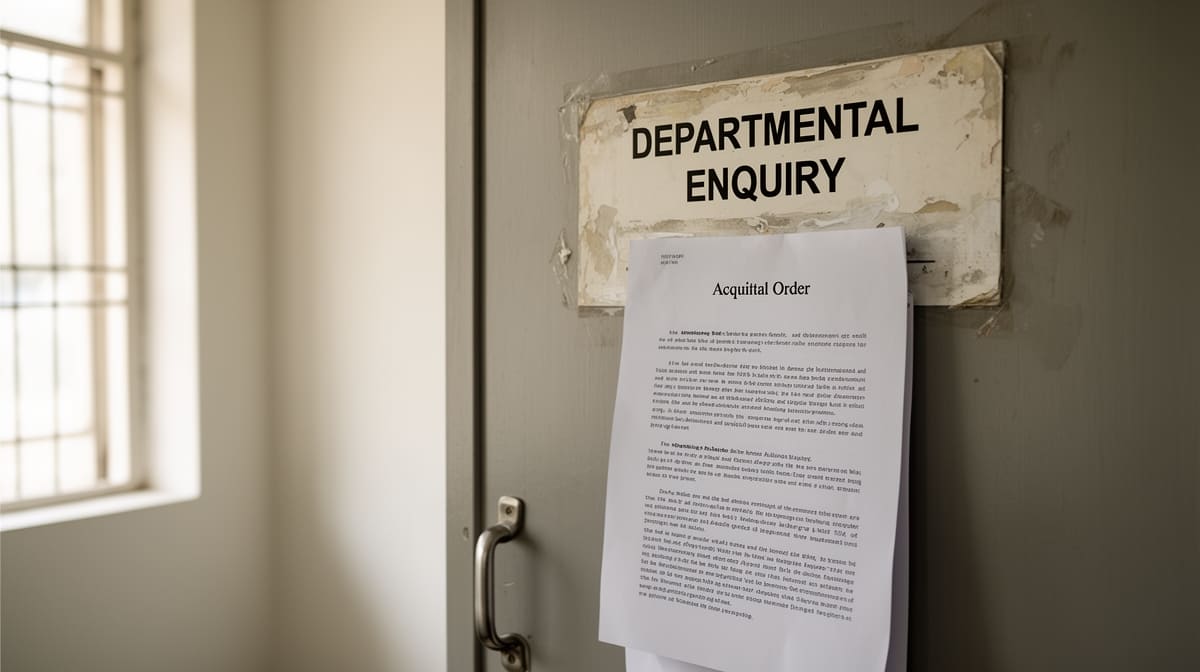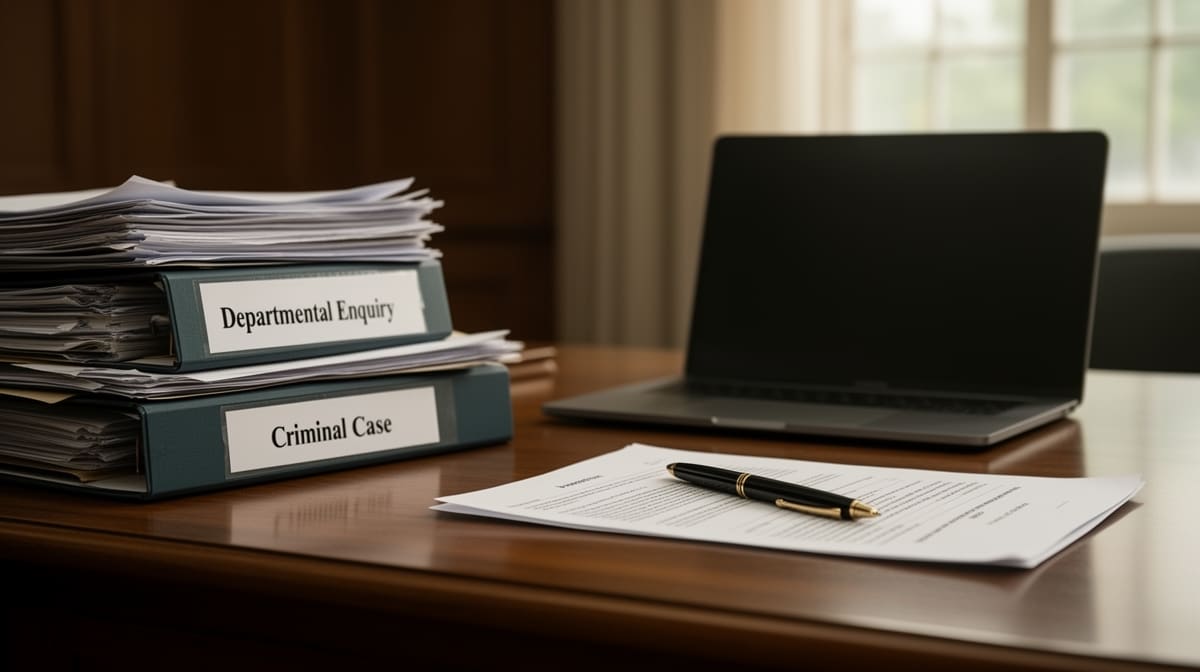
The Bombay High Court has clarified that when departmental proceedings and criminal trials arise from identical allegations, the former must be stayed until the conclusion of the latter to protect the employee’s constitutional rights. This ruling reinforces the principle that procedural fairness cannot be sacrificed in administrative inquiries merely because they are non-criminal in nature.
Background & Facts
The Dispute
The petitioner, Gajanan Ramesh Kotlawar, serves as Regional Manager with the Maharashtra State Cooperative Tribal Development Corporation Ltd. He is facing a departmental enquiry based on allegations of financial and administrative irregularities involving short-term financial transactions. These same allegations formed the basis of registered FIRs against him and other officers, triggering parallel criminal proceedings.
Procedural History
- The petitioner submitted an application on 27 January 2026 to the Inquiry Officer (Respondent No.2) and the Corporation (Respondent No.1), requesting that the departmental enquiry be kept in abeyance until the criminal trial concludes.
- The application was not decided within a reasonable time.
- Despite the pending application, the Inquiry Officer proceeded with the departmental enquiry, with the next hearing scheduled for 16 February 2026.
- The petitioner filed this writ petition seeking judicial intervention to prevent prejudice to his criminal defence.
Relief Sought
The petitioner sought an order directing the Corporation to decide his application for stay of the departmental enquiry and to suspend all proceedings until the conclusion of the criminal trial.
The Legal Issue
The central question was whether a departmental enquiry may proceed concurrently with a criminal trial when both are based on identical allegations, and whether such simultaneous proceedings violate the right against self-incrimination under Article 20(3) of the Constitution.
Arguments Presented
For the Petitioner
Mr. N.R. Saboo, Advocate for the petitioner, relied on S.P. Gupta v. Union of India and State of U.P. v. Krishna Ballabh to argue that forcing an employee to defend himself in a departmental enquiry while a criminal trial is pending compels him to disclose his defence strategy, thereby undermining his right to remain silent. He emphasized that admissions made in departmental proceedings can be used as evidence in criminal trials, creating a direct conflict with Article 20(3).
For the Respondent
The Respondent did not file a written submission. However, the Court inferred from the record that the Corporation had treated the departmental enquiry as an independent administrative process, unaffected by the pendency of criminal proceedings. The implicit position was that departmental enquiries are not bound by criminal procedure standards.
The Court's Analysis
The Court examined the doctrine of parallel proceedings and the jurisprudence developed under Article 20(3) and natural justice. It noted that while departmental enquiries are not criminal trials, they are not immune from constitutional safeguards when they intersect with criminal liability.
"The right against self-incrimination is not confined to the courtroom; it extends to any proceeding where an individual is compelled to furnish evidence that may later be used against him in a criminal case."
The Court distinguished K. Veeraswami v. Union of India, which permits departmental action against judges, by emphasizing that this case involved identical factual allegations and no separation of issues. It held that allowing the enquiry to proceed would create an intolerable risk of coercive disclosure, violating the principle of fair hearing.
The Court further observed that the Corporation’s delay in deciding the application amounted to a de facto denial of the petitioner’s request, thereby violating procedural fairness. The Court rejected the notion that administrative expediency justifies compromising fundamental rights.
The Verdict
The petitioner succeeded. The Court held that departmental enquiries must be stayed pending the conclusion of parallel criminal trials when allegations are substantially identical. It directed the Corporation to decide the petitioner’s application by 16 February 2026 and prohibited the Inquiry Officer from proceeding until then.
What This Means For Similar Cases
Departmental Enquiries Cannot Override Constitutional Rights
- Practitioners must immediately raise Article 20(3) objections when departmental proceedings threaten to compromise criminal defence.
- Employers must pause internal inquiries if criminal proceedings are pending on the same facts, regardless of whether the enquiry is framed as "administrative."
Delay in Decision Is a Violation of Natural Justice
- Failure to decide a stay application within a reasonable time constitutes a breach of audi alteram partem.
- Courts will intervene if administrative inaction effectively denies relief.
Identical Allegations Trigger the Stay Doctrine
- The doctrine applies only when the core allegations in both proceedings are the same.
- If the departmental enquiry involves distinct misconduct (e.g., attendance, conduct), it may proceed independently.
- Practitioners must carefully compare the charge sheets in both proceedings to establish overlap.