The Bombay High Court has clarified that an employer’s right to transfer an employee, as stipulated in the appointment letter, remains intact even after reinstatement following a successful industrial dispute. The Court set aside an interim order that had halted a transfer to Bhopal, emphasizing that personal hardship or timing of the transfer does not, by itself, establish mala fide intent.
Background & Facts
The Dispute
The petitioner, Dainik Bhaskar (D.B. Corp. Limited), is a media organization headquartered in Mumbai. The respondent, Asburt Gonsalves, was appointed as a System Engineer on 18 February 2008 under an Appointment Letter that explicitly stated: "The services of the respondent are liable to be transferred to any of the establishments or offices of the petitioner anywhere in India." The respondent accepted this term without objection.
Key Facts
- The respondent was employed continuously from 18 February 2008 until his termination on 31 August 2016.
- The petitioner cited persistent non-performance, habitual absenteeism, and unsatisfactory work as grounds for termination.
- The respondent challenged the termination by filing Reference (IDA) No. 9 of 2018 before the Assistant Commissioner of Labour, Mumbai, on 5 November 2018.
- The Labour Court, by its Award dated 24 April 2023, set aside the termination order and directed reinstatement with continuity of service, full back wages, and consequential benefits from 1 September 2016.
- The petitioner challenged the Award before the Bombay High Court in Writ Petition No. 3145 of 2024, contending no vacancy existed for the respondent at Mumbai. The High Court dismissed the petition on 14 March 2025.
- The Supreme Court dismissed the petitioner’s Special Leave Petition (Civil) No. 13636 of 2024 on 10 August 2025, affirming the Labour Court’s Award.
- The petitioner paid back wages amounting to Rs. 16,90,802/- following issuance of a recovery certificate by the Assistant Labour Commissioner on 31 January 2024 and enforcement action by the Tahsildar, Andheri on 13 June 2024.
- The respondent was reinstated in service in June 2023 but was not assigned any duties at the Mumbai office due to operational restructuring.
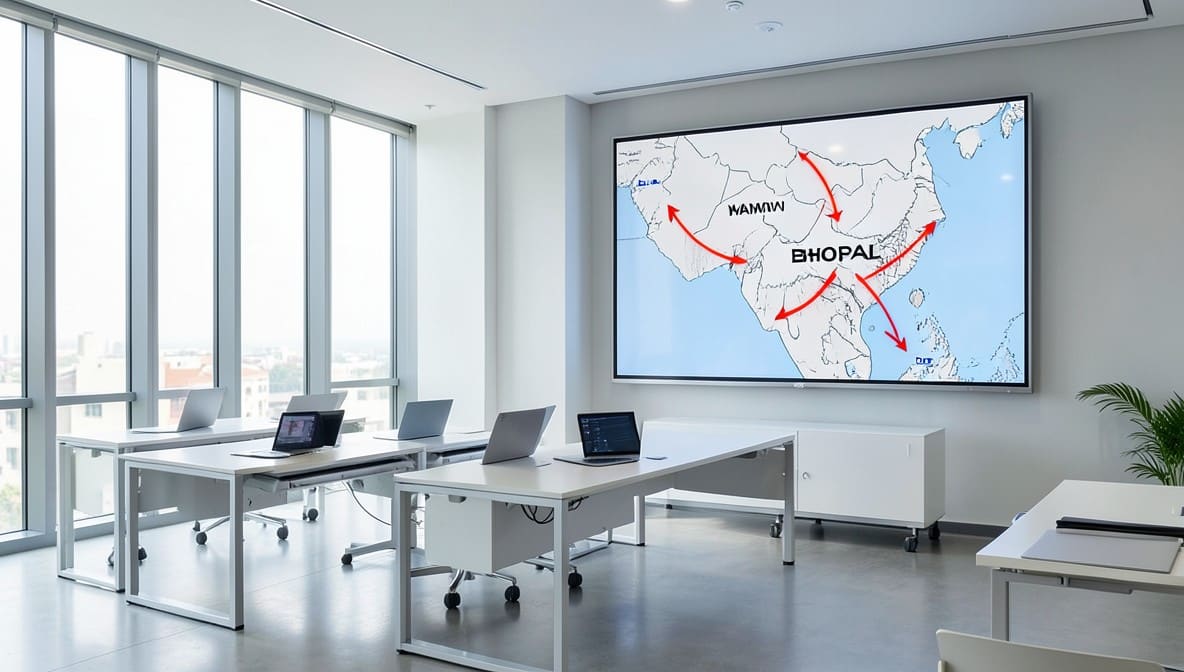
- Between 2018 and 2019, the petitioner centralized all IT operations at its Head Office in Bhopal, eliminating the need for on-site System Engineers in Mumbai.
- As of December 2024, the Mumbai office had only one System Engineer position, whose duties were minimal and limited to exceptional cases.
- On 26 December 2024, the petitioner issued a transfer order directing the respondent to report at the Bhopal office on 3 January 2025.
- The petitioner sent follow-up communications on 7 January 2025 and 19 February 2025, reiterating the transfer direction and informing the respondent of admissible transfer benefits, including joining time and travel expenses.
- The respondent did not report to Bhopal, nor did he seek leave or respond to any communication.
- On 21 February 2025, the respondent filed Complaint (ULP) No. 42 of 2025 before the Industrial Court, Mumbai, alleging the transfer constituted an unfair labour practice under Section 28 read with Section 30(2) of the Maharashtra Recognition of Trade Unions and Prevention of Unfair Labour Practices Act, 1971.
Procedural History
- 18 February 2008: Appointment letter issued with transfer clause.
- 30 August 2016: Termination order issued with effect from 31 August 2016.
- 5 November 2018: Reference (IDA) No. 9 of 2018 filed before Assistant Commissioner of Labour.
- 24 April 2023: Labour Court Award directing reinstatement and back wages.
- 14 March 2025: Bombay High Court dismissed Writ Petition No. 3145 of 2024.
- 10 August 2025: Supreme Court dismissed SLP (Civil) No. 13636 of 2024.
- 26 December 2024: Transfer order issued to Bhopal.
- 7 January 2025 & 19 February 2025: Follow-up communications sent.
- 21 February 2025: Respondent filed ULP complaint before Industrial Court.
- 24 September 2025: Industrial Court granted interim relief, stayed transfer, and directed work at Mumbai.
- 27 March 2026: Writ petition reserved.
- 2 April 2026: Judgment pronounced.
Relief Sought
The petitioner sought quashing of the Industrial Court’s interim order dated 24 September 2025, setting aside the stay on transfer, and directing the respondent to comply with the transfer order dated 26 December 2024. The respondent sought continuation of interim protection and preservation of his posting at Mumbai pending final adjudication of the ULP complaint.
The Legal Issue
The central question was whether the issuance of a transfer order to Bhopal, pursuant to a contractual term and operational restructuring, constitutes an unfair labour practice under the M.R.T.U. and P.U.L.P. Act, 1971, at the interim stage, in the absence of concrete evidence of mala fide intent, merely because the transfer followed a reinstatement order.
Arguments Presented
For the Petitioner
The petitioner argued that the transfer was lawful under the express terms of the Appointment Letter dated 18 February 2008, which permitted transfer anywhere in India. It submitted that the restructuring of IT operations since 2018 had centralized all technical support at Bhopal, rendering the Mumbai position redundant. The transfer was administrative, not punitive, and accompanied by full benefits. Reliance was placed on National Hydroelectric Power Corporation Limited v. Shri Bhagwan and Rajneesh Khajuria v. Wockhardt Limited to affirm that transfer is an incident of service and within managerial prerogative.
For the Respondent
The respondent contended that the transfer was a retaliatory measure following his successful litigation against termination. He argued that the timing - immediately after the Labour Court’s Award became final - indicated mala fide intent to harass and force resignation. He highlighted his settled family life in Mumbai, with a working spouse, aged mother, and school-going child, to argue that relocation would cause irreparable hardship. He relied on Venkitaramanan Potti v. Travancore Devaswom Board and C. Prabhakaran v. Southern Petrochemicals Industries Corporation to assert that transfers cannot be used to circumvent court orders or victimize employees.
The Court's Analysis
The Court emphasized that its role at the interim stage was not to decide the merits of the ULP complaint but to assess whether the Industrial Court was justified in granting a stay on the transfer. The Court observed that the transfer clause in the Appointment Letter was clear, unambiguous, and accepted by the respondent at the time of joining. Such terms form part of the contract of service and cannot be disregarded merely because the employee has been reinstated.
"Reinstatement only means restoration of employment. It does not mean that all other service conditions come to an end. The employer still retains the right to decide posting, place of work and distribution of duties, so long as it acts within the terms of service."
The Court noted that the petitioner had provided detailed evidence of operational restructuring: centralization of IT functions, elimination of on-site support needs in Mumbai, and the existence of a dedicated team in Bhopal. The respondent did not dispute these facts or produce any document indicating that the transfer decision was motivated by ill will.
"Timing alone though suspicious in appearance is not sufficient by itself to prove mala fide. There must be something more concrete."
The Court rejected the argument that personal hardship alone could invalidate a lawful transfer. While acknowledging the respondent’s family circumstances, it held that inconvenience is not equivalent to irreparable injury under service law. The respondent’s salary, seniority, and service benefits remained unaffected. The only change was the place of work.
The Court further observed that the petitioner’s conduct - issuing formal transfer orders, providing joining time, and communicating travel benefits - was consistent with a genuine administrative decision, not a covert attempt to force resignation. The Industrial Court’s finding of a prima facie unfair labour practice was unsupported by material evidence and improperly assumed guilt at the interim stage.
The Verdict
The petitioner succeeded. The Bombay High Court quashed and set aside the Industrial Court’s interim order dated 24 September 2025. The stay on the transfer order dated 26 December 2024 was lifted. The respondent was directed to comply with the transfer and report at the Bhopal office within four weeks from the date of judgment. The Court clarified that its observations were confined to the interim stage and did not prejudice the adjudication of the pending ULP complaint. No costs were awarded.
What This Means For Similar Cases
Transfer Clause Remains Binding Post-Reinstatement
- Employers may enforce pre-existing transfer clauses even after reinstatement following a successful industrial dispute.
- Reinstatement restores employment and back wages but does not freeze the employee’s posting or negate contractual terms.
- Practitioners must argue that reinstatement does not equate to permanent fixation of location unless explicitly ordered.
Mala Fide Must Be Proven, Not Assumed
- Suspicion based on timing of transfer after litigation is insufficient to establish mala fide.
- Courts require concrete evidence - such as discriminatory treatment, absence of operational rationale, or hostile conduct - to interfere with transfers.
- Employers should maintain documented records of restructuring, vacancies, and administrative decisions to defend against allegations of victimization.
Personal Hardship Is Not a Legal Ground to Block Transfer
- Family circumstances, residence, or educational needs of dependents do not override lawful transfer orders.
- Inconvenience is not irreparable injury; compensation for relocation or alternative posting may be sought in final adjudication.
- Practitioners representing employees must focus on proving mala fide intent, not merely hardship, to succeed in ULP or writ petitions.