The Bombay High Court has clarified that undertakings offered in contempt proceedings, even when made by co-operative housing societies, do not constitute final adjudication of liabilities but serve as binding interim security to protect the aggrieved party’s financial interests. This ruling reinforces the principle that contempt jurisdiction is not a substitute for civil litigation.
Background & Facts
The Dispute
The petitioner, Raghunath Bandekar Pal, proprietor of M/s. D.S. Electronics, is a member of Amardeep Mahal Co-operative Housing Society Ltd. (Respondent No. 6). He claims to have been using a 360 sq. ft. commercial premises on the ground floor of the building since 1984. In 2009, he initiated Dispute No. CC/IV/183 of 2009 before the Co-operative Court against the Society and its then-developer, M/s. Sun Shine Realtors Pvt. Ltd. (Respondents 7 and 8). The dispute was resolved through Consent Terms dated 26.11.2010.
Key Facts
- The Consent Terms acknowledged the petitioner as the bona fide owner of the 360 sq. ft. commercial premises, used since 1984.
- The terms stipulated that upon redevelopment and issuance of the Occupation Certificate, the petitioner would be allotted two new closed premises aggregating 360 sq. ft. on the ground floor, with water, electricity, and toilet facilities.
- Transit rent was agreed at ₹65 per sq. ft. per month, payable in advance for 18 months and thereafter until possession.
- The Society and the erstwhile developer paid ₹11,85,600 as transit rent for the period 01.10.2010 to 30.11.2014.
- No new premises were allotted after redevelopment, and transit rent payments ceased after November 2014.
- The Society terminated its agreement with the original developer and appointed Respondent No. 9 (Maniar Associates) as the new developer.
- The petitioner filed Civil Suit No. 2479 of 2019 before the City Civil Court at Dindoshi seeking enforcement of the Consent Terms.
- On 16.11.2019, Respondent No. 9 stated in court that it would retain ₹1,00,00,000 payable to the Society until the motion in the civil suit was heard.
- The Society’s counter-claim in the civil suit was dismissed on 14.02.2024.
Procedural History
- 26.11.2010: Consent Terms executed between petitioner, Society, and erstwhile developer.
- 30.11.2014: Last payment of transit rent made.
- 2019: Civil Suit No. 2479 filed seeking specific performance and transit rent.
- 16.11.2019: Respondent No. 9’s statement in civil suit regarding retention of ₹1,00,00,000.
- 14.02.2024: Society’s counter-claim dismissed by City Civil Court.
- 01.07.2024: Co-operative Court dismissed petitioner’s contempt application.
- 17.12.2025: Bombay High Court issued suo motu contempt notice.
- 22.12.2025: Respondents filed affidavit challenging validity of Consent Terms.
- 06.01.2026: Undertaking filed by Deepak Nemchand Shah offering ₹10,06,800 as transit rent and bank guarantee.
- 24.01.2026: Second undertaking filed by Deepak Shah offering bank guarantee of ₹19,85,948 based on Ready Reckoner rate.
- 23.12.2025: High Court issued directions regarding compliance.
- 23.02.2026: Judgment reserved.
- 17.03.2026: Judgment pronounced.
The Parties' Positions
Petitioner: Argued that the Society and its officers wilfully disobeyed the Consent Terms by failing to pay transit rent and allot premises. Contended that the ₹10,06,800 offered was grossly inadequate, as the correct liability at ₹65/sq. ft. for 132 months (Dec 2014 - Dec 2025) amounts to ₹57,56,400, with ₹45,70,800 outstanding.
Respondents: Denied wilful disobedience. Argued that the Consent Terms were not ratified by the General Body, lacked legal enforceability, and were void under municipal and town planning laws. Asserted that contempt proceedings are barred by limitation (Section 20, Contempt of Courts Act, 1971) and cannot be used to enforce private agreements.
Relief Sought
The petitioner sought: (1) declaration of contempt against all respondents; (2) punishment for wilful disobedience; (3) enforcement of Consent Terms; (4) payment of ₹45,70,800 as outstanding transit rent; and (5) allotment of 360 sq. ft. commercial premises.
The Legal Issue
The central question was whether an undertaking offered by a co-operative housing society in contempt proceedings, to secure a disputed monetary claim, can be accepted by the Court as interim relief without prejudicing the substantive adjudication of the underlying civil dispute.
Arguments Presented
For the Petitioner
The petitioner’s counsel contended that the Society’s failure to pay transit rent and provide premises constituted wilful disobedience under Section 2(b) of the Contempt of Courts Act, 1971. The Consent Terms were binding, duly executed, and acknowledged by the developer. The Society’s refusal to comply, despite repeated opportunities, amounted to civil contempt. The undertakings filed were inadequate and misrepresented the true liability, calculated at ₹45/sq. ft. instead of ₹65/sq. ft. as stipulated. The petitioner emphasized that contempt jurisdiction is not barred merely because a civil suit is pending, especially where there is deliberate non-compliance.
For the Respondent
The respondents’ counsel argued that contempt proceedings cannot be invoked to enforce private contractual obligations. The Consent Terms were not ratified by the General Body, making them ultra vires under the Maharashtra Co-operative Societies Act. No specific role was attributed to the managing committee members, negating personal liability. The proceedings were barred by limitation under Section 20 as the alleged default began in 2014. Further, the petitioner suppressed material facts - namely, that he held only an open stilt parking space, not a commercial premise, and had made unauthorized constructions. Reliance was placed on R.N. Dey v. Bhagyabati Pramanik to argue that contempt cannot substitute execution remedies.
The Court's Analysis
The Court undertook a careful distinction between the nature of contempt jurisdiction and civil adjudication. It acknowledged that while the petitioner’s grievance was substantial, the core dispute - regarding the validity of the Consent Terms, the correct rate of transit rent, and the legality of the premises - required evidentiary examination beyond the scope of contempt proceedings.
"The jurisdiction exercised in contempt proceedings is of a different character. The purpose of contempt jurisdiction is to ensure respect for the authority of the Court and to secure compliance with orders or undertakings given to the Court."
The Court noted that the undertakings dated 06.01.2026 and 24.01.2026 were filed by an office-bearer of the Society who claimed authority from the General Body. In the absence of rebuttal evidence, the Court accepted this representation. The undertakings provided concrete financial security: ₹10,06,800 as transit rent arrears and ₹19,85,948 as valuation of the 360 sq. ft. premises based on Ready Reckoner rates.
The Court emphasized that accepting these undertakings did not amount to a final determination of rights. The parties remained free to litigate the exact quantum of liability, the enforceability of the Consent Terms, and the legality of the premises in the pending civil suit. The undertakings were accepted as interim security, not as conclusive adjudication.
"Acceptance of the undertakings does not amount to a final determination of the rights and liabilities of the parties. All issues relating to the exact amount of transit rent, the interpretation of the Consent Terms and the legality of the underlying arrangements remain open for determination by the competent civil court."
The Court also rejected the argument that contempt jurisdiction was barred due to the existence of a civil suit. It held that while Section 20 of the Contempt Act imposes a limitation period, the Court retains discretion to act suo motu where the conduct undermines judicial authority. The Court further clarified that allegations of suppression of facts and statutory violations must be examined in the civil suit, not in contempt proceedings.
The Verdict
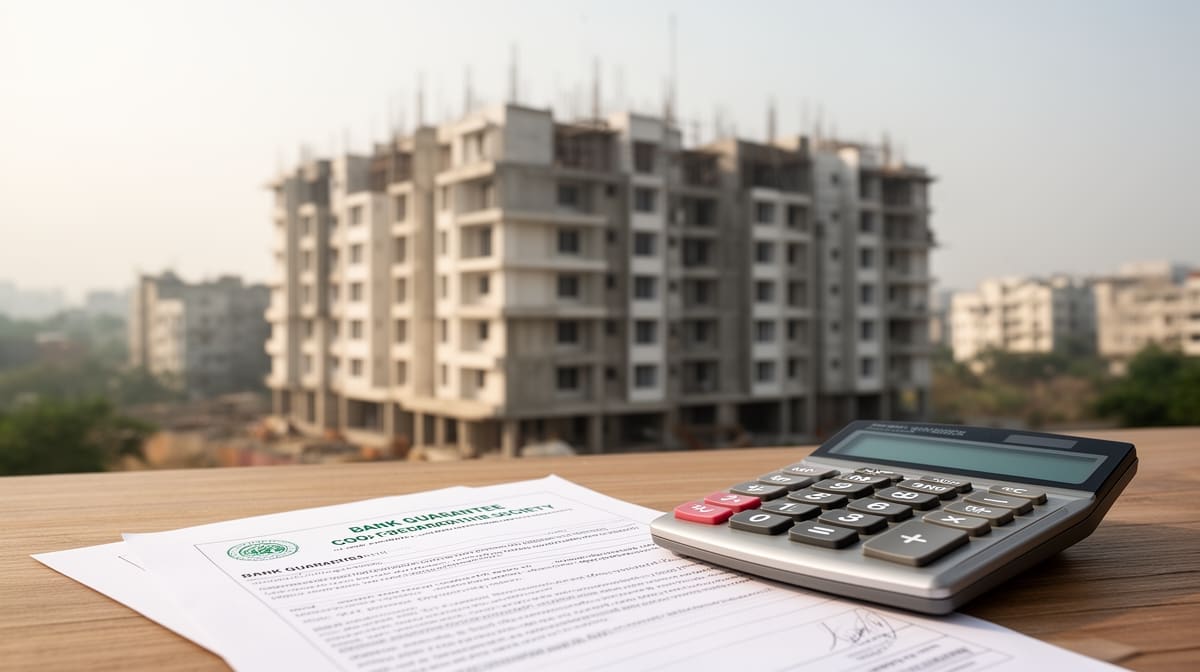
The petitioner’s writ petition and the suo motu contempt proceedings were disposed of upon acceptance of the undertakings. The Court directed: (1) Respondent No. 6 Society shall furnish, within four weeks, an unconditional, irrevocable, and on-demand Bank Guarantee for ₹29,92,748 (aggregate of ₹10,06,800 and ₹19,85,948) issued by a scheduled bank; (2) Alternatively, ₹19,85,948 may be deposited in the City Civil Court in Civil Suit No. 2479 of 2019, with a Bank Guarantee for ₹10,06,800; (3) The Bank Guarantee shall remain valid for six months and must be renewed until final disposal of the civil suit; (4) If the guarantee or deposit is not furnished, the contempt petition shall be restored for merits; (5) The Civil Court shall decide the suit on its own merits, uninfluenced by this order. There shall be no order as to costs.
What This Means For Similar Cases
Undertakings Are Interim Security, Not Final Settlement
- Practitioners must treat undertakings filed in contempt proceedings as interim protective measures, not conclusive admissions of liability.
- A party accepting such an undertaking retains the right to contest the exact quantum in the underlying civil suit.
- Courts may accept undertakings to prevent financial prejudice without prejudging substantive rights.
Contempt Cannot Be a Substitute for Execution
- Section 2(b) of the Contempt of Courts Act, 1971 requires wilful disobedience of a court order - not mere breach of contract.
- Where a civil suit is pending to enforce a private agreement, contempt jurisdiction should be invoked only if there is clear defiance of a court direction.
- The R.N. Dey principle applies: contempt is not a tool for enforcing decrees or agreements.
Authority of Deponents Matters
- Undertakings by society office-bearers are binding if they claim authority from the General Body, absent rebuttal.
- Practitioners must verify whether the person filing the undertaking has actual authority under the society’s bylaws.
- Failure to challenge such representation in affidavits may result in the Court accepting the undertaking as valid.