The Bombay High Court has clarified that courts cannot interfere with the encashment of bank guarantees in commercial arbitration disputes absent exceptional circumstances such as egregious fraud, irretrievable injury, or special equities. The judgment reinforces the independence of bank guarantees from underlying contracts and sets a high threshold for judicial intervention.
Background & Facts
The Dispute
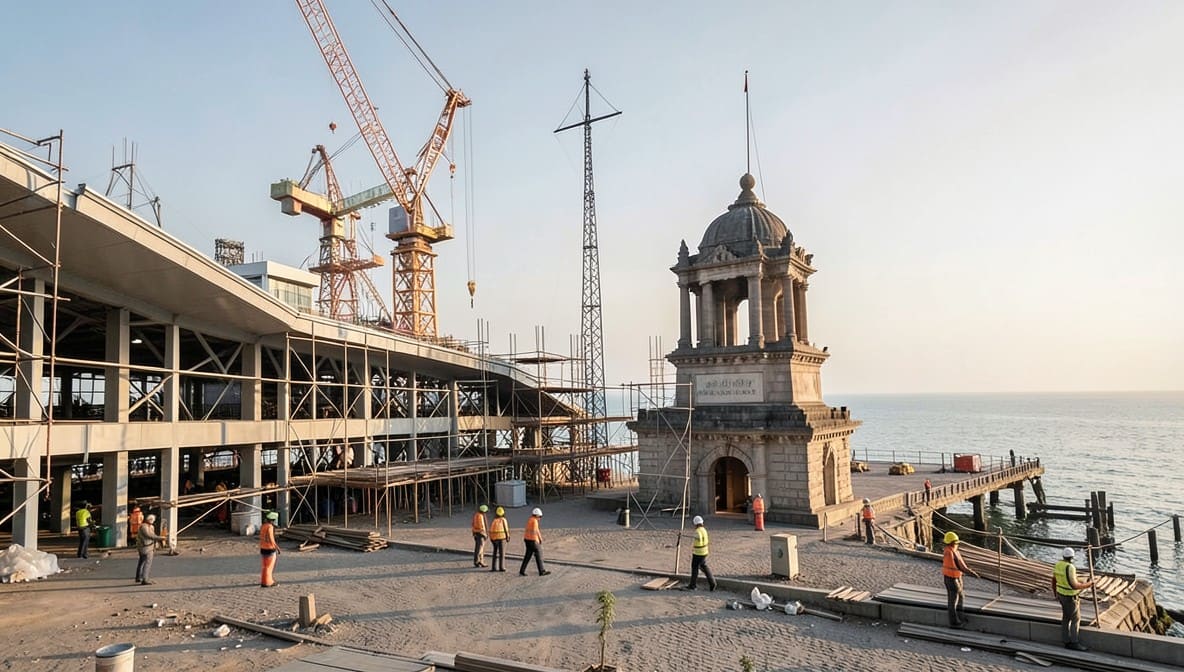
The dispute arises from the construction of a Passenger Jetty and Terminal Facilities at Radio Club, near Gateway of India, Mumbai, under a contract dated 11 October 2024 between RKEC Projects Limited (Petitioner) and the Maharashtra Maritime Board (Respondent No. 1). The project, aimed at decongesting Mumbai’s waterfront and improving public ferry infrastructure, was awarded following a tender process initiated on 8 September 2024. The Petitioner was issued a Letter of Award on 3 October 2024 and the formal Engineering Procurement and Construction Agreement was executed on 11 October 2024. The contract stipulated a 30-month timeline, ending on 11 April 2027.
Key Facts
- The Petitioner deposited two bank guarantees with Respondents: a Performance Bank Guarantee (PBG) of Rs. 11.33 crores and a Mobilization Advance Bank Guarantee (MABG) of Rs. 20.53 crores.
- The Petitioner received a mobilization advance of Rs. 19.35 crores under Article 19.2.1 of the Agreement.
- The Petitioner alleged delays caused by Respondents in finalizing General Arrangement Drawings (GADs) and deck elevation approvals, claiming 189 days were lost due to delays by Respondents’ consultants at IIT Madras.
- The Mumbai Port Authority’s ‘No Cold Moves’ circular from 1 June 2025 to 15 September 2025 allegedly caused an additional 107 days of delay.
- On 15 September 2025, Respondents requested a revised project schedule, which the Petitioner submitted on 24 September 2025.
- On 14 October 2025, Respondents proposed liquidated damages of Rs. 8.70 lakhs per day.
- On 5 December 2025, Respondents issued a Show Cause Notice.
- On 7 January 2026, the Petitioner raised a running bill of Rs. 6.21 crores, approved by the Engineer/PMC on 9 January 2026.
- On 3 February 2026, Respondents threatened termination.
- On 20 February 2026, the Petitioner requested conciliation.
- On 16 March 2026, a conciliation meeting occurred; a report was submitted on 20 March 2026.
- On 24 March 2026, Respondents issued a formal Notice of Intention to Terminate the Contract.
- On 1 April 2026, a second conciliation meeting was held before the Chairman.
- The Petitioner filed the present petition under Section 9 of the Arbitration and Conciliation Act, 1996 on 24 February 2026.
Procedural History
- 08.09.2024: Tender floated by Maharashtra Maritime Board
- 03.10.2024: Letter of Award issued to Petitioner
- 11.10.2024: Contract executed between Petitioner and Respondent No. 1
- 17.04.2025: Mumbai Port Authority issues ‘No Cold Moves’ circular
- 15.09.2025: Meeting held between parties; revised schedule requested
- 24.09.2025: Petitioner submits revised bar chart schedule
- 14.10.2025: Respondents propose liquidated damages of Rs. 8.70 lakhs/day
- 05.12.2025: Show Cause Notice issued by Respondents
- 07.01.2026: Petitioner raises running bill of Rs. 6.21 crores
- 09.01.2026: Running bill approved by Engineer/PMC
- 20.02.2026: Petitioner requests conciliation
- 16.03.2026: First conciliation meeting
- 20.03.2026: Conciliation report submitted
- 24.03.2026: Notice of intention to terminate issued
- 01.04.2026: Second conciliation meeting before Chairman
- 24.02.2026: Section 9 petition filed before Bombay High Court
- 16.03.2026: Affidavit in Reply filed by Respondents
- 09.04.2026: Judgment pronounced
Relief Sought
The Petitioner sought:
- Restraint on termination of the contract dated 11 October 2024
- Restraint on encashment of PBG (Rs. 11.33 crores) and MABG (Rs. 20.53 crores)
- Release of the balance 5% mobilization advance under Article 19.2.1
- Release of stage-wise payments under Article 19.5
At the hearing, the Petitioner withdrew all prayers except clause (c) - restraint on encashment of bank guarantees - and reserved the right to seek other reliefs before the future Arbitral Tribunal.
The Legal Issue
Can a court grant interim relief to restrain the encashment of bank guarantees under Section 9 of the Arbitration and Conciliation Act, 1996, where the petitioner has not pleaded or established egregious fraud, irretrievable injury, or special equities?
Arguments Presented
For the Petitioner
The Petitioner, through Senior Advocate Umesh Shetty, argued that encashment of the bank guarantees would cause economic death to the company, affecting 600 families. It claimed the delays were attributable to Respondents’ failure to approve GADs and deck elevations, and that conciliation proceedings were ongoing. It relied on Jindal Steel and Power Ltd. v. Bansal Infra Projects Pvt. Ltd. to argue that courts may preserve the status quo of bank guarantees in exceptional cases. It also cited Atlas Interactive (India) Pvt. Ltd. v. BSNL to assert that state instrumentalities must act fairly and not arbitrarily.
For the Respondent
Senior Advocate Birendra Saraf opposed the petition on multiple grounds: (1) the contract is determinable under Section 14 of the Specific Relief Act, 1963; (2) the project qualifies as infrastructure under Section 20A, barring injunctions; (3) bank guarantees are independent contracts; (4) no pleadings of fraud, irretrievable injury, or special equities were made; and (5) the Petitioner had already received Rs. 19.35 crores in mobilization advance, exceeding the value of the guarantees. He relied on Hindustan Steelworks Construction Ltd. v. Tarapore & Co., Vinitec Electronics v. HCL, Standard Chartered Bank v. Heavy Engineering Corporation, and Techno Unique Infratech v. Gammon Infrastructure to affirm that courts cannot interfere absent exceptional circumstances.
The Court's Analysis
The Court began by affirming the well-established principle that a bank guarantee is an independent contract between the beneficiary and the issuing bank. Its obligation is to pay on demand, and judicial interference is permissible only in exceptional cases involving egregious fraud, irretrievable injury, or special equities. Mere allegations of financial hardship or commercial loss are insufficient.
"The commitment by the bank must be honoured free from interference by the courts. It is only in exceptional and rare cases, where there is an element of egregious fraud or where the case involves irretrievable injury or irretrievable injustice or where there are special equities, that the court would be justified in making interim order restraining encashment of bank guarantee."
The Court examined Paragraph 57 of the Petition, the sole source of the Petitioner’s claim for restraint. It found that the paragraph contained only generalized assertions of "heavy losses," "severe prejudice," and "death knell of the company" without any factual substantiation or quantification of irretrievable injury. No evidence was tendered to show that the Petitioner would be unable to recover damages in arbitration if the contract termination were later held unlawful.
The Court noted that the Petitioner had already received Rs. 19.35 crores in mobilization advance - nearly 61% of the total bank guarantee amount of Rs. 31.86 crores. This significantly undermined the claim of irretrievable injury. The Court further held that the existence of conciliation proceedings, while commendable, does not create a legal bar to invocation of bank guarantees under the contract’s Clause 23.6, which explicitly permits encashment upon termination.
The Court distinguished Jindal Steel on the grounds that it involved a unique procedural bypass of Section 37 appeals and an exercise of Article 227 jurisdiction - not a general rule permitting injunctions against bank guarantees. Similarly, Atlas Interactive was held inapplicable as it concerned state conduct in contractual fairness, not the enforceability of bank guarantees.
The Court concluded that the Petitioner had failed to meet the stringent threshold required for judicial intervention. The absence of pleadings on fraud, irretrievable injury, or special equities was fatal to the petition.
The Verdict
The Petition was dismissed without any relief. The Court held that the Respondents are entitled to invoke and encash the Performance Bank Guarantee of Rs. 11.33 crores and the Mobilization Advance Bank Guarantee of Rs. 20.53 crores upon termination of the contract, as permitted under Clause 23.6 of the Agreement. The Petitioner retains the right to seek all other interim reliefs - including stay of termination, release of stage-wise payments, and recovery of mobilization advance - before the Arbitral Tribunal once constituted.
What This Means For Similar Cases
Bank Guarantees Are Not Subject to Judicial Stay on Mere Allegations
- Practitioners must plead and substantiate egregious fraud, irretrievable injury, or special equities with concrete evidence - not speculative financial harm.
- Generalized claims of "economic death" or "loss of livelihood" without quantified impact or proof of inability to recover in arbitration will not suffice.
- Receipt of substantial advance payments under the contract weakens claims of irretrievable injury.
Conciliation Does Not Automatically Suspend Contractual Rights
- Ongoing conciliation or mediation under the contract does not create a legal injunction against invoking bank guarantees unless explicitly agreed in writing.
- Parties must not assume that dispute resolution mechanisms automatically freeze contractual remedies.
- Termination clauses and guarantee encashment rights remain enforceable unless judicially restrained on valid grounds.
Section 9 Relief Requires Precision and Specificity
- Petitions under Section 9 must clearly identify which prayers are being pressed and why.
- Courts will not entertain broad, undifferentiated requests for interim relief; parties must narrow their focus to the most urgent and legally supportable claim.
- Failure to press certain reliefs at the interim stage does not preclude seeking them before the Arbitral Tribunal, but it limits the scope of judicial intervention.