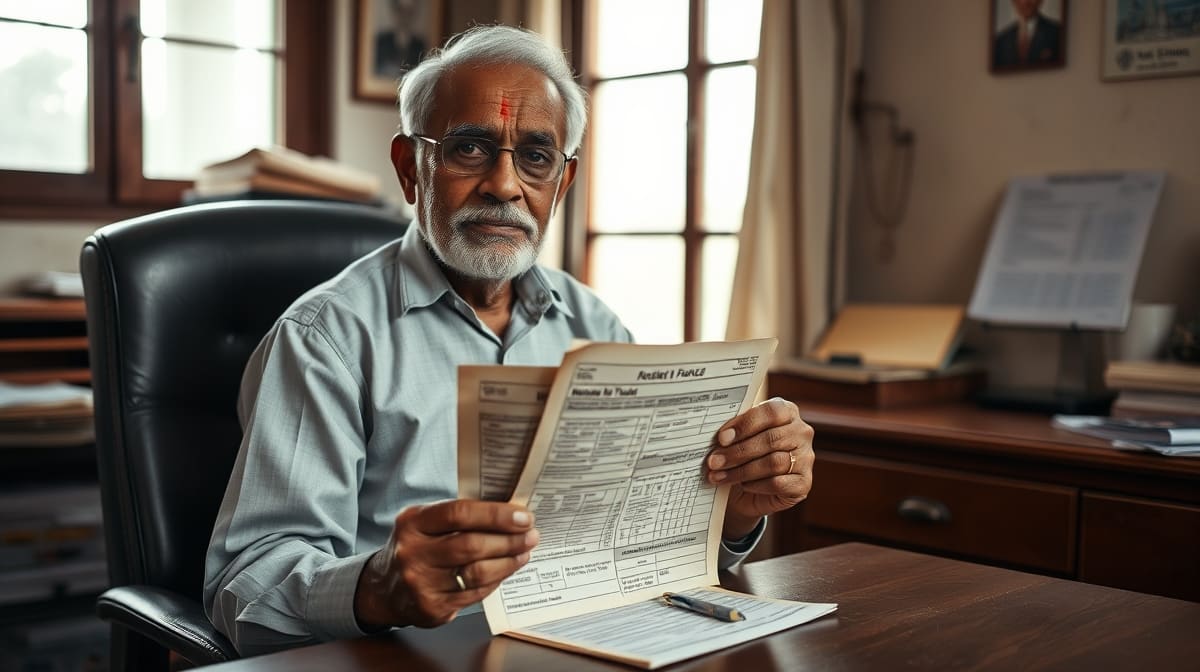
The Income Tax Appellate Tribunal, Kolkata, has clarified that an assessee’s delay in filing an appeal cannot be penalized solely on the ground of negligence by a deceased tax consultant, especially when the assessee acted in good faith and lacked technical expertise. This ruling reinforces the principle that substantial justice must prevail over technicalities in tax litigation.
Background & Facts
The Dispute
The assessee, Sri Samar Nath Mondal, was assessed for AY 2014-15 after the Assessing Officer (AO) reopened his case under Section 147 of the Income Tax Act, 1961, based on information regarding the sale of two ancestral plots of land. The AO, having received no response to multiple notices under Sections 148 and 142(1), completed the assessment ex parte under Section 144 read with Sections 147 and 144B, adding deemed long-term capital gains of ₹62,83,970 based on stamp duty valuations under Section 50C. No indexation benefit or exemption under Section 54F was considered.
Key Facts
- The assessee did not file a return for AY 2014-15, believing he had no taxable income.
- He had entrusted all income tax matters to a tax consultant, Mr. Chiranjib Das, since 2015, including receipt and response to notices.
- The assessment order dated 21.09.2021 was received and handed over to the consultant.
- The consultant failed to file any appeal or respond to any notices during the assessment proceedings.
- In June 2025, the assessee discovered that his refunds for AY 2023-24 and 2024-25 had been adjusted against the demand for AY 2014-15.
- On visiting the consultant’s office, he learned of the consultant’s death and retrieved all documents, including the assessment order and demand notice.
- The assessee engaged a new tax consultant and filed an appeal before the CIT(A) on 18.01.2025, after a delay of 1439 days from the date of the assessment order.
- The assessee submitted a sworn affidavit before a Notary Public detailing the circumstances of the delay.
- The assessee claimed indexation benefits and exemption under Section 54F for a flat purchased for ₹9,09,020, which, if allowed, would reduce his long-term capital gains to nil.
Procedural History
- 20.03.2020: Notice under Section 148 issued.
- 21.09.2021: Ex-parte assessment order passed under Section 144 read with Sections 147 and 144B.
- 18.01.2025: Appeal filed before CIT(A) - 1439 days after the assessment order.
- 17.11.2025: CIT(A) dismissed the appeal solely on grounds of delay, relying on Basawaraj v. Special Land Acquisition Officer.
- 28.04.2026: Hearing concluded before ITAT Kolkata.
- 09.06.2026: ITAT pronounced its order.
Relief Sought
The assessee sought condonation of the 1439-day delay in filing the appeal and remand of the case to the AO for fresh adjudication, with opportunity to substantiate claims for indexation and exemption under Section 54F.
The Legal Issue
The central question was whether the negligence of a deceased tax consultant, coupled with the assessee’s lack of digital literacy and reliance on professional representation, constitutes a reasonable cause for condonation of delay under Section 250 of the Income Tax Act, or whether such delay must be dismissed as inexcusable under the principle laid down in Basawaraj v. Special Land Acquisition Officer.
Arguments Presented
For the Appellant
The learned Advocate for the assessee submitted that the delay was neither deliberate nor due to culpable negligence on the part of the assessee. The assessee had entrusted all tax matters to a professional consultant, who had been handling his returns since 2015. The sudden death of the consultant was an unforeseen event beyond the assessee’s control. The assessee, being non-technical and unfamiliar with e-filing portals, had no means to independently monitor compliance. The affidavit submitted before the CIT(A) and reiterated before the Tribunal demonstrated bona fide efforts to rectify the situation upon discovery of the consultant’s death. The assessee relied on Collector, Land Acquisition v. Katiji to argue that the doctrine of condonation must be applied pragmatically, with preference to substantial justice over technicalities.
For the Respondent
The Senior DR relied on the CIT(A)’s order and the Supreme Court’s decision in Basawaraj v. Special Land Acquisition Officer, contending that negligence or inaction by an assessee’s representative cannot be a valid ground for condonation. The statutory duty to remain vigilant over tax affairs lies with the assessee, and reliance on a third party does not absolve him of responsibility. The delay of over three years was inordinate and unexplained, warranting dismissal.
The Court's Analysis
The Tribunal examined the nature of the delay and the circumstances surrounding it. It noted that the assessee had no prior experience with income tax procedures, had never filed a return independently, and had placed complete trust in a professional consultant. The death of the consultant was an unforeseen, extraneous event that severed the chain of representation. The assessee acted promptly upon discovering the issue - within a month of learning of the consultant’s death, he engaged a new representative and filed the appeal.
The Tribunal distinguished Basawaraj, which dealt with systemic negligence and repeated inaction over years, from the present case, where the delay arose from a singular, tragic event. The Tribunal emphasized that the assessee was not a sophisticated taxpayer and had no reason to suspect non-compliance.
"Every day's delay must be explained" does not mean that a pedantic approach should be made. Why not every hour's delay, every second's delay? The doctrine must be applied in a rational, common sense, pragmatic manner.
The Tribunal further held that the assessment was ex parte and the assessee had never been heard on the merits - including claims for indexation and exemption under Section 54F. Dismissing the appeal on limitation alone would result in a miscarriage of justice, as the assessee had a prima facie claim to substantial relief.
The Tribunal also noted that the CIT(A) had failed to consider the affidavit submitted by the assessee, which contained detailed, credible explanations. The Tribunal concluded that the delay was not attributable to the assessee’s negligence or mala fides, and that the interests of justice demanded that the matter be remanded for a fair hearing.
The Verdict
The appeal was partly allowed for statistical purposes. The Tribunal set aside the order of the CIT(A) dated 17.11.2025 and remanded the assessment proceedings to the AO for de novo adjudication. The assessee shall be granted a reasonable opportunity to substantiate his claims for indexation of cost of acquisition and exemption under Section 54F for the purchase of a flat for ₹9,09,020. The AO shall not deny the assessee’s right to be heard and shall not impose unnecessary adjournments. The matter shall be decided within 8 weeks from the date of receipt of this order.
What This Means For Similar Cases
Reliance on Tax Consultants Is Not Negligence
- Practitioners must argue that reliance on a professional tax consultant, especially by non-technical taxpayers, cannot be equated with culpable negligence.
- Where the consultant is the sole point of contact and the assessee has no digital access or awareness, the burden of compliance cannot be shifted unfairly.
- Affidavits detailing the nature of representation and the cause of disruption (e.g., death, illness, disappearance) must be filed promptly and supported by documentary evidence.
Substantial Justice Overrides Technical Limitation
- Tribunals and appellate authorities must apply the pragmatic test from Katiji - not a rigid, mechanical application of limitation.
- If the underlying claim has merit and the delay is not deliberate, dismissal on limitation alone violates the principle of natural justice.
- Ex-parte assessments must be scrutinized with greater caution; the right to be heard is fundamental and cannot be forfeited due to third-party failure.
Procedural Fairness in Ex-Parte Cases
- When an assessment is completed ex parte, the appellate authority must ensure that the assessee is given a meaningful opportunity to present evidence and arguments.
- The burden of proving deliberate delay lies with the revenue; mere passage of time is insufficient.
- Practitioners should always file a detailed affidavit explaining delay, even if the appellate authority initially rejects it - the Tribunal may still consider it on appeal.