The Bombay High Court has set aside a conviction for murder under Section 302 IPC, holding that circumstantial evidence must exclude every reasonable hypothesis of innocence - a threshold unmet when a third party present at the scene remains unexamined and unaccounted for. The judgment reinforces that conviction cannot rest on fragmented inferences when critical gaps in the prosecution’s chain remain unaddressed.
Background & Facts
The Dispute
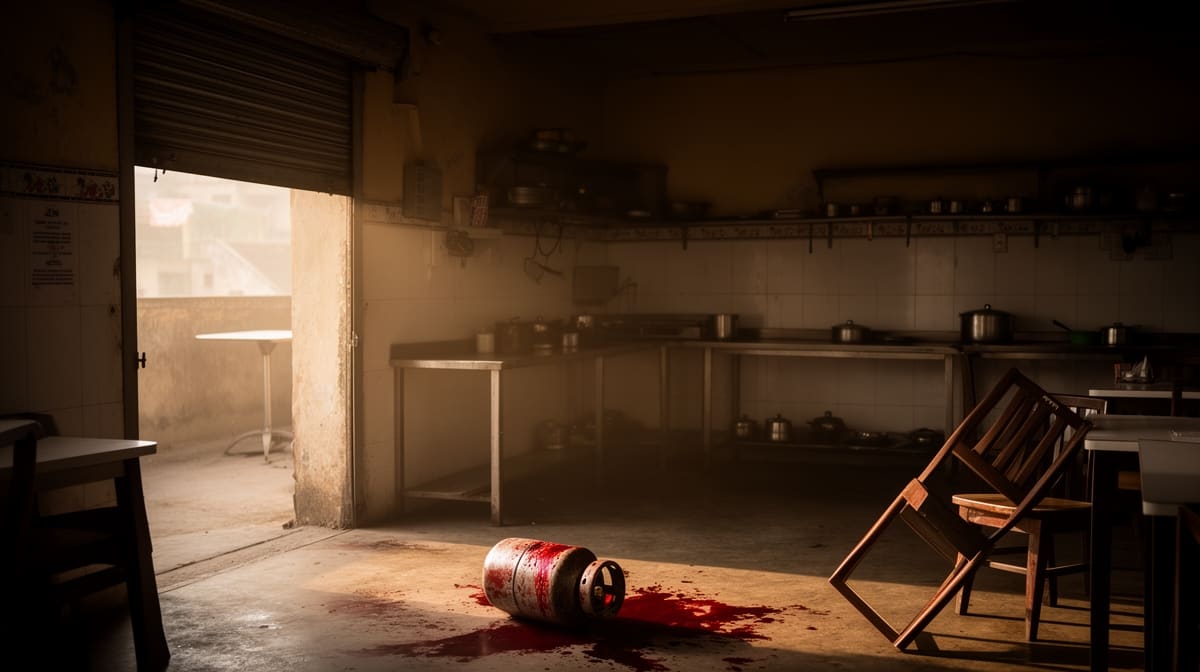
The appellant, Manjeetkumar Shriramrup Saroj, was convicted by the Sessions Court for the murder of his colleague, Ajeet Roy (deceased), and theft of mobile phones under Sections 302 and 379 IPC. The prosecution alleged that on the night of 5th July 2017, after a quarrel with the deceased, the appellant assaulted him with a gas cylinder while both were sleeping in the restaurant where they worked. The victim died the next morning from severe head injuries.
Procedural History
- 5th July 2017: Evening quarrel between appellant and deceased; both, along with third employee Kamlesh, slept in the restaurant.
- 6th July 2017, 6:00 a.m.: Victim found unconscious in a pool of blood; Kamlesh present at the scene.
- 6th July 2017, 14:23 hrs: FIR registered after an 8-hour delay.
- 2018: Sessions Case No. 148 initiated.
- 31st March 2021: Sessions Court convicted appellant based on circumstantial evidence.
- 2021: Appeal filed before Bombay High Court.
Relief Sought
The appellant sought acquittal on grounds that the prosecution failed to prove: (1) the last seen theory beyond reasonable doubt due to unexamined third party (Kamlesh); (2) the authenticity of the oral dying declaration; (3) the link between recovered mobile phones and the accused; and (4) the origin of bloodstained clothing.
The Legal Issue
The central question was whether the prosecution had established a complete chain of circumstantial evidence that excluded every reasonable hypothesis of innocence, particularly given the unexplained presence and non-examination of a third person, Kamlesh, who was last seen with both the victim and the accused.
Arguments Presented
For the Appellant
The appellant’s counsel argued that the prosecution’s case collapsed due to critical omissions: (1) Kamlesh, who was present throughout the night and found with the victim, was neither examined as a witness nor arraigned; (2) the oral dying declaration was medically implausible - the victim was unconscious upon hospital admission, as per Exhibits 69 and 70; (3) bloodstained clothes were recovered from a public space, rendering the recovery unreliable; (4) mobile phones recovered were registered in third parties’ names, with no proof linking them to the accused or victim; and (5) the delay in FIR registration suggested fabrication. Reliance was placed on Mohd. Sattarul Najrul Mulla v. State of Maharashtra and State of Maharashtra v. Santosh to challenge the dying declaration and recovery.
For the Respondent/State
The State contended that the Sessions Court correctly appreciated the evidence: (1) the last seen theory was established through PW1’s testimony; (2) the oral dying declaration was credible despite lack of medical records, as ocular testimony prevails over medical evidence per Trimukh Maroti Kirkan v. State of Maharashtra; (3) the appellant’s admission under Section 313 CrPC confirmed his arrest and quarrel with the victim, establishing motive; and (4) Section 106 of the Evidence Act shifted the burden to the accused to explain his absence from the scene. Reliance was placed on Laxman v. State of Maharashtra to uphold the dying declaration.
The Court's Analysis
The Court undertook a rigorous application of the Sharad Birdhichand Sarda v. State of Maharashtra (1984) test for circumstantial evidence, emphasizing that each circumstance must be proved beyond reasonable doubt and must form a chain pointing exclusively to the guilt of the accused.
"The circumstances should be of a conclusive nature and tendency, and they should exclude every possible hypothesis except the one to be proved."
The Court found the prosecution’s case fatally flawed on multiple fronts. First, the last seen theory was undermined by the unexplained presence of Kamlesh - the third employee who slept in the same room and was found beside the victim. The prosecution offered no explanation for why Kamlesh was not investigated, questioned, or arraigned, despite being a plausible perpetrator. This created a reasonable alternative hypothesis that could not be excluded.
Second, the oral dying declaration was rendered unreliable by the medical evidence. The postmortem requisition form (Exhibit 69) recorded the victim as unconscious upon arrival at the hospital, with severe head trauma likely causing immediate loss of consciousness. The doctor (PW7) testified that such injuries would render the victim incapable of making a coherent statement. The handwritten endorsement on Exhibit 70 confirmed the victim was unconscious at 7:30 a.m. - just 30 minutes after the alleged declaration. The Court held that direct ocular testimony cannot override medical evidence when the latter directly contradicts the former.
Third, the recovery of bloodstained clothes from an open space near a tree was held to be legally untenable under settled precedent (State of Maharashtra v. Santosh). The Chemical Analysis report failed to establish that the blood belonged to the deceased, as blood grouping was inconclusive.
Fourth, the recovery of mobile phones was unsupported. The Nodal Officers (PW12 and PW13) testified that the SIM cards were registered in the names of third persons, with no evidence linking them to the accused or victim. The appellant denied recovery during his Section 313 statement, and no corroborative evidence - such as tower location data - was produced to trace his movements.
The Court rejected the State’s reliance on Section 106 of the Evidence Act, noting that the burden to explain does not shift unless the prosecution first establishes a prima facie case. Here, the prosecution failed to establish even the foundational circumstances.
The Verdict
The appellant won. The Bombay High Court quashed the conviction and acquitted the appellant of all charges under Sections 302 and 379 IPC. The Court held that the prosecution failed to prove the chain of circumstantial evidence beyond reasonable doubt, particularly due to the unexplained role of Kamlesh and the unreliability of the dying declaration and recoveries. The appellant was ordered released forthwith upon execution of a PR bond.
What This Means For Similar Cases
Last Seen Theory Requires Exclusion of All Possible Suspects
- Practitioners must ensure that any third party present at the scene is either examined as a witness or formally ruled out by the prosecution.
- Courts will not accept last seen theory if a plausible alternative suspect remains uninvestigated.
- Failure to examine a person found at the scene with the victim may render the entire circumstantial chain defective.
Dying Declarations Must Be Medically Plausible
- Oral dying declarations are not sacrosanct - they must be consistent with the victim’s medical condition.
- If medical records show unconsciousness or imminent death, courts will discount oral declarations even if multiple witnesses testify to them.
- Prosecutors must produce hospital records to corroborate the victim’s mental state at the time of the declaration.
Recovery of Property Must Be Corroborated by Chain of Custody
- Recovery of mobile phones or other property from an accused must be linked through registration records, call logs, or tower data.
- Recovery from public spaces without independent witnesses is legally suspect.
- Absence of linking evidence (e.g., SIM registration in third party’s name) invalidates the prosecution’s theory of ownership.