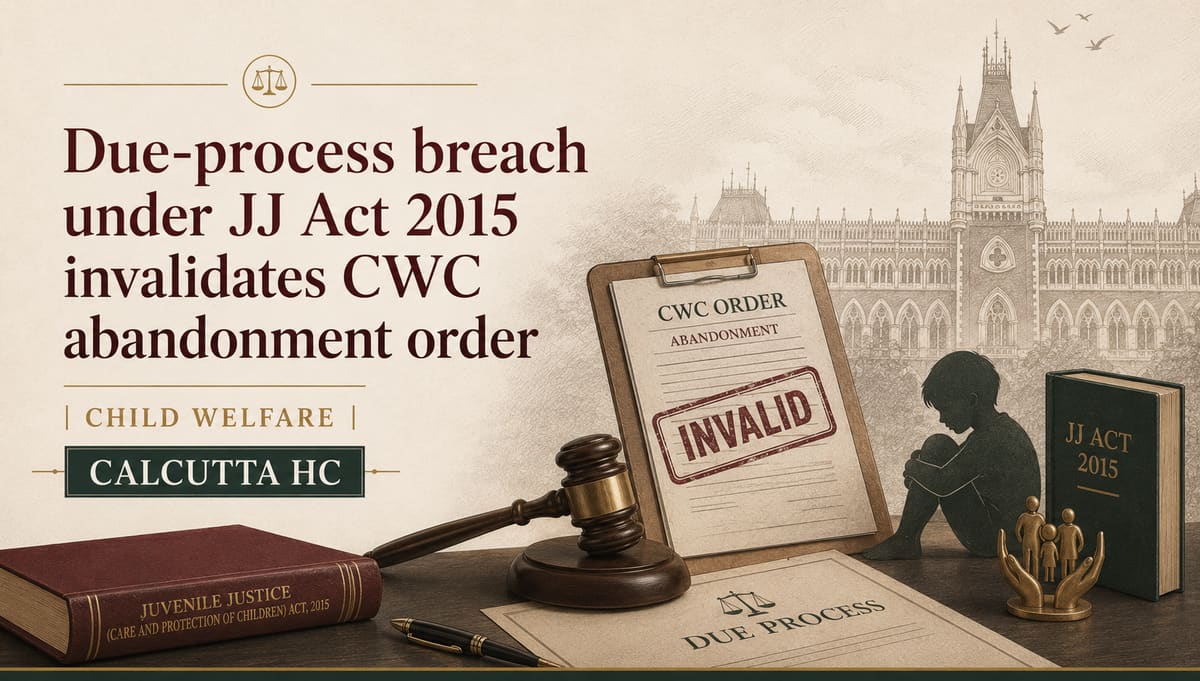
The Calcutta High Court held that the Child Welfare Committee’s removal of a child from the petitioners’ custody was unlawful because the child did not qualify as a ‘child in need of care and protection’ under Section 2(14) of the Juvenile Justice (Care and Protection of Children) Act, 2015. The court directed the Committee to restore custody and emphasized that administrative lapses cannot override the paramount welfare of the child.
Background & Facts
The Dispute
The petitioners, Smt. Aparna Das and her husband, sought a mandamus directing the respondents to disclose all records concerning the minor child, Amit Das, and to return his custody after the Child Welfare Committee (CWC) took the child into its custody without following the statutory adoption procedure.
Key Facts
- The child Amit Das was born on 24 February 2023 at M.R. Bangur Hospital, Kolkata, prematurely at approximately twenty-nine weeks gestation with a birth weight of about 1.68 kg.
- He was admitted to the Special New Born Care Unit (SNCU) and discharged on 21 March 2023.
- The biological parents voluntarily handed over the child to the petitioners on the same day of birth and, on 3 April 2023 (also noted as 23 April 2023), executed a notarized Deed of Adoption.
- Since birth, the child has remained in the care and custody of the petitioners, who have been providing his upbringing and education.
- On 18 February 2026, the petitioners approached the CWC, narrated the circumstances, and requested completion of adoption formalities.
- Instead of guiding the petitioners, the CWC took the child into its custody and refused to return him.
Procedural History
- 24 February 2023: Birth of Amit Das.
- 21 March 2023: Discharge from hospital.
- 3 April 2023 / 23 April 2023: Execution of notarized Deed of Adoption.
- 18 February 2026: Petitioners’ approach to CWC.
- 07 September 2026: Hearing concluded.
- 17 September 2026: Judgment delivered and uploaded.
- 18 September 2026, 04:00 P.M.: Deadline fixed for CWC to hand over custody to petitioners.
- December 2026 onwards: Quarterly reports on the child’s welfare to be sought by the Member Secretary of the District Legal Services Committee.
Relief Sought
The petitioners prayed for a writ of mandamus directing the respondents to disclose and furnish all orders, proceedings, recommendations, inquiry reports, social investigation reports, individual care plans, assessments, communications, placement orders and all other records relating to the child, and to return the child’s custody to them.
The Legal Issue
The central question was whether the Child Welfare Committee’s action of taking custody of the child was in accordance with the Juvenile Justice (Care and Protection of Children) Act, 2015, given that the child was not an orphan, abandoned, or a child in need of care and protection under Section 2(14) of the Act.
Arguments Presented
For the Petitioners
The petitioners contended that the CWC had no jurisdiction because the child did not fall within the definition of “child in need of care and protection” under Section 2(14) of the JJ Act. They relied on the general principles in Section 3 of the Act - particularly the principle of best interest, principle of family responsibility, principle of safety, and positive measures - to argue that the child’s welfare lay with the petitioners. They asserted that the CWC’s failure to guide them through the statutory adoption process amounted to procedural lapse, not a justification for removing the child. They further argued that the notarized Deed of Adoption, though not registered, reflected the parties’ consent and should not be disregarded.
For the Respondents
The State defended the CWC’s action, submitting that under Sections 56, 57 and 58 of the JJ Act read with the Adoption Regulations, 2022, every adoption must be processed through a recognized Specialized Adoption Agency (SAA) after the child is declared legally free for adoption by the competent CWC. The State argued that the CWC, upon receiving information about the child’s placement, was statutorily obliged to examine the matter and pass orders in the child’s best interest, and that the petitioners’ private arrangement could not confer legal recognition of adoption.
The Court's Analysis
The Court began by noting that the Juvenile Justice (Care and Protection of Children) Act, 2015, aims to protect two categories of children: those in conflict with law and those in need of care and protection. It then examined the definition of “child in need of care and protection” under Section 2(14), which enumerates twelve circumstances, including being found without home, working in contravention of laws, residing with an abusive guardian, being mentally or physically challenged with no support, having unfit parents, being abandoned, being missing, being vulnerable to drug abuse, being abused for unconscionable gains, being a victim of armed conflict, or being at imminent risk of marriage before the legal age.
The Court observed that none of these circumstances applied to Amit Das. He was born in a hospital, discharged after SNCU care, and had been continuously in the petitioners’ custody since birth. There was no allegation of abuse, neglect, exploitation, or abandonment by the petitioners. The biological parents had voluntarily handed over the child and consented to the adoption. Consequently, the child did not fall within any of the sub-clauses (i) to (xii) of Section 2(14).
Turning to the general principles enumerated in Section 3 of the Act, the Court highlighted that the principle of best interest requires that all decisions regarding a child be based on the primary consideration of the child’s welfare and development of full potential. The principle of family responsibility places the primary responsibility for care, nurture and protection on the biological family or adoptive/foster parents. The principle of safety mandates that the child be protected from harm, abuse or maltreatment while in contact with the care and protection system. The principle of positive measures calls for mobilising resources to reduce vulnerabilities and facilitate development.
The Court held that, in the present case, the child’s best interest lay with the petitioners, who had been providing care, affection and educational opportunities since birth. Removing the child from that settled environment, without any finding of risk or harm, would contravene the principles of best interest, family responsibility and safety. The Court further noted that the principle of institutionalisation as a measure of last resort and the principle of repatriation and restoration reinforce that a child should be removed from family care only when absolutely necessary and that efforts must be made to reunite the child with family whenever possible.
The Court also considered the procedural requirements under Chapter VI of the Act. It held that the CWC’s power to take cognizance of a child arises only when the child is produced before it as a “child in need of care and protection”. Since Amit Das did not satisfy that threshold, the CWC lacked jurisdiction to initiate any inquiry or to pass orders taking the child into its custody. The Court emphasized that the CWC’s role is to guide and facilitate the statutory adoption process, not to supplant the petitioners’ lawful custody based on administrative lapses.
The Court quoted: > "For the ends of justice, it would be appropriate to direct the Child Welfare Committee to return of child to the petitioners. This is by the following the principle of the best interest of the child, principle of family responsibility, principle of safety, positive measures, principle of institutionalization as a measure of last resort, principle of repatriation and restoration, which are also enunciated as general principles in Section 3 of the Act of 2015."
Finally, the Court concluded that the CWC’s action was not in accordance with law because the child was neither an orphan nor abandoned and did not fall within the statutory definition of a child in need of care and protection. Accordingly, it directed the CWC to restore custody and issued ancillary directions for monitoring the child’s welfare.
The Verdict
The Calcutta High Court allowed the petitioners’ writ petition. It directed the Child Welfare Committee to hand over the custody of the minor child, Amit Das, to the petitioners on or before 18 September 2026 at 04:00 P.M.. The Court further directed the Member Secretary of the District Legal Services Committee, South 24 Parganas, to seek quarterly reports on the child’s welfare and progress from the petitioners starting from December 2026, and to be at liberty to depute a Child Welfare Expert to inspect the petitioners’ residence. The petitioners were also directed to take appropriate steps before the appropriate Court of law to obtain a declaration that they are the adoptive parents of the child and that the child is their adoptive child. The writ petition (W.P.A. No. 13525 of 2026) was thus disposed of.
What This Means For Similar Cases
Best Interest Paramount
Courts will scrutinize whether a child satisfies the statutory definition of “child in need of care and protection” under Section 2(14) before allowing any Child Welfare Committee intervention. If the child does not meet any of the twelve enumerated circumstances, the Committee lacks jurisdiction to remove the child from private custody.
Procedural Compliance Mandatory
Adoption must be processed through a recognized Specialized Adoption Agency after the child is declared legally free for adoption by the competent Child Welfare Committee. Private notarized deeds, irrespective of the parties’ consent, do not create legal adoptive status under the Juvenile Justice Act, 2015.
Family Responsibility Overrides Administrative Lapses
Mere lapses in adoption formalities do not justify removing a child from a settled, safe family environment. The principles of best interest, family responsibility and safety prevail over procedural irregularities, and the State must facilitate, not supplant, the existing caregiving arrangement.
- Verify the child’s status under Section 2(14) before invoking CWC jurisdiction.
- Ensure adoption proceedings follow the SAA route; challenge any CWC action lacking statutory basis.
- Argue that the child’s continued care with private custodians serves best interest unless concrete risk is shown.