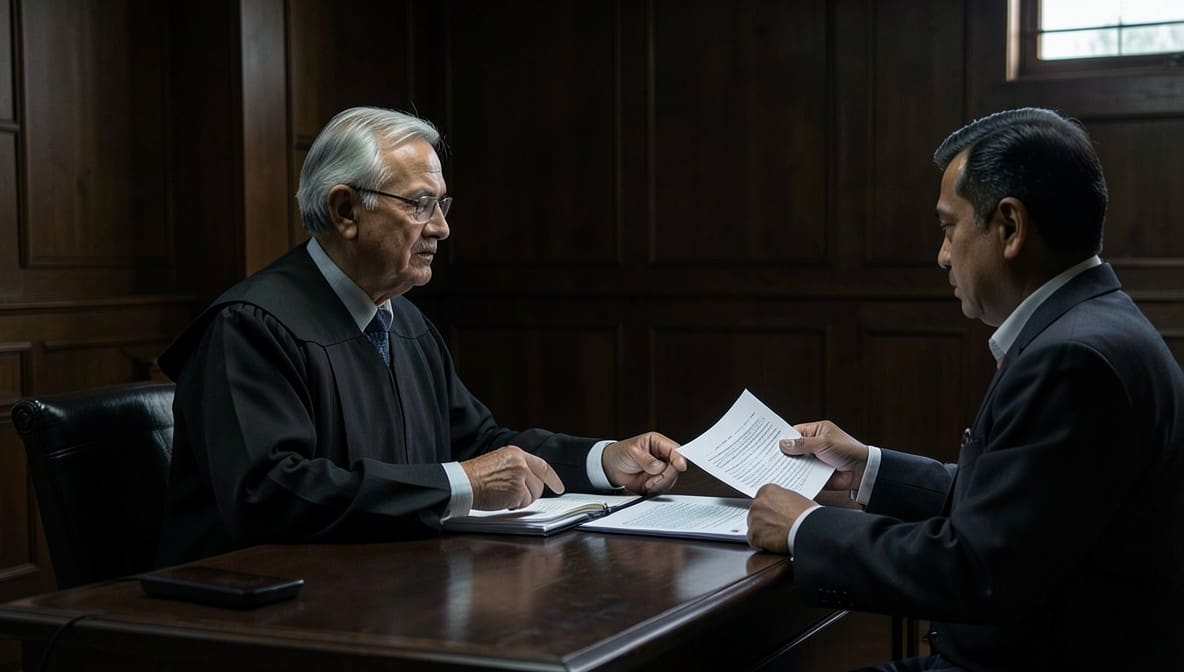
The Chhattisgarh High Court has reaffirmed that allegations of concealing material facts in a marriage, such as a prior divorce, may constitute a cognizable offence under the Bharatiya Nyaya Sanhita if they prima facie indicate deception and inducement. The Court declined to quash the FIR and charge sheet, emphasizing that such disputes, even if rooted in matrimonial discord, cannot be dismissed at the pre-trial stage without evidence appreciation.
Background & Facts
The Dispute
The petitioner, Vijay Kumar Pandey, married Respondent No. 2, Smt. Pooja Tiwari, on 24.11.2025 at Utai, Durg, under Hindu rites and customs. Prior to the engagement, in July 2025, the petitioner disclosed to the complainant’s family that he had been previously married in April 2016 and had obtained a mutual consent divorce decree from the Family Court, Durg, dated 19.12.2023. The engagement was formalized on 04.08.2025, and the marriage proceeded with full knowledge and consent of both families. No dowry was demanded or accepted by the petitioner or his family; instead, he incurred significant expenses for marriage arrangements.
Key Facts
- The petitioner’s prior marriage and divorce were disclosed to the complainant and her family before engagement in July 2025.
- The marriage was solemnized on 24.11.2025 after mutual consent and family verification.
- Respondent No. 2 resided peacefully at the matrimonial home from 25.11.2025 until 01.12.2025.
- On 01.12.2025, she left the matrimonial home on the pretext of the "Pag Phera" ritual, taking personal belongings, and refused to return.
- Thereafter, she allegedly made unlawful demands, including transfer of the petitioner’s house and separate residence, and threatened to file false criminal cases upon refusal.
- A complaint was lodged on 22.12.2025, leading to FIR No. 0505/2025.
- A charge sheet (No. 478/25) was filed on 29.12.2025 under Sections 318(4) and 85 of the Bharatiya Nyaya Sanhita (BNSS).
- The petitioner filed a complaint with the Inspector General of Police on 31.12.2025, alleging harassment and extortion of ₹1,00,00,000 by the complainant’s relatives.
Procedural History
- 24.11.2025: Marriage solemnized between petitioner and Respondent No. 2.
- 01.12.2025: Respondent No. 2 left matrimonial home and refused to return.
- 22.12.2025: Complaint filed by Respondent No. 2.
- 29.12.2025: Charge sheet filed by Police Station Utai under BNSS Sections 318(4) and 85.
- 08.01.2026: Judicial Magistrate First Class, Durg, took cognizance in RCC/MJC Criminal Case No. 158/2026.
- 11.03.2026: Chhattisgarh High Court dismissed a similar petition filed by Vindvasini Prasad Shukla, the marriage mediator, in CRMP No. 704/2026.
- 22.04.2026: Present petition (CRMP No. 1219 of 2026) filed before the High Court seeking quashing of FIR and charge sheet.
The Parties' Positions
Petitioner’s Position: The petitioner contends that he fully disclosed his prior marriage and divorce before engagement. The complainant’s subsequent departure and criminal complaint were motivated by refusal to meet unlawful financial demands. The allegations lack dishonest intent at inception and are an abuse of process.
Respondent’s Position: The State argues that the FIR and charge sheet prima facie disclose offences under BNSS Sections 318(4) and 85, involving concealment of material facts and misrepresentation of employment and income. The defence of prior disclosure is a factual dispute requiring trial.
Relief Sought
The petitioner seeks quashing of FIR No. 0505/2025, charge sheet No. 478/25, and the cognizance order dated 08.01.2026, on grounds of mala fide, absence of essential ingredients of the offence, and abuse of process.
The Legal Issue
The central question was whether allegations of concealing a prior marriage and misrepresenting employment status, even if made with consent after disclosure, prima facie disclose the essential ingredients of cheating under Section 318(4) and criminal breach of trust under Section 85 of the Bharatiya Nyaya Sanhita, warranting continuation of criminal proceedings.
Arguments Presented
For the Petitioner
The petitioner’s counsel argued that the marriage was solemnized with full knowledge of his prior divorce, negating any dishonest intention at inception. The complainant lived peacefully for over a week, indicating no immediate grievance. The criminal complaint followed refusal to meet unlawful financial demands, indicating mala fide. No independent evidence of deception was collected; the charge sheet relied solely on interested statements. The dispute is purely matrimonial and should not be criminalized.
For the Respondent/State
The Government Advocate contended that the FIR and charge sheet allege concealment of material facts and false representation of income and employment status, which prima facie satisfy the elements of cheating under Section 318(4) and criminal breach of trust under Section 85. The petitioner’s defence of prior disclosure involves disputed questions of fact that cannot be adjudicated under Section 528 BNSS (equivalent to Section 482 CrPC). The investigation is complete, and the charge sheet is based on recorded statements, making interference unwarranted.
The Court's Analysis
The Court examined the legal threshold for quashing an FIR under Section 528 of the Bharatiya Nyaya Sanhita, which corresponds to Section 482 of the CrPC. It reiterated the settled principle that the High Court, when exercising inherent powers, must not conduct a mini-trial or assess the credibility of allegations. The sole inquiry is whether the facts alleged, taken at face value, disclose a cognizable offence.
"The power under Section 482 Cr.P.C. is very wide, but conferment of wide power requires the Court to be cautious. The Apex Court has emphasized that though the Court has the power to quash the F.I.R. in suitable cases, the Court, when it exercises power under Section 482 Cr.P.C., only has to consider whether or not the allegations of F.I.R. disclose the commission of a cognizable offence and is not required to consider the case on merit."
The Court noted that the FIR alleged the petitioner concealed his prior marriage and falsely represented himself as a high-income earner in Nagpur. These allegations, if true, could constitute dishonest inducement under Section 318(4), which criminalizes deceitful conduct leading to consent to marriage. The Court held that the complainant’s subsequent peaceful cohabitation and delayed complaint do not negate the prima facie existence of criminal intent at the time of marriage.
The Court further observed that the petitioner’s claim of prior disclosure is a factual defence that must be tested during trial. The High Court cannot accept or reject such claims at the quashing stage. The Court also referenced its earlier dismissal of a similar petition filed by the marriage mediator, Vindvasini Prasad Shukla, on identical grounds, reinforcing consistency in judicial approach.
The plea of mala fide was rejected for lack of cogent evidence. The Court emphasized that even matrimonial disputes may attract criminal liability if they involve elements of deception, fraud, or inducement.
The Verdict
The petition was dismissed. The Court held that the FIR and charge sheet prima facie disclose offences under Sections 318(4) and 85 of the Bharatiya Nyaya Sanhita. The cognizance order dated 08.01.2026 stands affirmed. The trial shall proceed in RCC/MJC Criminal Case No. 158/2026. No costs were awarded.
What This Means For Similar Cases
Concealment of Material Facts Can Trigger Criminal Liability
- Practitioners must advise clients that even if a prior marriage is disclosed, misrepresentation of employment, income, or financial status during marriage negotiations may still attract charges under BNSS Section 318(4).
- Consent obtained after partial disclosure does not automatically negate criminal intent if material facts were misrepresented.
Pre-Trial Quashing Requires Clear Absence of Offence
- Courts will not quash FIRs merely because the accused claims prior disclosure or consent.
- The burden shifts to the petitioner to show that the allegations, even if true, cannot constitute an offence - a high threshold.
Matrimonial Disputes Are Not Immune from Criminal Prosecution
- A complaint arising from marital breakdown will not be dismissed as "purely matrimonial" if it contains allegations of deception, fraud, or inducement.
- Lawyers must distinguish between civil remedies (divorce, restitution) and criminal liability (cheating, breach of trust) at the earliest stage.
Evidence Collection Is Critical at Investigation Stage
- Prosecutors must ensure that statements from family members, mediators, and digital communications are recorded to substantiate allegations of misrepresentation.
- Defence counsel should challenge the reliability of interested witnesses early in trial proceedings.
Judicial Consistency in Related Cases
- Courts will consider prior rulings in related matters involving the same parties or factual matrix, as seen in the dismissal of CRMP No. 704/2026.
- Lawyers should cite such parallel dismissals to reinforce arguments against quashing.