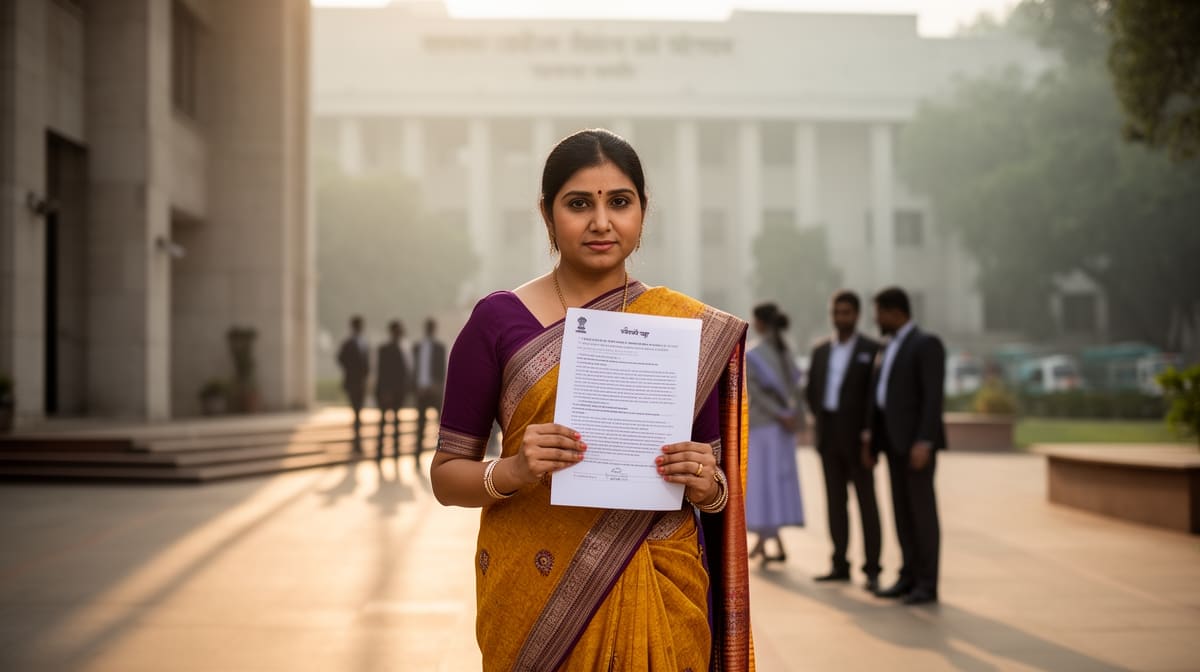
The Allahabad High Court has granted bail to a woman accused of murder under Section 302 IPC after she spent over six years in judicial custody with no conclusion in sight. The judgment underscores that prolonged trial delays, even in grave offences, can violate the fundamental right to speedy trial and justify bail, particularly when the accused is a woman with no prior criminal record.
Background & Facts
The Dispute
The applicant, Lalti Devi, is accused of strangulating her five-year-old daughter, born of her husband’s earlier marriage, in the absence of the first informant (her husband). The incident allegedly occurred in their household in Phoolpur, District Prayagraj. The FIR was lodged on 15.01.2020 under Section 302 IPC. The applicant has been in custody since the date of arrest.
Key Facts
- The alleged offence occurred on or before 15.01.2020, the date of FIR registration.
- There are no independent eye witnesses to the incident.
- The only incriminating material is the applicant’s alleged confession to the husband, who is the complainant.
- Fourteen witnesses were listed in the charge sheet, but as of the hearing, only six had been examined before the trial court.
- The applicant has no prior criminal history.
- She is a woman and has been in jail since 15.01.2020 - a period exceeding six years.
- The trial has progressed at an extremely slow pace, with no indication of imminent conclusion.
Procedural History
- 15.01.2020: FIR registered at Police Station Phoolpur, District Prayagraj, under Section 302 IPC.
- 15.01.2020: Applicant arrested and remanded to judicial custody.
- Ongoing since 2020: Trial proceedings in the Court of Sessions Judge, Prayagraj.
- As of 06.05.2026: Only 6 out of 14 witnesses examined; trial remains incomplete.
- 06.05.2026: Criminal Misc. Bail Application No. 14105 of 2026 filed before the Allahabad High Court.
Relief Sought
The applicant sought release on bail pending trial, citing: (i) excessive pre-trial detention exceeding six years; (ii) lack of corroborative evidence; (iii) absence of criminal antecedents; (iv) her gender; and (v) the mandate of Section 480 of the Bharatiya Nagarik Suraksha Sanhita, 2023 (BNSS), which mandates liberal bail for women.
The Legal Issue
The central question was whether prolonged pre-trial detention exceeding six years in a case with minimal evidentiary progress, coupled with the accused being a woman and having no criminal history, justifies the grant of bail under Section 480 BNSS and the constitutional right to speedy trial, despite the gravity of the offence under Section 302 IPC.
Arguments Presented
For the Appellant/Petitioner
Learned counsel for the applicant argued that:
- The trial has been unduly delayed, with only six of fourteen witnesses examined over six years, violating the applicant’s right to speedy trial under Article 21.
- The sole evidence against her is a confession to the husband, who is also the complainant, raising concerns about reliability and potential bias.
- There are no independent witnesses or forensic evidence linking her to the crime.
- She is a woman with no prior criminal record, and Section 480 BNSS mandates that bail should be granted to women unless exceptional circumstances exist.
- The Supreme Court in Sahil Manoj Machare v. State of Maharashtra (2026) held that undue delay in trial, even in serious offences, can be a ground for bail.
- Her continued incarceration in overcrowded jails is unjustified given the lack of prosecutorial progress.
For the Respondent/State
The Additional Government Advocate did not dispute any of the factual assertions made by the applicant. He did not contest the length of detention, the number of witnesses examined, or the absence of corroborative evidence. He opposed bail only on the general ground that the offence was heinous, without offering any specific rebuttal to the applicant’s legal submissions.
The Court's Analysis
The Court undertook a comprehensive review of the factual and legal landscape. It acknowledged the seriousness of the charge under Section 302 IPC, but emphasized that the gravity of the offence alone cannot override the constitutional guarantee of a speedy trial.
"The right to speedy trial is not a mere procedural formality but a fundamental right under Article 21, and its violation cannot be condoned merely because the charge is serious."
The Court relied on the Supreme Court’s decision in Kapil Wadhawan v. Central Bureau of Investigation (2025 SCC OnLine SC 3038), which held that excessive pre-trial detention without reasonable justification amounts to a denial of justice. It also referenced its own precedent in Maya Tiwari v. State of U.P. (2024 SCC Online All 6765), which reiterated that bail should be the rule, not the exception, especially for women.
The Court noted that Section 480 BNSS explicitly provides that "a woman accused of any offence shall be released on bail unless the court is satisfied that there are reasonable grounds for believing that she is likely to commit any offence while on bail or is likely to tamper with evidence." No such grounds were established here.
The Court further observed that the prosecution’s failure to examine more than half the witnesses over six years indicated a lack of prosecutorial diligence. The absence of independent evidence and the reliance on a confession to the complainant further weakened the case against the applicant.
The Court explicitly declined to express any opinion on the merits of the case, stating that its decision was based solely on the procedural and constitutional grounds of delay and gender-based bail entitlement.
The Verdict
The applicant, Lalti Devi, was granted bail. She must furnish a personal bond of Rs. 50,000 and two sureties each in the like amount, to the satisfaction of the trial court. She shall not tamper with evidence, threaten witnesses, or commit any further offence. She must attend all court proceedings without seeking adjournments. The trial court is directed to transmit the bail order via the Bail Order Management System (BOMS) within 24 hours of this order. The jail superintendent must receive a copy via e-prison portal within 24 hours. The applicant may be released on a computer-generated copy of this order, with a certified copy to be filed within 15 days.
What This Means For Similar Cases
Delay in Trial Can Override Gravity of Offence
- Practitioners may now invoke Kapil Wadhawan and Sahil Manoj Machare to argue for bail in serious cases where trial delay exceeds five years with minimal progress.
- Courts must now quantify prosecutorial inaction - failure to examine more than half the witnesses over six years is a critical factor.
Section 480 BNSS Mandates Liberal Bail for Women
- Section 480 BNSS is not discretionary; it creates a presumption in favor of bail for women unless exceptional circumstances are proven.
- Gender alone, combined with no criminal history, is sufficient to trigger this protection.
- Prosecutors must now affirmatively demonstrate why bail should be denied - silence is not enough.
Procedural Compliance Is Non-Negotiable
- Courts must ensure bail orders are transmitted via BOMS and e-prison portals within 24 hours, as mandated by Policy Strategy for Grant of Bail (2024) 10 SCC 685.
- Failure to comply with these directives may attract contempt proceedings.
- Computer-generated copies are now valid for immediate release, subject to filing certified copies within 15 days.