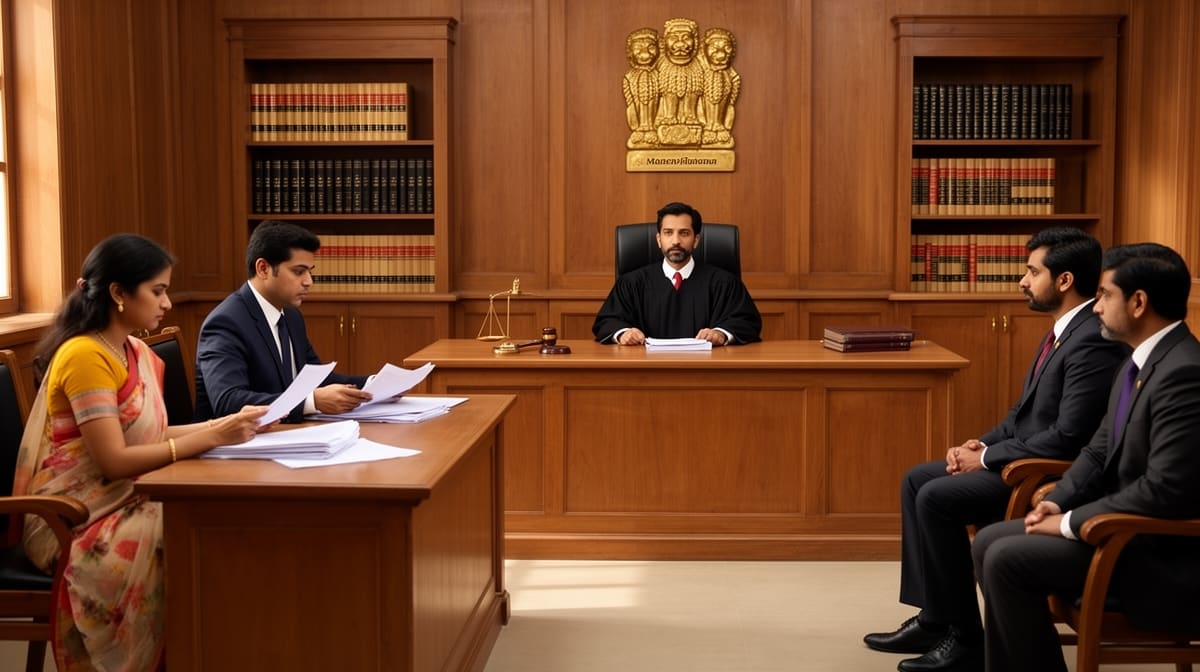
The Chhattisgarh High Court has clarified that maintenance under Section 144 of the Bharatiya Nagarik Suraksha Sanhita (BNSS) cannot be awarded based on speculative assumptions about a husband’s earning capacity. The judgment underscores the necessity of concrete evidence in determining financial liability, reinforcing the principle that judicial discretion must be anchored in documented facts, not conjecture.
Background & Facts
The Dispute
The applicant, an agriculturist, challenged the Family Court’s order granting his wife Rs.10,000 per month as maintenance under Section 144 of BNSS. The marriage, solemnized in June 2023, ended when the wife left the matrimonial home in March 2024 and refused to return despite repeated requests. She filed for maintenance, alleging neglect and harassment, while the husband contended that she was financially independent and had rejected a prior community settlement offering Rs.5,000 per month.
Procedural History
- March 2024: Respondent left matrimonial home and moved to parental residence
- 2025: Respondent filed application under Section 144 of BNSS for maintenance
- February 2026: Family Court granted Rs.10,000/month maintenance
- March 2026: Applicant filed criminal revision before Chhattisgarh High Court
Relief Sought
The applicant sought quashing of the maintenance order, arguing that the Family Court erred in presuming his income without documentary proof, ignoring his seasonal agricultural income, and failing to account for his obligation to maintain his aged mother.
The Legal Issue
The central question was whether Section 144 of BNSS permits a Family Court to fix maintenance based on presumed earning capacity in the absence of verified income records, bank statements, or tax returns, and whether the court must consider the wife’s own financial resources and the husband’s existing dependents.
Arguments Presented
For the Appellant
The applicant’s counsel argued that the Family Court violated the principle of proportionality in maintenance awards as laid down in Rajnesh v. Neha (2021) 2 SCC 324. He emphasized that no income proof - no salary slips, no bank statements, no agricultural yield records - was produced. The Court ignored the community settlement, the respondent’s post-graduation, her brother’s government employment, and her ownership of 27 acres of agricultural land. The applicant’s income was seasonal and insufficient to sustain Rs.10,000/month while also supporting his dependent mother.
For the Respondent
The respondent did not appear or file any written submission. The Court proceeded on the basis of the record and the Family Court’s findings.
The Court's Analysis
The High Court examined whether the Family Court’s reliance on "earning capacity" without concrete evidence was legally sustainable. It noted that while Section 144 of BNSS empowers courts to grant interim maintenance, such orders must be grounded in the actual financial reality of both parties.
"The learned Family Court observed that the exact income of the applicant was not proved, yet presumed his capacity to pay Rs.10,000 per month without recording any specific finding regarding willful neglect or refusal."
The Court held that the Family Court’s conclusion - that the applicant had "sufficient means" - was based on speculative inferences: ownership of land does not equate to liquid income; agricultural activity does not guarantee monthly earnings; and the absence of proof of the wife’s income does not automatically render her destitute. However, the Court found no jurisdictional error because the Family Court had considered the wife’s dependency on her family, the lack of rebuttal to her allegations of neglect, and the husband’s involvement in a family business. The amount, though high, was not manifestly excessive given the context.
The Court emphasized that while presumption of earning capacity is permissible under certain circumstances, it must be accompanied by a reasoned analysis of assets, liabilities, and lifestyle. Here, the Family Court’s reasoning, though imperfect, was not arbitrary.
The Verdict
The applicant’s revision was dismissed. The Court held that Section 144 of BNSS allows maintenance to be fixed based on a holistic assessment of circumstances, even in the absence of precise income records, provided the order is not arbitrary or grossly disproportionate. The Family Court’s discretion was upheld as reasonable.
What This Means For Similar Cases
Documentary Evidence Is Non-Negotiable
- Practitioners must insist on production of income tax returns, bank statements, and land revenue records before maintenance is fixed
- Oral assertions about income or assets are insufficient without corroboration
- Courts must record why documentary evidence was deemed unavailable or unreliable
Financial Capacity ≠ Ownership of Assets
- Land ownership or family business involvement does not automatically translate to monthly disposable income
- Seasonal income (e.g., agriculture) must be averaged over a reasonable period
- Courts must distinguish between asset value and cash flow
Burden of Proof Is Shared
- The wife must establish genuine need, especially if educated and from a well-off family
- The husband must substantiate financial constraints, including dependents
- Community settlements, if bona fide, must be weighed as evidence of conduct and intent