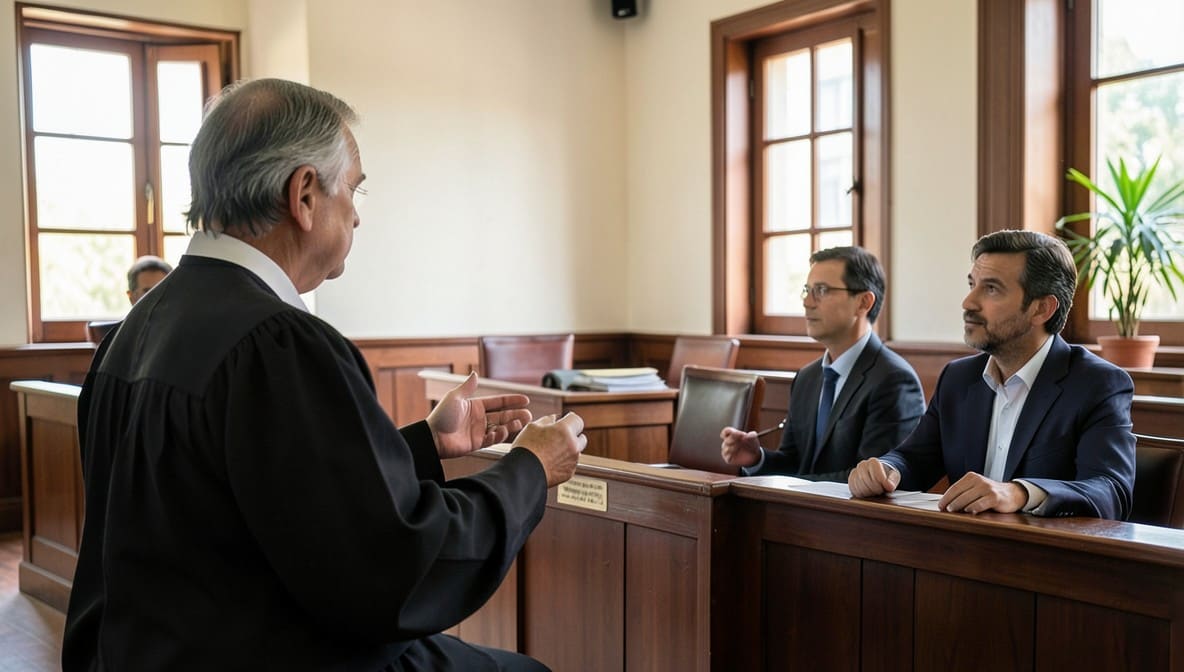
The Allahabad High Court has granted bail to two accused in a poisoning case under the Bharatiya Nyaya Sanhita, emphasizing the absence of incriminating evidence, the principle of parity with co-accused already released, and the non-requirement of custodial interrogation after charge sheet filing. This decision reinforces the judiciary’s caution against prolonged pre-trial detention in cases lacking substantive proof.
Background & Facts
The Dispute
The applicants, Smt. Mithlesh and Nawab, are accused in Crime No. 308 of 2025 under Sections 191(2), 115(2), and 103(1) of the Bharatiya Nyaya Sanhita (BNS), registered at Police Station Gangiri, District Aligarh. The case arises from the death of a man allegedly caused by ingestion of a poisonous substance administered by the applicants and other family members. The deceased was reportedly found unconscious at the residence of Shiv Dayal, and later died while being transported to a hospital. The FIR was filed by a relative who claimed to have audio and video recordings of the deceased during transit, but no such material was found in the case diary.
Key Facts
- The deceased was the husband of applicant no. 1, Smt. Mithlesh, and the brother of applicant no. 2, Nawab
- The allegation stems from a longstanding matrimonial dispute between Smt. Mithlesh and the deceased
- The FIR was based on suspicion, not eyewitness testimony or forensic evidence
- No audio or video recording mentioned in the FIR was recovered or produced
- The statement of Shiv Dayal, the only person present when the deceased was found unconscious, was not recorded
- The complainant submitted an affidavit to the Superintendent of Police stating that the names of the accused were included only on the basis of doubt
- Co-accused Yashpal and Smt. Maya Devi were granted bail by a coordinate Bench of this Court on 30.03.2026 in Criminal Misc. Bail Application No. 10562 of 2026
- The applicants have no prior criminal record
- The charge sheet was filed on 15.12.2025
- The applicants have been in custody since 21.11.2025
Procedural History
- 21.11.2025: Applicants arrested and taken into custody
- 15.12.2025: Charge sheet filed by police
- 05.03.2026: Criminal Misc. Bail Application No. 14136 of 2026 filed before the Allahabad High Court
- 06.05.2026: Hearing conducted before Hon’ble Justice Arun Kumar Singh Deshwal
The Parties' Positions
For the Applicants
- The applicants are innocent and falsely implicated due to a domestic dispute
- No incriminating material exists in the case file
- The complainant himself retracted the accusation in writing
- The co-accused have already been granted bail
- Custodial interrogation is no longer required as the charge sheet is filed
- The applicants are law-abiding citizens with no criminal antecedents
- Prolonged detention without substantial evidence violates the right to liberty under Article 21
For the Respondent
- The allegations are serious and involve potential homicide
- The case involves poisoning, which requires careful investigation
- The State did not dispute the factual submissions made by the applicants
- No counter-evidence was presented to challenge the applicants’ claims
Relief Sought
The applicants sought immediate release on bail pending trial, with conditions to ensure cooperation with the investigation and trial proceedings.
The Legal Issue
The central question was whether bail can be granted in a serious criminal case under the Bharatiya Nyaya Sanhita where there is no incriminating evidence, the charge sheet has been filed, co-accused have been released on bail, and the accused have no criminal history.
Arguments Presented
For the Appellant/Petitioner
Counsel for the applicants relied on the principle of parity, citing the earlier bail grant to co-accused Yashpal and Smt. Maya Devi. They emphasized the absence of any physical or digital evidence linking the applicants to the crime, the retraction of the complaint by the informant, and the non-recording of the sole eyewitness’s statement. They invoked Kapil Wadhawan v. Central Bureau of Investigation (2025 SCC OnLine SC 3038) to argue that bail should not be denied merely on the gravity of the offence, especially when custodial interrogation is no longer required. They also cited Maya Tiwari v. State of U.P. (2024 SCC Online All 6765) to underscore the High Court’s own guidelines favoring bail in cases lacking prima facie evidence.
For the Respondent/State
The Additional Government Advocate did not dispute any of the factual assertions made by the applicants. No counter-affidavit or evidence was filed to challenge the claim of false implication or the absence of incriminating material. The State’s opposition was general and lacked specific legal or factual rebuttal.
The Court's Analysis
The Court examined the nature of the allegations, the state of the evidence, and the procedural posture of the case. It noted that the FIR was based on suspicion and not on any tangible proof. The absence of the audio-video recording referenced in the FIR, the non-recording of the sole eyewitness’s statement, and the complainant’s subsequent affidavit admitting doubt in the accusation collectively undermined the prosecution’s case.
"The applicants have been languishing in custody since 21.11.2025 without any incriminating material being adduced against them, and the charge sheet has already been filed, rendering custodial interrogation unnecessary."
The Court emphasized that the principle of parity is a well-established facet of bail jurisprudence. Since two co-accused had already been released on bail on identical facts and under the same charges, denying bail to the applicants would amount to arbitrary discrimination. The Court further observed that the applicants have no criminal antecedents and are not likely to tamper with evidence or influence witnesses.
The Court also took judicial notice of the overcrowding of jails and the pendency of criminal trials, referencing the Supreme Court’s directive in In Re: Suo Motu Writ Petition (Crl.) No. 4 of 2021 to ensure prompt release of accused entitled to bail. The Court held that the applicants met the threshold for bail under the triple test - nature of accusation, likelihood of fleeing, and risk of tampering - none of which were substantiated.
The Verdict
The applicants succeeded. The Court granted bail to Smt. Mithlesh and Nawab on furnishing a personal bond of Rs. 50,000 each with two sureties of the like amount. The applicants must comply with conditions including no contact with witnesses, no criminal activity, full cooperation in trial, and verification of identity and Aadhaar details. The trial court is directed to transmit the bail order via the Bail Order Management System (BOMS) within 24 hours of receipt, and the High Court’s office must email the order to Aligarh Jail Superintendent within 24 hours. The applicants may be released on a computer-generated copy of this order, with a certified copy to be filed within 15 days.
What This Means For Similar Cases
Parity in Bail Grants Is Not Discretionary
- Practitioners must cite earlier bail grants to co-accused as binding precedent in similar factual matrices
- Courts cannot deny bail to one accused while granting it to others on identical charges without compelling justification
- Failure to apply parity may amount to violation of Article 14
Absence of Evidence Trumps Allegation in Bail Decisions
- In cases where the charge sheet is filed but no incriminating material exists, bail should be the norm, not the exception
- Reliance on suspicion, hearsay, or uncorroborated FIRs is insufficient to deny liberty
- Retractions by complainants must be weighed heavily in bail hearings
Procedural Compliance Ensures Timely Release
- Courts must direct use of BOMS and e-prison portals to prevent avoidable delays in release
- Jail authorities are bound to act on computer-generated orders pending certified copies
- Failure to comply with e-communication directives may attract contempt proceedings