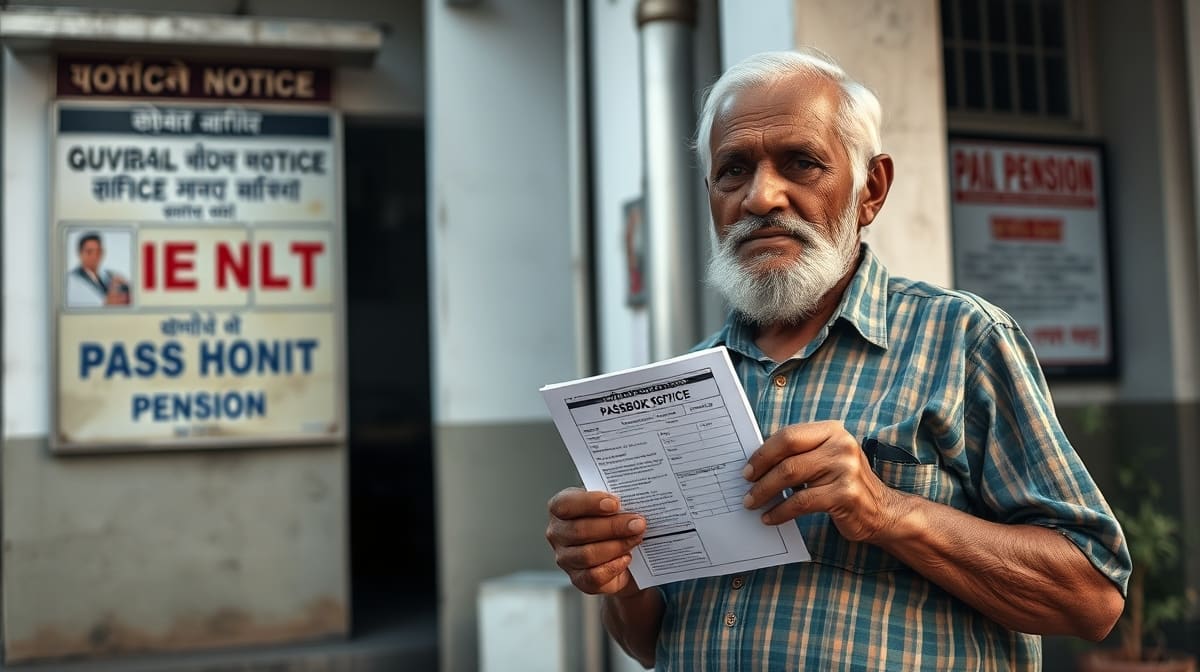
The Punjab and Haryana High Court has reaffirmed that executive instructions cannot override statutory pensionary entitlements, quashing a government circular that withheld Old Age Allowance and Travel Concession from retired officials pending departmental or judicial proceedings. The judgment underscores the constitutional protection of pension as property under Article 300A and establishes that such benefits, once granted by rule, cannot be curtailed without explicit statutory backing.
Background & Facts
The Dispute
The petitioners, retired employees of the Punjab State Warehousing Corporation (PSWC), were denied Old Age Allowance and Travel Concession under a circular dated 22.12.2022 issued by the Punjab Finance Department. The circular directed that these benefits be withheld from retired officials against whom departmental or judicial proceedings were pending and who were drawing provisional pension. The petitioners contended that these benefits were part of their statutory entitlements under the Punjab Civil Services Rules (CSR), which the PSWC had expressly adopted as "at par" with State Government employees.
Key Facts
- The PSWC introduced a Pension & Gratuity Scheme effective 01.01.1986 via notification dated 24.04.1996 (Annexure R-2/1), explicitly stating that pension and allied benefits including LTC and medical facilities would be "at par" with State Government employees.
- The State Government, by letter dated 31.08.1989 (Annexure P-1), granted Travel Concession equal to one month’s basic pension after every two-year block to pensioners.
- Rule 6.18 of Punjab CSR Vol. II (Annexure P-2) provides for Old Age Allowance as an "additional pension" payable on a graduated scale from age 65 onwards, ranging from 5% to 100% of basic pension.
- The petitioners retired between 2015 and 2022 and were receiving 100% provisional pension as mandated under Rule 2.2(c)(1) and Rule 9.14 of the CSR.
- Despite receiving full provisional pension, their Old Age Allowance and Travel Concession were stopped under the impugned circular dated 22.12.2022 (Annexure P-4).
- No statutory amendment to the Punjab CSR had been made to authorize withholding of these specific benefits.
Procedural History
- 24.04.1996: PSWC issues Pension & Gratuity Scheme notification adopting State Government benefits "at par".
- 31.08.1989: State Government issues letter granting Travel Concession to pensioners.
- 22.12.2022: Finance Department issues circular withholding Old Age Allowance and Travel Concession from retirees with pending proceedings.
- 28.01.2026: Writ petition heard and reserved.
- 06.04.2026: Judgment pronounced by Justice Harpreet Singh Brar.
The Parties' Positions
For the Petitioners
The petitioners, retired PSWC employees, argued that:
- Old Age Allowance is statutorily defined as "additional pension" under Rule 6.18 of Punjab CSR Vol. II.
- Travel Concession is a long-standing benefit granted by State Government circular and incorporated into the PSWC scheme.
- The impugned circular is an executive instruction lacking statutory sanction.
- Withholding these benefits violates Article 14 and Article 16 by creating an arbitrary classification between retirees with and without pending proceedings.
- Since provisional pension is paid at 100%, denying additional components reduces the effective pension below statutory entitlement.
For the Respondent
The State, represented by the Additional Advocate General, contended that:
- The PSWC’s pension scheme is "at par" with State Government rules, and therefore, any subsequent instructions issued by the State apply equally.
- The circular is a reasonable administrative measure to prevent misuse of benefits during pending proceedings.
- The State has the right to safeguard public funds and ensure discipline even post-retirement.
Relief Sought
The petitioners sought:
- Quashing of the circular dated 22.12.2022.
- Immediate release of all withheld Old Age Allowance and Travel Concession dues.
- Payment of arrears from the date of withholding.
- A direction that the judgment apply to all similarly situated retirees, whether or not they are parties to the petition.
The Legal Issue
The central question was whether executive instructions can lawfully withhold Old Age Allowance and Travel Concession from retired government employees who are drawing 100% provisional pension, in the absence of any statutory provision under the Punjab Civil Services Rules authorizing such withholding.
Arguments Presented
For the Petitioner
The petitioners relied on Dr. Hira Lal v. State of Bihar (2020(2) SCT 200) and Dr. Ishar Singh v. State of Punjab (1994(1) SCT 563) to argue that pension and its components are statutory rights protected under Article 300A. They emphasized that Rule 6.18 explicitly classifies Old Age Allowance as "additional pension," making it inseparable from the core pension entitlement. They further cited State of U.P. v. Babu Ram Upadhyaya (AIR 1961 SC 751) to assert that administrative instructions cannot amend or override statutory rules. The petitioners argued that since the CSR explicitly permits withholding of gratuity and leave encashment under Rules 2.2(c)(1), 9.14, and 8.21(aa), but is silent on Old Age Allowance and Travel Concession, their denial is ultra vires.
For the Respondent
The State contended that the PSWC’s adoption of State Government benefits meant that all subsequent administrative instructions issued by the State applied automatically. It argued that the circular was a prudent measure to prevent potential misuse of benefits during pending proceedings and that the State’s interest in financial discipline justified the restriction. However, the State could not point to any statutory provision in the Punjab CSR that authorized the withholding of these specific benefits.
The Court's Analysis
The Court undertook a rigorous analysis of the statutory framework governing pensionary benefits under the Punjab Civil Services Rules. It noted that Rule 6.18 defines Old Age Allowance as "additional pension," thereby integrating it into the pension structure itself. The Court held that this classification is not merely administrative but substantive, making it a component of the pensioner’s accrued right.
"The power to withhold pension or gratuity can be invoked only when the proceedings are concluded finding guilty and not before... There is no provision in the rules for withholding of the pension/gratuity when such departmental proceedings or judicial proceedings are still pending."
The Court relied on Dr. Hira Lal v. State of Bihar, where the Supreme Court held that executive instructions cannot override statutory rules and that pension is "property" under Article 300A. The Court emphasized that while the State may withhold gratuity and leave encashment under specific statutory provisions, it cannot create new grounds for withholding benefits by mere circular. The absence of any enabling provision for Old Age Allowance and Travel Concession rendered the circular legally invalid.
The Court also examined Dr. Ishar Singh v. State of Punjab, which held that pension rules must be construed liberally in favor of retirees to secure social security. The Court observed that the State’s interest in discipline is already protected through its power to withhold gratuity and leave encashment. Extending such restrictions to Old Age Allowance and Travel Concession, which are not subject to any statutory condition, would amount to punishment without trial.
The Court further clarified that the PSWC’s adoption of State Government benefits was not a blank endorsement of all future instructions, but a commitment to parity with rules in force at the time and as amended by law. Since no amendment to the CSR authorized the withholding of these benefits, the circular was ultra vires.
The Verdict
The petition succeeded. The Court quashed the circular dated 22.12.2022 and directed the respondents to release all pending dues of Old Age Allowance and Travel Concession to the petitioners and all other similarly situated retired employees within six weeks of receipt of a certified copy of the order. The judgment was declared a judgment in rem, binding on all similarly placed retirees regardless of whether they were parties to the petition. The Court did not award monetary compensation for arrears, but mandated full payment of the withheld benefits from the date of withholding.
What This Means For Similar Cases
Pension Components Cannot Be Arbitrarily Withheld
- Practitioners must now argue that any benefit classified as part of pension under statutory rules - including allowances, increments, or supplements - cannot be suspended by administrative order.
- Where a benefit is defined as "additional pension" or "integral to pension" in the rules, its denial during pending proceedings is unconstitutional.
Statutory Silence = No Power to Withhold
- The absence of a specific provision in the CSR to withhold a benefit means the State has no authority to do so, even if it has such power for other benefits.
- This principle applies across all State services: if gratuity can be withheld under Rule 9.14 but medical allowance cannot, the latter cannot be stopped by circular.
Executive Instructions Are Not Law
-
Government departments cannot use internal circulars to create new conditions for payment of statutory entitlements.
-
Any attempt to withhold pensionary benefits without statutory backing is liable to be struck down under Article 300A and the doctrine of ultra vires.
-
Always check the statutory definition of a benefit before challenging its withholding.
-
If a benefit is labeled as part of pension in the rules, treat its denial as a constitutional violation, not merely a service dispute.
-
Cite Dr. Hira Lal and Dr. Ishar Singh as binding authority in all pension-related writ petitions.