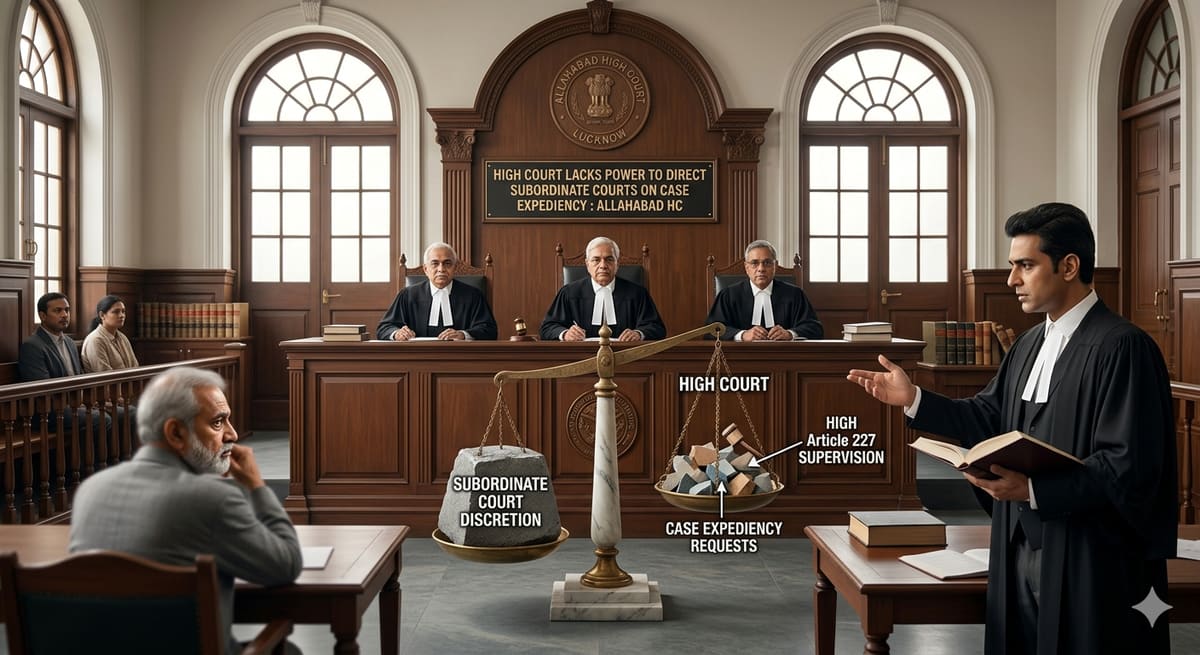
The Allahabad High Court has reiterated that the availability of a statutory appeal under the Civil Procedure Code (CPC) precludes the invocation of Article 227 of the Constitution, even in cases of alleged urgency or ex-facie illegality. This judgment underscores the primacy of statutory remedies over constitutional supervisory jurisdiction when alternative redressal mechanisms exist.
Background & Facts
The Dispute
The petitioners, Shri Shivji Maharaj Virajman Mandir Pakka Talab and others, filed an application (6-C) in Original Suit No. 581 of 2023 before the Civil Judge (Senior Division), Firozabad, seeking injunctive relief. The trial court partly allowed and partly rejected the application by order dated 30.05.2026, prompting the petitioners to approach the High Court under Article 227 of the Constitution.
Key Facts
- The petitioners sought injunction relief in a pending civil suit (OS No. 581/2023)
- The trial court’s order dated 30.05.2026 partly allowed and partly rejected the injunction application
- The petitioners alleged ex-facie illegality and misapplication of Section 11 CPC (res judicata) in the impugned order
- The matter was claimed to be urgent, warranting bypass of the statutory appeal process
Procedural History
- Original Suit No. 581/2023: Filed before the Civil Judge (S.D.), Firozabad
- 30.05.2026: Trial court passed order on application 6-C, partly allowing and partly rejecting injunction
- 02.06.2026: Petition under Article 227 filed before the Allahabad High Court
- 05.06.2026: Petition listed before the Court on mention, accepted by the Senior Vacation Judge
The Parties' Positions
For the Petitioners
- Argued that the impugned order was ex-facie illegal and misapplied Section 11 CPC (res judicata)
- Contended that the matter was urgent, justifying bypass of the statutory appeal process
- Submitted that filing an appeal would be cumbersome and delay relief
For the Respondents
- No formal submissions recorded, as the Court disposed of the petition on maintainability grounds
Relief Sought
The petitioners sought:
- Quashing of the trial court’s order dated 30.05.2026 to the extent it rejected the injunction
- Grant of injunctive relief under Article 227 of the Constitution
The Legal Issue
The central question was whether a petition under Article 227 of the Constitution is maintainable when a statutory appeal lies under Section 104 read with Order XLIII Rule 1(r) CPC, particularly in cases of alleged urgency or ex-facie illegality.
Arguments Presented
For the Petitioner
- Relied on the extraordinary constitutional powers under Article 227 to challenge the impugned order, arguing it was ex-facie illegal
- Contended that Section 11 CPC (res judicata) was wrongly invoked in the facts of the case
- Submitted that the matter was urgent, warranting immediate intervention by the High Court
- Argued that filing an appeal would be cumbersome and delay relief
For the Respondent
- No counter-arguments were presented, as the Court disposed of the petition on maintainability grounds
The Court's Analysis
The Court observed that the petitioners sought to bypass the statutory remedy of appeal under Section 104 read with Order XLIII Rule 1(r) CPC on the ground of urgency. The Court held that urgency alone cannot justify overriding statutory remedies, as this would set a precedent where every aggrieved party could approach the High Court directly, undermining the appellate hierarchy.
"Merely because the matter is urgent, the same is no ground to by-pass the remedy of appeal provided under CPC, otherwise, in every case, where injunction application is decided eitherway, the party aggrieved would approach this Court by-passing the appellate jurisdiction which may lie before the District Judge or before this Court depending upon facts of the case."
The Court further noted that Rule 13 of the General Rules (Civil), 1957 provides for urgent matters to be taken up during summer vacations, ensuring that statutory remedies are not unduly delayed. Thus, the petitioners were not without recourse even in cases of urgency.
The Court also rejected the argument that the impugned order was ex-facie illegal, holding that such a determination would require a substantive examination of the merits, which is beyond the scope of Article 227 when a statutory appeal is available.
The Verdict
The High Court disposed of the petition as not maintainable, with liberty to the petitioners to file a statutory appeal before the District Judge, Firozabad, along with an application under Rule 13 of the General Rules (Civil), 1957. The Court directed the District Judge to take up the matter during the summer vacations itself, ensuring timely adjudication.
What This Means For Similar Cases
Primacy of Statutory Remedies Over Article 227
- Article 227 cannot be invoked to bypass statutory appeals under the CPC, even in cases of alleged urgency or ex-facie illegality
- Practitioners must exhaust statutory remedies before approaching the High Court under Article 227, unless exceptional circumstances exist
Urgency Does Not Justify Bypassing Appellate Hierarchy
- Rule 13 of the General Rules (Civil), 1957 ensures that urgent matters can be heard during vacations, negating the argument of delay
- Courts will not entertain Article 227 petitions merely on grounds of urgency if a statutory appeal lies
Ex-Facie Illegality Must Be Substantiated
- Allegations of ex-facie illegality must be backed by clear legal errors visible on the face of the record
- Mere dissatisfaction with the trial court’s order is insufficient to invoke Article 227 when a statutory appeal is available