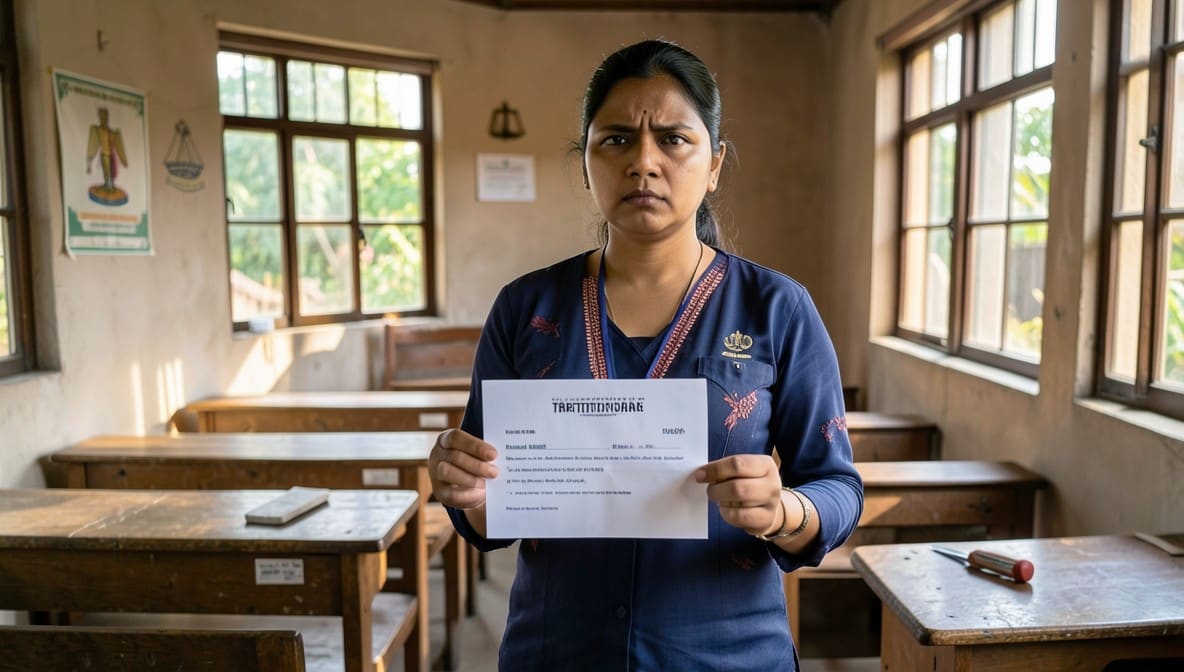
The Bombay High Court has affirmed that teachers absorbed into state-run schools after the closure of a centrally sponsored scheme for disabled children cannot be arbitrarily reclassified as untrained merely due to administrative transition. The judgment upholds the principle that prior training, experience, and qualifications must be recognized, and continuity of service must be preserved under Article 14 of the Constitution.
Background & Facts
The Dispute
The petitioners, five teachers employed under the Central Government’s Integrated Education for Disabled Children (IEDC) Scheme, were rendered surplus when the scheme was discontinued on 31.03.2009. They were subsequently absorbed into primary schools managed by local bodies such as Municipal Corporations and Zilla Parishads, but under conditions that denied them their prior service benefits, pay scale, and seniority.
Key Facts
- Petitioner No.1 completed a Diploma for Primary School Teachers for Visually Handicapped from Pune (1998) and graduated in Arts from Pune University (1998). She was registered with the Rehabilitation Council of India.
- Petitioner No.2 completed a similar diploma from the National Institute for the Visually Handicapped, Dehradun (1989), and graduated in Arts from Pune University (1989). He was also registered with the Rehabilitation Council of India.
- Petitioner No.3 completed her Higher Secondary Certificate from Kolhapur Board and a Special Diploma for Primary School Teachers for Visually Handicapped from Dehradun (1989), and was registered with the Rehabilitation Council of India.
- All three petitioners were employed as Research Teachers in 100% grant-in-aid schools under the IEDC Scheme from the late 1980s to March 2009.
- The IEDC Scheme, implemented nationwide from 1986, was funded entirely by the Central Government and operated in 595 units across Maharashtra until its termination on 31.03.2009.
- On 15.09.2010, the State issued a Government Resolution (Exh. H) directing the absorption of all 595 surplus teachers into local body schools, but with three restrictive conditions:
- Denial of continuity of service prior to absorption
- Placement in the lower pay scale of untrained teachers (Rs. 5200-20200 + Grade Pay 2000)
- Requirement to acquire a fresh Diploma in Education (D.Ed.) to be recognized as trained
- Petitioners No.1 and 2 received absorption orders dated 17.03.2011, directing them to join as untrained teachers and recover all salaries paid from 01.04.2009 to 17.03.2011.
- Petitioner No.3 was absorbed on 27.05.2011 under identical conditions by Zilla Parishad, Kolhapur.
- The Rehabilitation Council of India had recognized the petitioners’ diplomas as equivalent to D.Ed. under its statutory mandate.
- The petitioners had served continuously for over 19 years without break, performing identical duties before and after absorption.
Procedural History
- 31.03.2009: IEDC Scheme terminated by Union Government.
- 15.09.2010: State issues Government Resolution (Exh. H) outlining absorption conditions.
- 17.03.2011: Absorption orders issued to Petitioners No.1 and 2.
- 27.05.2011: Absorption order issued to Petitioner No.3.
- 2011-2013: Multiple writ petitions filed in Bombay High Court challenging similar absorption conditions.
- 09.04.2013: Division Bench in Jahida Mohd. Shaikh v. State of Maharashtra (WP No. 1855 of 2013) held that teachers with special diplomas must be treated as trained.
- 22.08.2023: Division Bench in Chitra Nitin Pendharkar v. State of Maharashtra (WP No. 507 of 2011) reiterated that denial of trained status and continuity violates Article 14.
- 18.05.2026: Present petition heard and decided by Division Bench.
The Parties' Positions
For the Petitioners: Argued that their diplomas, recognized by the Rehabilitation Council of India, are equivalent to D.Ed. and qualify them as trained teachers. Their continuous service since the 1980s entitles them to seniority from date of initial appointment, pay scale of trained teachers, and old pension benefits. The recovery of salaries and denial of continuity are arbitrary and violate Article 14 and the Maharashtra Employees of Private Schools (Conditions of Service) Rules, 1981.
For the Respondent-State: Contended that absorption into local body schools required compliance with state norms, which classify teachers without D.Ed. as untrained. The recovery of salaries paid during the interim period was justified as the petitioners were not formally appointed under state rules until absorption.
Relief Sought
The petitioners sought:
- Quashing of Government Resolution dated 15.09.2010 to the extent it denied continuity, trained status, and higher pay scale.
- Direction to deposit arrears of Sixth Pay Commission installments into provident fund accounts with interest.
- Cessation of recovery of salaries paid from 01.04.2009 to date of absorption.
- Payment of salary in the pay scale of trained teachers from date of absorption.
- Payment of salary differential from date of absorption until 31.12.2012.
- Recognition of higher pay scale upon completion of 12 years of service.
The Legal Issue
The central question was whether teachers with diplomas in special education, recognized by the Rehabilitation Council of India and employed continuously since before 2009, can be lawfully classified as "untrained" upon absorption into state-run schools, thereby denying them continuity of service, seniority, and the pay scale of trained teachers under Article 14 of the Constitution.
Arguments Presented
For the Petitioner
Counsel relied on Chitra Nitin Pendharkar v. State of Maharashtra (22.08.2023) and Sangita Maruti Pund v. State of Maharashtra (21.11.2012), where the Court held that special education diplomas recognized by the Rehabilitation Council of India are equivalent to D.Ed. and qualify teachers as trained. The petitioners had over 19 years of uninterrupted service, performed identical duties, and possessed higher qualifications including B.Ed. and M.A. The State’s attempt to demote them based on administrative transition was arbitrary and violated the principle of equal protection under Article 14. The Maharashtra Employees of Private Schools Rules, 1981, contemplate absorption without loss of status.
For the Respondent
The State argued that absorption into local body schools required compliance with state norms, which mandate D.Ed. for trained teacher status. The petitioners were not appointed under state rules prior to 2011 and thus were not entitled to the same pay scale. Recovery of salaries paid during the interim period was necessary to prevent unjust enrichment.
The Court's Analysis
The Court found the State’s position legally untenable. It emphasized that the petitioners were not merely hired under a temporary scheme - they were qualified, experienced educators who had served continuously for nearly two decades. The Rehabilitation Council of India, a statutory body under the Ministry of Social Justice, had explicitly recognized their diplomas as equivalent to D.Ed. The Court observed:
"An untrained teacher may become a trained teacher, but it is inconceivable that a teacher trained in one discipline or field can ever become 'untrained' - only on account of absorption under a particular scheme."
The Court distinguished the State’s reliance on administrative convenience from the constitutional obligation to recognize merit and continuity. It noted that the petitioners performed the same duties before and after absorption, with no reduction in responsibility or skill requirement. The denial of seniority from the date of initial appointment and the demand to recover salaries paid during the interim period were held to be punitive and without legal basis.
The Court further held that the State’s failure to define what constituted "training" beyond a formal D.Ed. certificate rendered its classification arbitrary. The petitioners’ qualifications, experience, and statutory recognition rendered them trained teachers by any objective standard.
The Verdict
The petition succeeded. The Court set aside the Government Resolution dated 15.09.2010 to the extent it denied trained status, continuity of service, and higher pay scale. The petitioners are directed to be treated as trained teachers from the date of their initial appointment. Their seniority is to be reckoned from the date of their original engagement under the IEDC Scheme. The State must release arrears of salary in the pay scale of trained teachers from 01.04.2009 until date of absorption, and pay the differential salary from date of absorption until 31.12.2012. Petitioner No.1 is entitled to the higher pay scale upon completion of 12 years of service. Recovery of salaries paid from 01.04.2009 to 17.03.2011 is prohibited. The State must deposit Sixth Pay Commission arrears into provident fund accounts with interest within four weeks.
What This Means For Similar Cases
Absorption Does Not Erase Prior Qualifications
- Practitioners representing absorbed teachers must argue that statutory recognition of special education diplomas by the Rehabilitation Council of India supersedes state-level D.Ed. mandates.
- Any attempt to reclassify qualified teachers as "untrained" post-absorption is void under Article 14.
Continuity of Service Is Preserved
- Service under centrally funded schemes qualifies as continuous service for pension, seniority, and pay scale purposes if duties remain unchanged.
- The burden shifts to the State to prove a legitimate reason for breaking continuity - mere administrative transition is insufficient.
Pay Scale Must Reflect Actual Qualifications
-
Teachers with recognized diplomas in special education are entitled to the pay scale of trained teachers, even if they lack a conventional D.Ed. certificate.
-
Denial of higher pay scale based on bureaucratic classification, rather than actual competence, is unconstitutional.
-
Always cite Chitra Nitin Pendharkar v. State of Maharashtra and Sangita Maruti Pund v. State of Maharashtra as binding precedents.
-
File applications for seniority revision and pension recalibration immediately upon judgment.
-
Challenge recovery notices for salaries paid during interim periods as illegal and violative of Article 14.