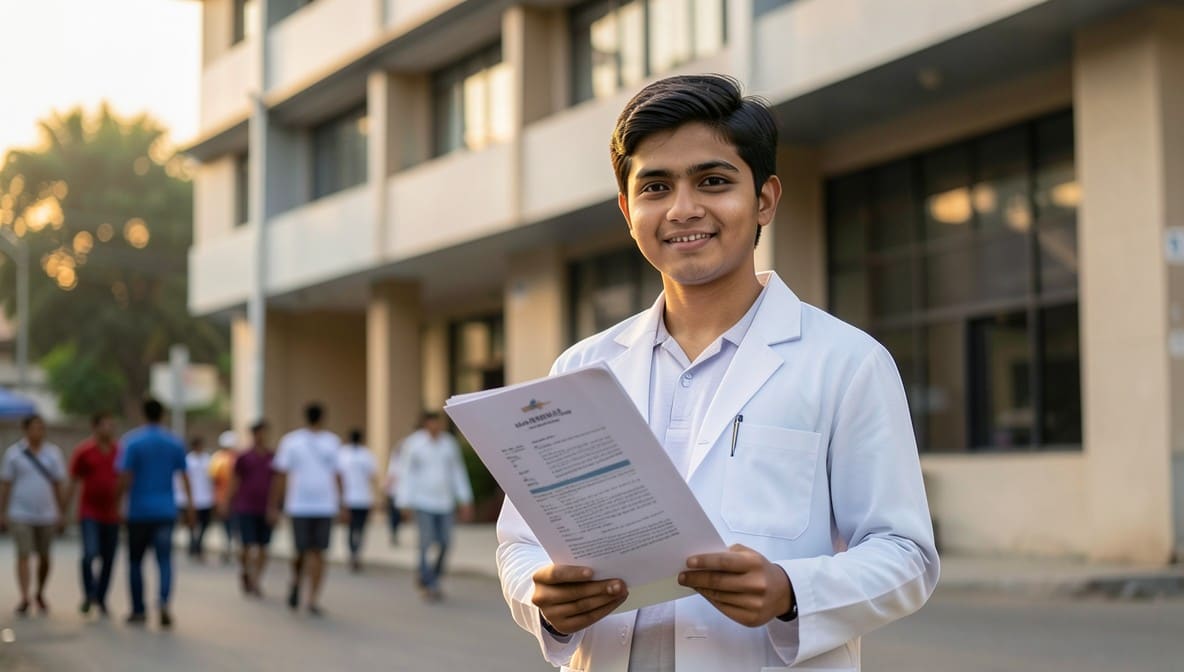
The Madhya Pradesh High Court has affirmed that medical graduates who have cleared their postgraduate studies and qualified for super specialty courses cannot be denied their original academic documents by private colleges on the basis of arbitrary bond conditions. This ruling ensures that procedural barriers do not obstruct access to higher medical education, reinforcing constitutional guarantees of equality and reasonable procedure.
Background & Facts
The Dispute
The petitioners, Dr. Fulbaria Vrajesh Vithalbhai and other medical graduates, completed their postgraduate medical studies at a private medical college in Madhya Pradesh and successfully qualified for the NEET-SS 2025 examination, the national entrance test for super specialty medical courses. The results were declared in January 2026, making them eligible for admission. However, the private medical college withheld their original academic documents - including mark sheets, degree certificates, and internship completion records - citing a bond agreement requiring a bank guarantee of ₹10,00,000 for release.
The petitioners contend that this demand is unlawful, as the 2017 Rules permitting such financial guarantees apply only to government medical colleges and not to private institutions. They argue that the college’s refusal to return documents is arbitrary, discriminatory, and violates their right to pursue higher education under Article 14 of the Constitution.
Key Facts
- The petitioners completed their postgraduate medical course and were declared passed by the private medical college.
- They appeared for and qualified NEET-SS 2025, with results declared in January 2026.
- Admission counselling for super specialty courses is scheduled to commence shortly.
- The private college is demanding a bank guarantee of ₹10,00,000 for release of original documents.
- The petitioners have not yet completed their mandatory rural service (SR) period, which is a condition under the bond agreement.
- The State Government’s 2017 Rules on bond conditions apply only to government medical colleges, not private ones.
- On 25.02.2020, the Director of Medical Education issued an order relaxing the bank guarantee requirement for MBBS graduates seeking postgraduate admission.
Procedural History
- January 2026: NEET-SS 2025 results declared; petitioners qualified for super specialty admission.
- February 2026: Petitioners requested release of original documents from the private college; request denied.
- March 2026: Writ Petition No. 9252 of 2026 filed before the High Court of Madhya Pradesh at Jabalpur.
- 18.03.2026: Hearing conducted; parties consented to final disposal.
The Parties' Positions
For the Petitioners: The withholding of documents is arbitrary and violates Article 14. The 2020 relaxation for MBBS graduates should extend by analogy to PG graduates seeking super specialty admission. The bond condition is unenforceable against private institutions under the 2017 Rules.
For the Respondent State: The petitioners are bound by the bond agreement signed at the time of admission to the PG course. Release of documents is contingent upon completion of rural service or deposit of the bond amount. The college is merely enforcing contractual obligations.
Relief Sought
The petitioners sought a direction to the private medical college to immediately release all original academic documents without requiring a bank guarantee, and to refrain from imposing any unlawful conditions for document return.
The Legal Issue
The central question was whether a private medical college can lawfully withhold original academic documents from postgraduate medical graduates seeking admission to super specialty courses, solely on the basis of a bond condition requiring a bank guarantee, when such a condition is not mandated by applicable rules and is inconsistent with prior judicial directions.
Arguments Presented
For the Petitioner
Learned counsel for the petitioners relied on the High Court’s own order dated 28.11.2025 in Dr. Annu Raghuwanshi & Others v. State of Madhya Pradesh & Others (WP No. 46644/2025), which directed all government and private medical colleges to return original documents to MBBS graduates upon production of PG admission letters and affidavits regarding future rural service compliance. The counsel argued that the petitioners, having completed PG and now seeking super specialty admission, are identically placed and entitled to the same relief. Further, reliance was placed on the Supreme Court’s decision in Shyam Chandran v. State of Himachal Pradesh (Civil Appeal No. 562/2026, decided on 28.01.2026), which upheld the principle that educational rights cannot be obstructed by arbitrary financial demands.
For the Respondent
The Additional Advocate General for the State acknowledged the existence of the bond agreement but did not contest the applicability of the Raghuwanshi precedent. The State conceded that the 2017 Rules do not extend the bank guarantee requirement to private institutions and that the 2020 relaxation for MBBS graduates logically applies by analogy to PG graduates. The State did not oppose the petitioners’ request for document release.
The Court's Analysis
The Court observed that the petitioners have fulfilled all academic requirements for super specialty admission and are now at the threshold of the next stage of their medical education. The withholding of original documents by the private college serves no legitimate public interest and impedes their constitutional right to pursue higher education.
"The principle laid down in WP No. 46644/2025 applies mutatis mutandis to all students who have cleared the Post-Graduation Course and are going to take admission in the Super Specialty Course."
The Court noted that the 2020 relaxation order issued by the Director of Medical Education, which removed the bank guarantee requirement for MBBS graduates, was based on the recognition that academic progression must not be stalled by procedural impediments. Extending this principle to PG graduates seeking super specialty admission is not only logical but necessary to ensure uniformity and fairness.
The Court further held that while the petitioners remain obligated to complete their rural service or deposit the bond amount, this obligation cannot be enforced by withholding documents essential for admission. The bond remains enforceable through other means, including post-dated cheques or undertakings, but not by denying access to academic records.
The Court also emphasized that the Supreme Court’s recent affirmation in Shyam Chandran reinforces the constitutional imperative that educational institutions, whether public or private, cannot impose arbitrary conditions that obstruct academic mobility.
The Verdict
The writ petition is allowed. The private medical college is directed to release all original academic documents to the petitioners within two days of production of their super specialty admission counselling allotment letter and a sworn affidavit regarding their commitment to complete the remaining rural service period after obtaining the super specialty degree. The petitioners shall submit an undated cheque for the bond amount to the college and disclose their bond obligation in writing. The original documents shall be re-deposited with the super specialty institution upon admission and shall be released only after completion of the rural service period. The college shall forward the undated cheque and one photocopy of the documents to the Director of Medical Education.
What This Means For Similar Cases
Document Release Cannot Be Tied to Financial Guarantees
- Private medical colleges cannot impose bank guarantees or cash deposits as a precondition for releasing original academic documents.
- The 2020 relaxation for MBBS graduates applies by analogy to all subsequent stages of medical education, including super specialty admission.
- Institutions must distinguish between enforcing contractual obligations and obstructing educational progression.
Judicial Precedents Create Uniform Standards
- The Raghuwanshi precedent now binds all medical colleges in Madhya Pradesh, whether government or private, for all levels of medical education.
- Courts will apply the same reasoning to similar cases involving postgraduate and super specialty admissions across India.
- Any institution refusing compliance may face contempt proceedings.
Bond Enforcement Must Be Proportionate
- Bond obligations remain valid but must be enforced through non-disruptive means: post-dated cheques, affidavits, or direct recovery mechanisms.
- Withholding documents is disproportionate and violates the right to education under Article 21A and Article 14.
- Practitioners should cite this judgment to challenge similar document withholding in other states.