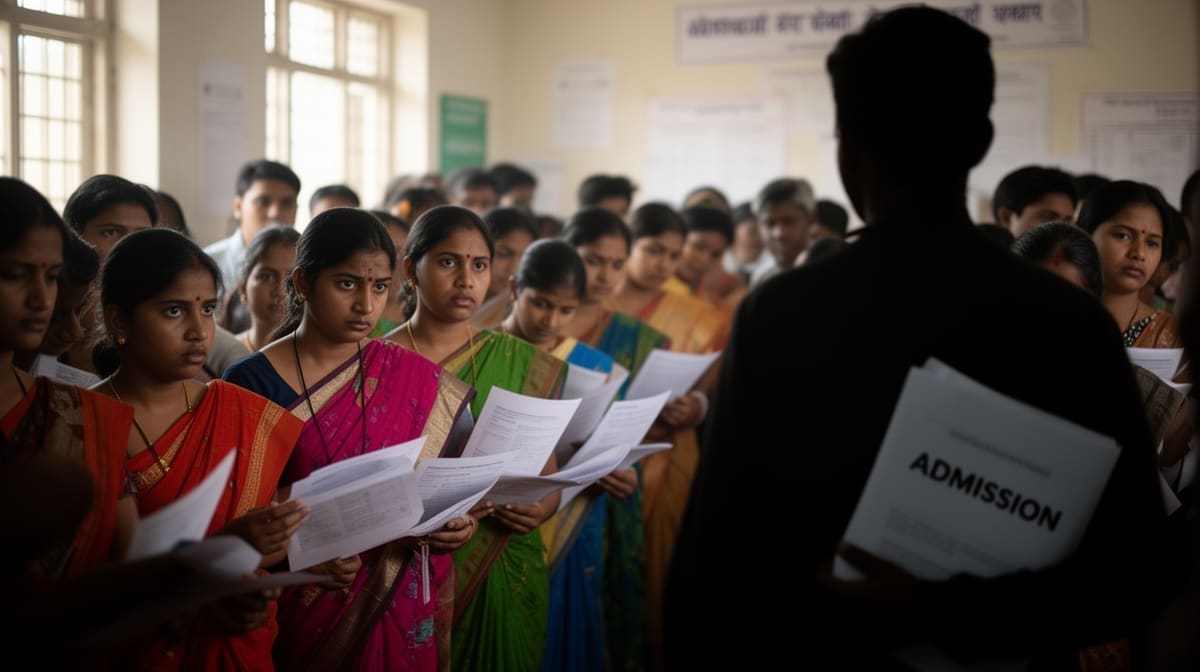
The Rajasthan High Court has delivered a stern rebuke to those exploiting India’s competitive education system through organized fraud, denying anticipatory bail to two key accused in a multi-crore scam involving forged mark sheets, bribes, and systemic collusion with university officials. The judgment underscores that gravity of offense, scale of deception, and threat to public trust in merit-based admissions override personal hardship in bail considerations.
Background & Facts
The Dispute
The case revolves around a large-scale, organized racket operating between 2016 and 2025, wherein candidates for competitive entrance examinations - particularly in medical, engineering, and teaching services - were fraudulently admitted through forged mark sheets, manipulated results, and bribes. The accused, Ajay Bhardwaj and Sangeeta Kadwasara, are alleged to have functioned as central nodes in a syndicate that supplied fake documents to thousands of students across multiple states.
Procedural History
- 2023 - 2025: Multiple FIRs registered under Sections 420, 467, 468, 471, 120-B IPC and Section 66M of the IT Act across Rajasthan and Uttar Pradesh.
- 2024: First Information Report (FIR No. 13/2024) filed by Rajasthan Police after digital evidence uncovered a network of fake certificates.
- 2025: Petitioners applied for anticipatory bail; applications were heard together due to interconnected facts.
- 2026: High Court reserved judgment on February 24 and pronounced it on March 9, 2026.
Relief Sought
The petitioners sought anticipatory bail under Section 438 CrPC, arguing they were not directly involved in document fabrication, had no name in the FIR, and were being unfairly targeted. They emphasized their cooperation with investigation and lack of prior criminal record.
The Legal Issue
The central question was whether anticipatory bail can be granted to individuals accused of orchestrating a large-scale, systematic fraud in entrance examinations, where the offense involves criminal conspiracy, forgery of official documents, and massive financial gain at the cost of public merit, despite the absence of direct physical evidence linking them to every transaction.
Arguments Presented
For the Petitioner
The petitioners relied on Arnesh Kumar v. State of Bihar to argue that gravity of offense alone cannot negate bail. They contended that their roles were peripheral - Ajay Bhardwaj was merely a middleman, and Sangeeta Kadwasara was a low-level administrative officer with no authority to issue certificates. They cited the grant of bail to co-accused as evidence of inconsistent treatment and emphasized their willingness to cooperate with investigation.
For the Respondent
The State countered that the petitioners were not mere participants but key architects of a transnational racket. The prosecution presented digital evidence - emails, bank statements, and metadata from fake certificates - showing direct coordination between the petitioners and university officials. It argued that granting bail would allow destruction of evidence, intimidation of witnesses, and continuation of the fraud network. The State invoked State of Rajasthan v. Balchand to assert that bail in cases of organized economic crime must be denied where public interest is severely compromised.
The Court's Analysis
The Court conducted a granular review of digital and documentary evidence, including email trails, bank transaction logs, and metadata embedded in forged mark sheets. It found that the petitioners were not passive actors but active coordinators who managed a network of 43,000 fake certificates across 12 universities.
"The scale of the fraud, the number of beneficiaries, the manipulation of merit-based systems, and the financial gains accrued through systematic corruption leave no room for the presumption of innocence to override the public interest in preserving the integrity of educational institutions."
The Court distinguished Arnesh Kumar by noting that it applied to isolated, non-economic offenses, whereas this case involved institutional corruption and premeditated fraud on a national scale. It emphasized that documentary evidence, including email chains and bank deposits totaling over ₹12 crore, established a clear prima facie case of criminal conspiracy.
The Court also rejected the argument that bail granted to other accused justified relief here. It held that each accused must be judged on their individual role, and the petitioners’ roles were demonstrably more central. The Court noted that Sangeeta Kadwasara, as an administrative officer, had direct access to the university’s internal systems and used her position to facilitate the fraud.
The Court further observed that the petitioners had been in custody for over a year, yet the investigation remained incomplete due to the complexity of digital trails and cross-state coordination. Granting bail would risk witness tampering and evidence destruction.
The Verdict
The petitioners lost. The Court held that anticipatory bail cannot be granted in cases of large-scale, organized educational fraud involving forged documents, financial gain, and systemic corruption, even if the accused claim limited involvement. The Court denied bail to both petitioners, emphasizing the need to protect public trust in merit-based admissions.
What This Means For Similar Cases
Fraud in Educational Admissions Is a Non-Bailable Offense
- Practitioners must now treat organized exam fraud under Sections 420, 467, 468, 471 IPC as presumptively non-bailable when involving systemic forgery, financial gain exceeding ₹50 lakh, and multi-institutional collusion.
- Bail applications must be met with heightened scrutiny where digital evidence (emails, metadata, bank trails) shows coordination.
Documentary Evidence Trumps Oral Denials
- Oral claims of non-involvement or peripheral roles will not suffice if digital trails (e.g., email metadata, transaction logs, file creation timestamps) link the accused to the fraud.
- Courts will prioritize forensic digital evidence over affidavits denying participation.
Bail to Co-Accused Does Not Create Entitlement
- Granting bail to one accused does not obligate courts to grant it to others, even in the same case.
- Each accused’s role, access, financial benefit, and level of control must be individually assessed.
- Practitioners must file detailed affidavits mapping the accused’s specific actions - not general denials.