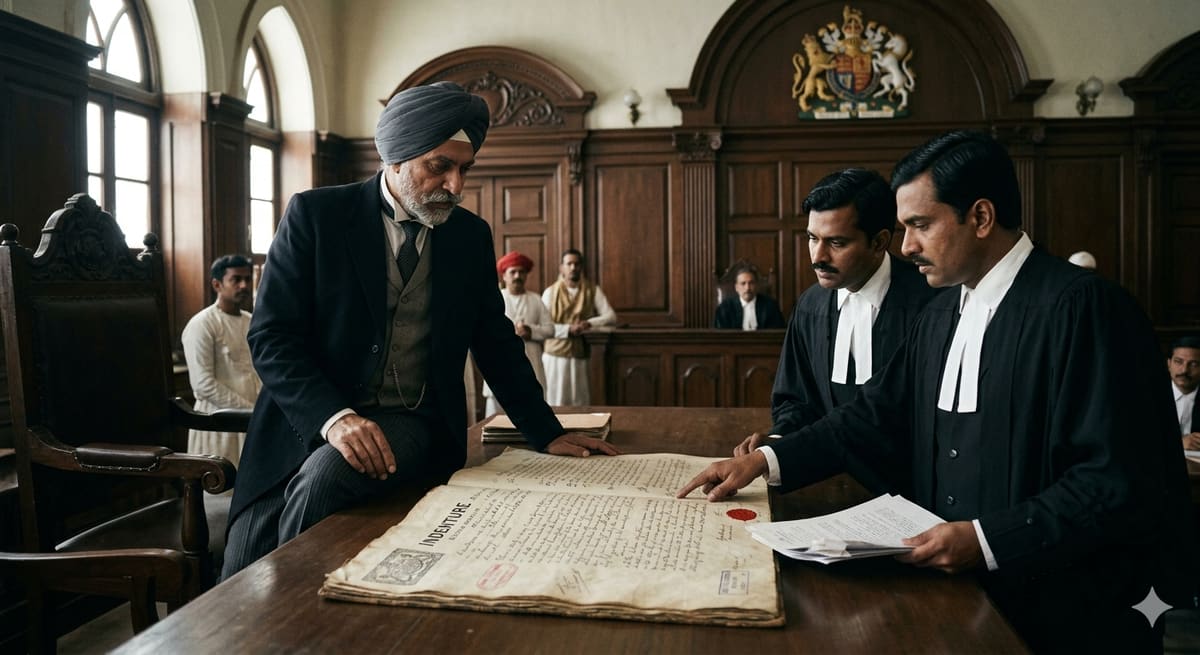
The Bombay High Court has definitively held that a 999-year indenture executed in 1870 conferred proprietary rights upon the Grantee, not a mere lease, and that the subsequent use of the land for salt manufacture does not vest ownership in the Union of India. This judgment resolves a century-old title dispute over 227 acres of Eksali land in Thane, affirming the statutory status of the Grantee as a superior holder under the evolving revenue jurisprudence of Maharashtra.
Background & Facts
The Dispute
The appellant, the Union of India through the Deputy Salt Commissioner, claimed ownership over approximately 227 acres of land in village Bhayander, Thane, known as the Mira, Manek/Shapur Salt Works. The appellant asserted that the land, originally granted under an Indenture dated 7th November 1870, remained vested in the Federal Government under the Government of India Act, 1935, and subsequently in the Union of India under Article 294 of the Constitution, due to its use for salt manufacture. The respondents, The Estate Investment Company Pvt. Ltd. (Respondent No.1) and M/s Mira Salt Work Company (Respondent No.2), contested this claim, asserting that the Indenture transferred a heritable, transferable estate, and that they held proprietary rights as superior holders and tenants respectively.
Key Facts
The Indenture of 7th November 1870 granted Ramchunder Luxumonjee and his heirs, executors, and administrators a 999-year interest in approximately 3,688 acres of land comprising villages Bhayander, Ghodbunder, and Mira, including Eksali, Inam, and Wurkus lands.
The Indenture permitted assignment upon notice to the Collector, allowed recovery of land revenue from occupants, and reserved rights to re-enter upon non-payment of annual rent of Rs.6,791-9-6.
The suit land, comprising approximately 227 acres of Eksali land, was not used for salt manufacture at the time of the Indenture.
On 1st April 1937, the Government of India Act, 1935 came into force. On 16th July 1938, a notification under Section 172(1)(a) listed lands vested in His Majesty for the purposes of the Government of India; the suit lands were not included.
In 1945, Respondent No.1 acquired the rights of the Grantee through two Deeds of Assignment dated 22nd March 1945 and 5th April 1945.
On 19th December 1949, the Government of Bombay issued a notification under Section 2(9) of the Bombay Tenancy and Agricultural Lands Act, 1948, declaring Respondent No.1 as the "land-holder" of the suit lands.
On 1st October 1957, the State Government reversed its earlier assumption of management under Section 44 of the BTAL Act and restored possession to Respondent No.1.
The Salsette Estates (Land Revenue Exemption Abolition) Act, 1951, came into force, abolishing land revenue exemptions for estates in Bhayander, Mira, and Ghodbunder, and making Respondent No.1 liable to pay land revenue to the State.
In 1955, Respondent No.1 filed Suit No.123 of 1955 against the State of Bombay for accounts of income during the period of State management; a preliminary decree was passed and confirmed by the Bombay High Court and Supreme Court.
On 16th July 1983, the Union of India issued a notice to Respondent No.2 requiring execution of a lease under Rule 76 of the Bombay Land Revenue Rules, 1921, as a condition for renewal of Salt Licence No.48.
Respondent No.2 challenged the notice in Writ Petition No.2861 of 1983; the Bombay High Court directed renewal of the licence without requiring concession of title.
On 25th March 1996, the Supreme Court dismissed the Union’s Special Leave Petition and directed the parties to approach the Collector for adjudication of title.
On 12th May 1999, the Union’s Special Leave Petition No.14528 of 1998 was dismissed.
On 18th November 2002, the Collector, Thane, held that the State of Maharashtra was the owner of the suit lands.
On 8th October 2010, the Additional Commissioner, Konkan Division, set aside the Collector’s order and declared Respondent No.1 as the owner and Respondent No.2 as the tenant.
On 5th September 2008, the Collector, under Section 3 of the Salsette Act, declared Respondent No.1 as the superior holder; this order was upheld by the Bombay High Court and Supreme Court.
On 11th October 2011, the Union’s Letters Patent Appeal was dismissed.
On 8th December 2011, the Union’s Special Leave Petition was dismissed.
On 13th April 2018, the trial court dismissed the Union’s suit for declaration of title.
On 28th March 2023, the First Appeal was filed before the Bombay High Court.
Procedural History
7th November 1870: Indenture executed between Secretary of State for India in Council and Ramchunder Luxumonjee.
1st April 1937: Government of India Act, 1935 came into force.
16th July 1938: Notification under Section 172(1)(a) issued; suit lands not listed.
1945: Respondent No.1 acquires rights via Deeds of Assignment.
19th December 1949: Notification under BTAL Act declares Respondent No.1 as land-holder.
1st October 1957: State Government reverses management assumption and restores possession.
1951: Salsette Act enacted.
1955: Suit No.123 of 1955 filed by Respondent No.1 for accounts.
14th December 1957: Civil Appeal No.288 of 1956 dismissed by Bombay High Court.
13th February 1980: Second Appeal dismissed.
3rd November 1988: Supreme Court dismisses SLP.
16th July 1983: Union issues notice under Rule 76 of BLRC.
23rd June 1993: Bombay High Court directs renewal of salt licence without requiring title concession.
25th March 1996: Supreme Court dismisses SLPs and directs parties to approach Collector for title adjudication.
12th May 1999: Union’s SLP No.14528 of 1998 dismissed.
18th November 2002: Collector holds State of Maharashtra as owner.
8th October 2010: Additional Commissioner sets aside Collector’s order; declares Respondent No.1 as owner, Respondent No.2 as tenant.
5th September 2008: Collector under Salsette Act declares Respondent No.1 as superior holder.
14th/15th July 2011: Bombay High Court dismisses writ petition challenging Collector’s Salsette Act order.
11th October 2011: Bombay High Court dismisses Letters Patent Appeal.
8th December 2011: Supreme Court dismisses SLP.
12th June 2011: Special Civil Suit No.771 of 2011 filed by Union.
13th April 2018: Trial Court dismisses suit.
28th March 2023: First Appeal No.1430 of 2019 filed before Bombay High Court.
The Parties' Positions
The Union of India (Appellant) contended that:
The Indenture of 1870 was a lease, not a conveyance of title.
The land, being used for salt manufacture, fell under Entry 47 of List I of the 1935 GOI Act.
Section 172 of the 1935 GOI Act and Article 294 of the Constitution vested title in the Federal Government and subsequently in the Union.
The State of Maharashtra (Respondent No.3) had no title, so title must vest in the Union.
Respondent No.1 (The Estate Investment Company) and Respondent No.2 (Mira Salt Work Company) contended that:
The Indenture was a grant of an alienated estate, conferring proprietary rights as a superior holder.
Entry 47 of List I relates to legislative competence over salt, not land ownership.
Land and land revenue are State subjects under Entries 21 and 39 of List II.
The 1938 notification under Section 172 did not include the suit lands.
The Salsette Act and subsequent judicial orders affirmed their status as superior holder and tenant.
The Union’s claim surfaced only in 1983, after 113 years of inaction.
Relief Sought
The appellant sought:
A declaration that it is the owner of the suit land.
Setting aside of the Collector’s order dated 18th November 2002 and the Additional Commissioner’s order dated 8th October 2010.
Possession of the suit land.
Permanent injunction against respondents.
Damages of Rs.2,078 and mesne profits.
Costs of the suit.
The Legal Issue
The central question was whether the Indenture of 1870 conveyed a leasehold interest or a proprietary estate, and whether the subsequent use of the land for salt manufacture under a license vested ownership in the Union of India under the Government of India Act, 1935 or Article 294 of the Constitution.
Arguments Presented
For the Appellant
The Additional Solicitor General argued that:
The Indenture was a limited grant, evidenced by the use of the term "demise" and Clause XI requiring Collector’s consent for assignment, indicating retention of title by the Crown.
Entry 47 of List I of the 1935 GOI Act, relating to "Salt", conferred proprietary rights over land used for salt manufacture.
Section 172 of the 1935 GOI Act vested lands used for federal purposes in the Federal Government, and Article 294 of the Constitution continued this vesting in the Union.
The Union’s witness PW-1’s admissions were not binding, and the burden shifted to respondents to prove divestment.
The trial court erred in not adjudicating prayer (b) challenging the Revenue Orders.
The Government Grants Act, 1895, and precedents like Union of India v. Dinshaw Shapoorji Anklesari supported the view that government grants operate strictly by their tenor, and the Indenture was a lease.
For the Respondent
Senior Advocates for Respondents No.1 and No.2 contended that:
The Indenture was a grant of an alienated estate, consistent with the legislative framework under the Bombay Survey and Settlement Act, 1865, the Bombay Land Revenue Code, 1879, and the Maharashtra Land Revenue Code, 1966.
"Superior holder" under these statutes denoted proprietary ownership, not tenancy.
Entry 47 of List I is a legislative head, not a source of ownership; land and land revenue are exclusively State subjects under Entries 21 and 39 of List II.
The 1938 notification under Section 172 excluded the suit lands, negating any vesting in the Federal Government.
The Salsette Act and subsequent judicial orders affirmed Respondent No.1’s status as superior holder.
The Union’s failure to assert title for over a century, and its witness’s admissions, undermined its claim.
The challenge to Revenue Orders was subsumed in the title issue and did not require independent adjudication.
The Court's Analysis
The Court undertook a meticulous analysis of the Indenture of 1870, the legislative history of land revenue in Maharashtra, and the constitutional framework under the Government of India Act, 1935 and the Constitution of India.
The Court first examined the nature of the Indenture. It rejected the appellant’s characterization of the document as a lease. Clause XI, requiring Collector’s consent for assignment, was held to be a protective covenant, not indicative of retained title. The Indenture conferred upon the Grantee the right to assign, mortgage, recover land revenue from occupants, and enforce payment - rights inconsistent with a mere lease. The Court emphasized that contemporaneous statutes, including the Bombay Survey and Settlement Act, 1865, recognized "superior holders" as proprietors with heritable and transferable rights. The Indenture, therefore, effected an alienation of the Crown’s proprietary and fiscal rights, converting the land into an alienated estate.
The Court then addressed the appellant’s reliance on Entry 47 of List I of the 1935 GOI Act. It held that legislative entries demarcate fields of competence, not sources of ownership. Entry 47 empowered the Federal Government to legislate on salt, not to acquire land used for its manufacture. The Court cited Megh Raj & Anr. v. Allah Rakhia & Ors. to affirm that "land" in Entry 21 of List II is broad enough to include all rights in land, and that salt manufacture does not convert land into a federal asset. The Court further noted that the 1938 notification under Section 172, which listed lands vested in the Federal Government, did not include the suit lands - a decisive omission.
The Court examined the constitutional transition under Article 294. It held that Article 294 merely continues the pre-constitutional status quo. Since the suit lands were not vested in the Federal Government under Section 172, they could not vest in the Union under Article 294. The Court relied on Mundra Salt and Chemical Industries v. State of Gujarat to hold that post-constitutional ownership disputes between Union and State must be resolved under Article 294, not obsolete provisions like Section 37 of the 1879 BLRC.
The Court also rejected the appellant’s reliance on Rule 76 of the 1921 BLRC. It held that Rule 76 applied only to unalienated land, whereas the suit lands were part of alienated villages. Moreover, the appellant’s own witness admitted that no relinquishment deed or lease was executed under Rule 76(2)(a), and that Respondent No.1 never applied for conversion of the land.
The Court found the appellant’s conduct fatal to its claim. For 113 years, from 1870 to 1983, the Union and its predecessors never asserted ownership, issued notices, or recorded title. The claim emerged only during a salt licence renewal dispute. The Court held that such prolonged inaction, coupled with the absence of any contemporaneous notification or administrative record, negated the claim.
"The absence of notification in appellant’s favour coupled with continuous recognition by respondents 3 to 5 of respondent no.1’s rights as landholder negates the appellant’s argument of the title and ownership in the suit lands vesting in the Federal Government."
The Court also dismissed the argument that the trial court failed to adjudicate prayer (b). It held that the challenge to Revenue Orders was entirely dependent on establishing title. Once the appellant’s claim of ownership failed, the challenge to the orders became academic. Under Order XLI Rule 24 of the CPC, the appellate court may sustain the decree on any ground supported by the record.
The Verdict
The First Appeal was dismissed. The Union of India failed to establish title to the suit land. The orders of the trial court and the Additional Commissioner dated 8th October 2010, declaring Respondent No.1 as the owner and Respondent No.2 as the tenant, were upheld. There shall be no order as to costs. The appellant’s prayer for continuation of the status quo order dated 2nd September 2021 was rejected.
What This Means For Similar Cases
Proprietary Rights Under Historical Grants Prevail Over Subsequent Use
Practitioners must distinguish between legislative competence (e.g., salt, mining) and proprietary ownership when challenging land titles.
Use of land for a federally regulated activity (e.g., salt, defense, railways) does not automatically vest ownership in the Union.
Historical grants executed before 1935 must be interpreted in light of contemporaneous revenue jurisprudence, not modern statutory interpretations.
Burden of Proof in Title Disputes Is Strictly on the Claimant
In suits for declaration of title, the burden never shifts to the defendant to disprove ownership.
Failure to assert title for decades, absence of revenue records, and non-involvement in prior litigation are fatal to a claim.
Admissions by a party’s own witness, if unequivocal and unambiguous, are strong evidence against the party, even if not determinative alone.
Revenue Jurisprudence Defines "Ownership" in India
The terms "superior holder" and "occupant" under the Maharashtra Land Revenue Code, 1966, denote proprietary rights, not tenancy.
Alienated estates under the 1865 Act, 1879 Code, and 1966 Code are treated as private property, immune from state acquisition absent statutory procedure.
Courts will uphold long-standing revenue records and judicial pronouncements over speculative claims based on post-hoc legislative entries.