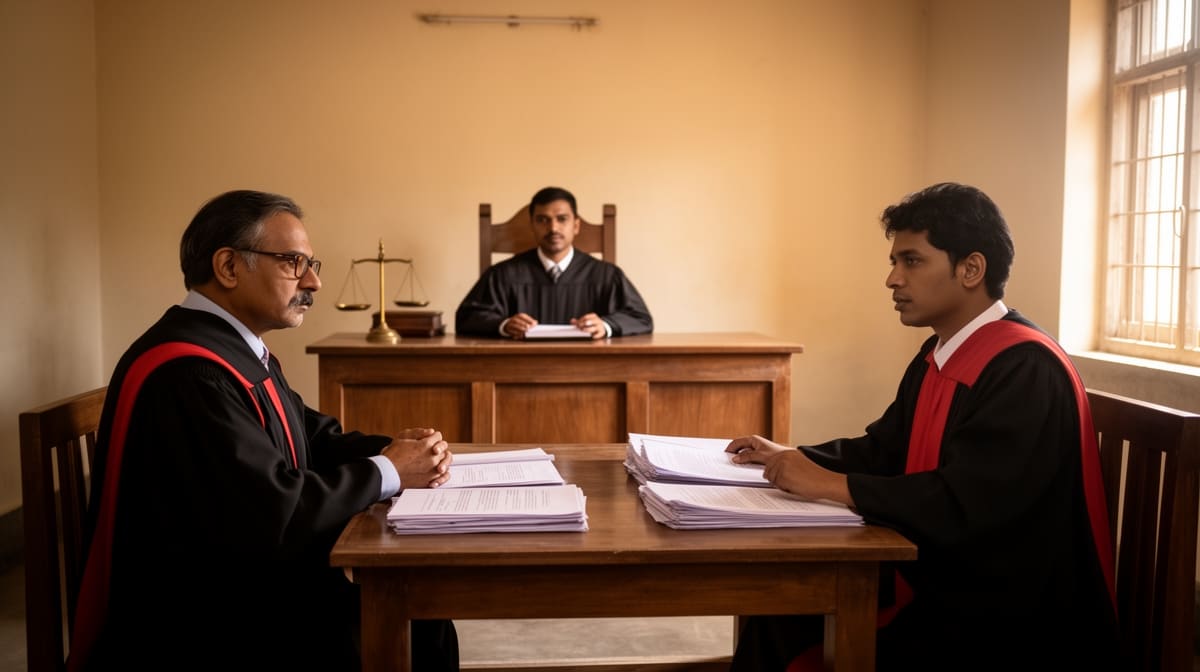
The Calcutta High Court set aside a revision order that had dismissed a wife’s maintenance claim, reaffirming that proceedings under Section 125 Cr.P.C. are summary in nature and do not demand the rigorous civil proof of marriage required in matrimonial suits. The judgment underscores the protective purpose of the statute for destitute spouses.
Background & Facts
The Dispute
The petitioner, Jyotsnara Bibi, alleged that she was lawfully married to MD Azam Ali Sarkar on 28 May 2014 under Muslim Shariyat law. She claimed that after the marriage she endured continuous physical and mental cruelty and was forced to leave the matrimonial home on 24 September 2014, seeking refuge with her parents.
Key Facts
- 28 May 2014: Marriage solemnised according to Muslim law.
- 24 September 2014: Petitioner driven out of matrimonial home.
- 15 October 2014: FIR registered under Section 498A IPC (Balurghat Police Station Case No. 773 of 2014).
- 31 December 2014: Charge Sheet No. 864 filed.
- 2015: Application under Section 125 Cr.P.C. filed as M.R. Case No. 123 of 2015 before the Chief Judicial Magistrate, Balurghat, later transferred to the Judicial Magistrate, 1st Court, Balurghat.
- Petitioner’s claim: Monthly maintenance of Rs 15,000, citing husband’s employment as a primary school teacher.
- Husband’s objections: Denied existence of a valid marriage, alleged prior marriages (with Dashimuddin Molla and Nazimuddin Mahalat) and asserted lack of Ijab-o-Qabool, Kazi, or Nikahnama.
- 4 October 2016: Interim maintenance rejected by the Trial Magistrate.
- 23 June 2017: Interim rejection affirmed in Criminal Revision No. 1 of 2017.
- 18 November 2020: Trial Magistrate awarded maintenance of Rs 6,000 per month and Rs 2,000 litigation costs, relying on police charge sheet, Aadhaar and voter ID showing husband as spouse.
- 25 February 2022: Additional Sessions Judge, Special Court, Dakshin Dinajpur, reversed the trial order, holding petitioner failed to prove dissolution of prior marriages or produce formal Islamic marriage documents.
Procedural History
- 2015: Section 125 application filed (M.R. Case No. 123 of 2015).
- 4 Oct 2016: Interim maintenance denied.
- 23 Jun 2017: Interim denial affirmed (Criminal Revision No. 1 of 2017).
- 18 Nov 2020: Trial Magistrate order granting maintenance.
- 17 2020: Husband filed Criminal Revision No. 17 of 2020.
- 25 Feb 2022: Revision order dismissing maintenance.
- 14 Aug 2026: High Court reserved judgment (CRR 1349 of 2022).
- 18 Aug 2026: High Court pronounced judgment.
Parties' Positions
- Petitioner (appellant): Argued that the revisional court exceeded its jurisdiction by treating the matter as a civil title suit, ignored statutory public records establishing a prima facie marriage, and imposed an unreasonable evidentiary burden.
- Respondent (husband/state): Contended that petitioner failed to produce formal Islamic marriage documents or proof of dissolution of alleged prior marriages, justifying dismissal of the maintenance claim.
Relief Sought
- Set aside the revision order dated 25 February 2022.
- Restore the trial magistrate’s order of 18 November 2020 granting Rs 6,000 monthly maintenance and Rs 2,000 costs.
- Direct the husband to pay all arrears from the date of filing and continue regular maintenance payments.
- No order as to costs.
The Legal Issue
What is the correct standard of proof and jurisdiction for a maintenance proceeding under Section 125 Cr.P.C., and may a revisional court demand the same level of documentary proof of marriage required in a civil matrimonial suit?
Arguments Presented
For the Appellant
The petitioner relied on the principle that Section 125 is a remedial, summary provision aimed at preventing destitution. Citing Dwarika Prasad Satpathy v. Bidyut Prava Dixit, Badshah v. Urmila Badshah Godse and Rajathi v. C. Ganesan, counsel argued that a prima facie case of marriage may be established through public records, cohabitation evidence, and oral testimony, without the need for formal Ijab-o-Qabool or a Nikahnama. The petitioner further invoked Section 482 Cr.P.C. to seek correction of a jurisdictional error.
For the Respondent
The husband’s counsel maintained that the petitioner failed to produce legally admissible proof of a valid marriage, specifically the dissolution of alleged prior marriages and the essential Islamic contract documents. Relying on the requirement of clear documentary evidence, the respondent argued that the revisional court was correct in dismissing the maintenance claim.
The Court's Analysis
The Court began by reiterating that Section 125 Cr.P.C. is an ameliorative measure intended to prevent vagrancy and destitution. It emphasized that the provision is summary and does not invite a full-blown civil trial on the validity of the marriage.
"The standard of proof required in a proceeding under Section 125 Cr.P.C. is not as rigorous, exacting, or formalistic as that required in a criminal trial for bigamy or a full-dress civil suit for declaration."
The Court examined the precedents:
- Dwarika Prasad Satpathy v. Bidyut Prava Dixit held that the court need only be satisfied of a prima facie marriage based on cumulative material.
- Badshah v. Urmila Badshah Godse stressed a humanitarian interpretation, allowing cohabitation and public records to create a presumption in favour of the claimant.
- Rajathi v. C. Ganesan clarified that a mere denial of marriage by the husband is insufficient to defeat a maintenance claim when the wife produces credible evidence.
Applying these principles, the Court found that the trial magistrate correctly relied on the 498A charge sheet, Aadhaar and voter ID, all of which listed the husband as the petitioner’s spouse. The husband’s failure to challenge these records in a civil suit, coupled with his admission that he had filled out a marriage registration form, satisfied the prima facie requirement.
The Court held that the revisional court erred by demanding proof of talak, Kazi, and Nikahnama - requirements belonging to a civil matrimonial suit, not a summary maintenance proceeding. This constituted an over-reach of its revisional jurisdiction under Section 482 Cr.P.C..
Consequently, the Court concluded that the petitioner was entitled to maintenance and that the revision order must be set aside.
The Verdict
The High Court set aside the revision order dated 25 February 2022, restored the trial magistrate’s order of 18 November 2020 granting monthly maintenance of Rs 6,000 and litigation costs of Rs 2,000, and directed the husband to clear all arrears from the date of filing within 60 days. Regular maintenance shall be paid by the 7th of each succeeding English calendar month. No order as to costs was made.
What This Means For Similar Cases
Summary Maintenance Remains Summary
- Courts must treat Section 125 applications as remedial, not as full-scale matrimonial disputes.
- Evidentiary standards are lower; a prima facie case can be established through public records and cohabitation evidence.
Technical Proof of Marriage Is Not Required
- Absence of formal Ijab-o-Qabool, Kazi, or Nikahnama does not defeat a maintenance claim where other statutory documents identify the parties as spouses.
- Husbands cannot evade liability by demanding civil-law standards of proof.
Revisional Courts Must Respect Jurisdiction
-
Under Section 482 Cr.P.C., revisional courts cannot transform a summary proceeding into a civil title suit.
-
Any order exceeding the scope of Section 125 is liable to be set aside.
-
Practitioners should marshal police records, identity documents, and cohabitation evidence early.
-
Anticipate and counter any attempt by the opposite party to raise technical matrimonial defenses.