The Delhi High Court has reaffirmed that courts may decree summary suits without granting leave to defend when the defendant's objections are purely technical and fail to disclose any bona fide triable issue. This ruling clarifies the threshold for resisting summary proceedings in commercial disputes, emphasizing documentary evidence over speculative denials.
Background & Facts
The Dispute
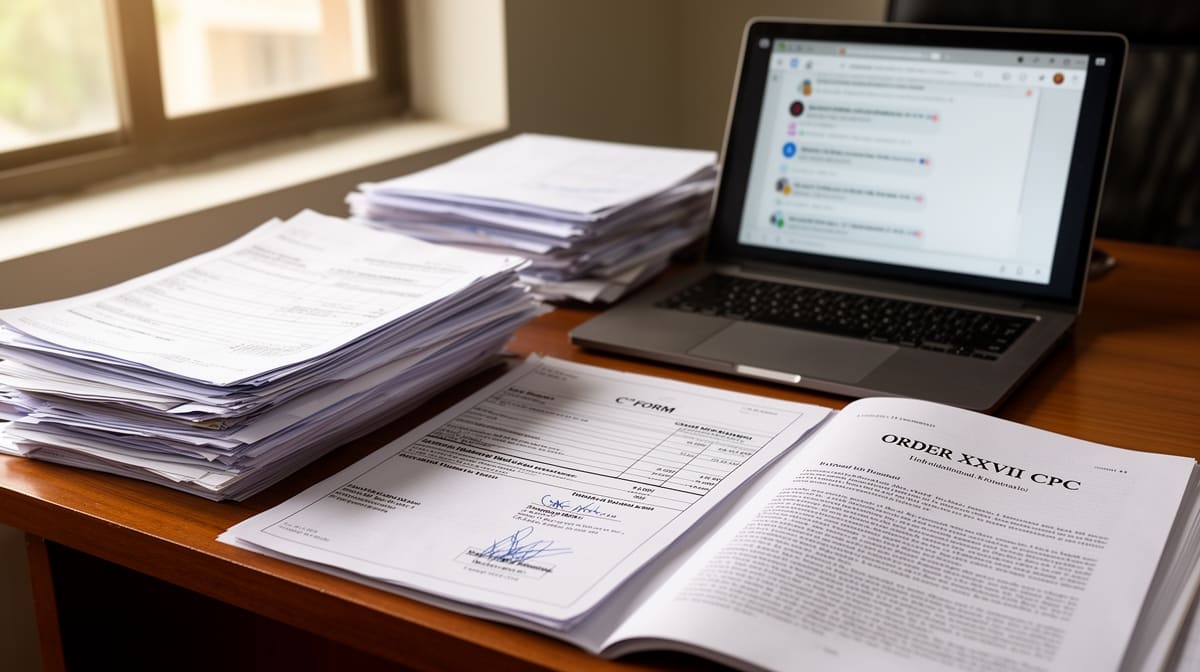
The Respondent, SASUMOROV ENTERPRISES PVT. LTD., filed a summary suit for recovery of Rs. 2,33,46,254/- alleging unpaid dues for supply of Thermo Mechanically Treated (TMT) bars under three purchase orders issued by the Appellant, ODEAN BUILDERS PVT. LTD., in 2013. The Respondent produced invoices, debit notes, statutory 'C' Forms, and an email dated 12.09.2014 from the Appellant’s Manager (Purchase) acknowledging the outstanding liability.
Procedural History
- 2016: Summary suit filed in Delhi under Order XXXVII CPC
- 2016-2017: Respondent filed additional documents, including a Section 65-B certificate for the email
- 2018: Learned Single Judge refused leave to defend, holding no triable issue existed, and decreed the suit
- 2019: Appellant filed this appeal challenging the decree
Relief Sought
The Appellant sought reversal of the decree and grant of leave to defend, arguing lack of territorial jurisdiction, inadmissibility of electronic evidence, mismatched invoices, and alleged full payment of dues.
The Legal Issue
The central question was whether the refusal of leave to defend in a summary suit under Order XXXVII CPC was justified when the defence raised technical objections without substantiating them with credible evidence, and whether the subsequent filing of a Section 65-B certificate invalidated the proceedings.
Arguments Presented
For the Appellant
The Appellant contended that: (i) Delhi courts lacked territorial jurisdiction as the transaction was finalized in Panipat and goods delivered in Panchkula; (ii) the email dated 12.09.2014 was fabricated and lacked a Section 65-B certificate at the time of filing; (iii) invoices did not match purchase orders; (iv) payments were fully discharged but no bank records were required to be produced; and (v) documents filed after suit initiation were inadmissible without court leave.
For the Respondent
The Respondent argued that: (i) multiple acts constituting the cause of action - issuance of purchase orders, correspondence, 'C' Forms, and payment - occurred in Delhi; (ii) the Section 65-B certificate was filed promptly upon challenge and the Appellant had full opportunity to rebut; (iii) the email chain, including the 26.08.2014 and 12.09.2014 communications, was consistent and unchallenged by affidavit; and (iv) the Appellant admitted receipt of goods and never disputed liability until litigation.
The Court's Analysis
The Court examined the nature of summary suits under Order XXXVII CPC and the standard for granting leave to defend. It held that leave must be refused if the defence is frivolous, speculative, or lacks credible documentary support. The Court emphasized that a triable issue must be real and substantial, not merely a denial without evidence.
"The bald assertion of mismatch, without material substantiation, does not constitute a bona fide or substantial defence raising a triable issue."
Regarding jurisdiction, the Court noted that issuance of purchase orders from Delhi, transmission of debit notes and 'C' Forms from the Appellant’s registered office, and receipt of payments through Delhi-based dealings collectively established a cause of action arising within Delhi. The Appellant’s failure to demonstrate prejudice rendered the jurisdictional objection untenable at the appellate stage.
On the Section 65-B certificate, the Court observed that procedural lapses do not invalidate proceedings if the opposing party is not prejudiced. The Appellant had ample opportunity to cross-examine and challenge the email’s authenticity but filed no affidavit from Mr. Punit Kumar Bansal denying its origin. The Court held that the absence of a denial from the purported sender cannot be equated with fabrication.
The Court also rejected the claim of invoice mismatch, noting that bulk material transactions routinely involve multiple consignments under a single order. The total invoiced quantity aligned with the total ordered quantity, and no specific discrepancy was proven.
Finally, the Appellant’s claim of full payment was unsupported by any bank records, payment advices, or reconciliation statements. The issuance of 'C' Forms and balance confirmations, which are statutory acknowledgments under the Central Sales Tax Act, strongly corroborated the Respondent’s claim.
The Verdict
The Appellant’s appeal was dismissed. The Delhi High Court upheld the decree, holding that the defence raised no bona fide triable issue warranting trial. The refusal of leave to defend was justified, and the summary suit was rightly decreed on the strength of documentary evidence.
What This Means For Similar Cases
Documentary Evidence Prevails Over Oral Denials
- Practitioners must ensure that denials in summary suits are backed by affidavits, bank records, or contemporaneous documents
- Mere assertions of fabrication or non-receipt without sworn rebuttals will not suffice to raise a triable issue
- 'C' Forms and balance confirmations carry significant evidentiary weight in commercial disputes
Section 65-B Certificate Can Be Filed Later Without Invalidating Proceedings
- Courts will not invalidate summary decrees for late filing of Section 65-B certificates if the opposing party had opportunity to respond
- Procedural compliance must serve justice, not obstruct it
- The burden shifts to the challenging party to prove prejudice from delayed filing
Jurisdictional Objections Must Be Raised Early and With Consequence
- Technical objections to territorial jurisdiction will be dismissed at appellate stage if no prejudice is shown
- Acts such as issuing purchase orders, sending confirmations, or receiving payments from a registered office can establish cause of action
- Lawyers must plead jurisdictional defects with specificity and supporting facts at the earliest opportunity