The Bombay High Court has clarified that a plaintiff’s purchase of an adjacent property at a significantly lower price does not, by itself, negate proof of readiness and willingness to perform a contract of sale, where affirmative evidence of financial preparedness, timely notice, and presence at the registrar’s office is established. This judgment reinforces the principle that specific performance must be granted when the plaintiff has discharged the burden of proving both capability and desire to fulfill contractual obligations.
Background & Facts
The Dispute
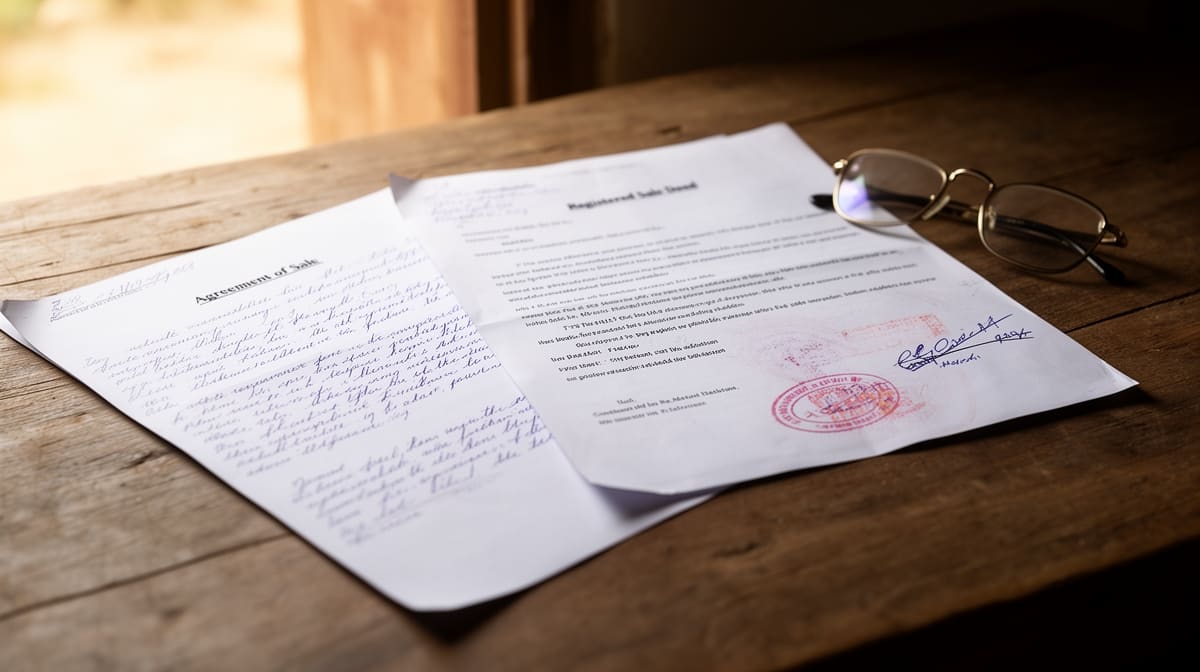
The appellant, Brijkishor Bansilal Jaiswal, entered into an agreement of sale dated 02.09.2009 with the respondent, Kirit Nagindas Kiri, for the purchase of a plot of land measuring 233.93 square meters (2518 square feet) at a rate of Rs.311 per square foot. The total agreed sale consideration was Rs.7,83,072. The agreement stipulated that the defendant would get the plot measured by a Government agency prior to execution of the sale deed, and the sale was to be completed on or before 30.10.2009.
Key Facts
- The appellant paid Rs.2,00,000 as advance on the date of the agreement (02.09.2009).
- The agreement (Exhibit 58) explicitly stated: "The defendant shall get the plot measured."
- On 30.10.2009, the appellant obtained a banker’s cheque (Exhibit 59) for Rs.5,83,161, the balance consideration, and submitted an affidavit (Exhibit 60) before an Executive Magistrate affirming his presence at the Sub-Registrar’s office on that date.
- The appellant issued a legal notice dated 15.12.2009 (Exhibit 61) informing the defendant that the actual area of the plot was less than stipulated (222.94 sq. mts. vs. 233.93 sq. mts.) and requesting government measurement.
- The defendant issued a reply notice on 05.01.2010, calling upon the appellant to appear at the Sub-Registrar’s office on 12.01.2010 for execution of the sale deed.
- The appellant purchased a neighboring plot (Plot No.1-B), measuring 232.95 sq. mts., from the same vendor on 02.12.2009 for Rs.1,90,000, which was registered as Exhibit 96.
- On 10.08.2010, the appellant arranged for government measurement of the suit property (Plot No.1-A), which confirmed the area as 222.94 sq. mts. The application for measurement (Exhibit 92) bore the contact numbers of the appellant’s sons.
- The appellant filed the suit for specific performance on 01.02.2010.
- The defendant sold the suit property to Respondent No.2, Rajiv Kanhaiyalal Kouskiya, during the pendency of the first appeal, within the limitation period.
Procedural History
- 02.09.2009: Agreement of sale executed.
- 30.10.2009: Deadline for execution of sale deed; appellant present with balance payment.
- 15.12.2009: Appellant’s notice demanding government measurement and specific performance.
- 12.01.2010: Date of appearance called by defendant; appellant claims presence, defendant disputes.
- 01.02.2010: Suit for specific performance filed (Special Civil Suit No.44 of 2010).
- 04.01.2014: Trial Court dismisses specific performance, grants refund of Rs.2,00,000 with 9% interest.
- 17.10.2019: First Appellate Court upholds Trial Court’s decision.
- 22.04.2026: Judgment reserved.
- 30.04.2026: Judgment pronounced.
The Parties' Positions
Appellant (Plaintiff): Contended he was ready and willing to perform the contract, evidenced by the banker’s cheque, affidavit, notice, and timely filing of suit. Argued that the defendant’s failure to get the land measured constituted breach.
Respondents (Defendants): Denied any obligation to get the land measured, claimed the plaintiff was not ready or willing, citing the purchase of the adjacent plot at a lower price as evidence of bad faith.
Relief Sought
The appellant sought: (1) a decree for specific performance of the agreement dated 02.09.2009; (2) direction to the defendant to execute and register the sale deed; (3) delivery of possession; and (4) rejection of the refund decree.
The Legal Issue
Whether the plaintiff has established readiness and willingness to perform the contract of sale under Section 20 of the Specific Relief Act, 1963, despite purchasing an adjacent plot at a significantly lower price, and whether the courts erred in refusing specific performance based on an unpleaded inference.
Arguments Presented
For the Appellant
The appellant’s counsel argued that readiness was conclusively proven by the banker’s cheque dated 30.10.2009 for the full balance consideration and the sworn affidavit affirming presence at the Sub-Registrar’s office on that date. Willingness was demonstrated by the notice dated 15.12.2009, the reply notice from the defendant calling for appearance on 12.01.2010, and the prompt filing of the suit on 01.02.2010. The purchase of the adjacent plot was not a ground to infer lack of willingness, as it was not pleaded in the written statement. The agreement expressly required the defendant to arrange measurement, and his failure to do so was the primary breach.
For the Respondent
The respondents’ counsel contended that the plaintiff’s conduct showed lack of sincerity, particularly in purchasing the adjacent plot for Rs.1,90,000 while refusing to pay Rs.7,83,072 for the suit property. They argued that the agreement did not mandate government measurement as a condition precedent, and that the plaintiff’s own initiation of measurement after filing suit indicated bad faith. The disparity in prices, they submitted, justified the courts’ conclusion that the plaintiff was not genuinely interested in completing the transaction.
The Court's Analysis
The Court undertook a rigorous review of the evidence and found that both the Trial Court and the First Appellate Court erred in their appreciation of facts. The agreement clearly stated that the defendant was obligated to get the plot measured. The defendant himself admitted this in cross-examination, confirming that the sale consideration was contingent on the actual area. The failure to carry out measurement was therefore a breach by the defendant.
"The observation that the measurement of the land was not necessary for execution of the sale deed is contrary to the contents of the agreement and express admission by the defendant in this regard in the witness box."
The Court further held that the inference drawn by the lower courts - that the plaintiff was unwilling to purchase the property due to the price disparity - was impermissible. The written statement did not raise this as a defense. The High Court emphasized that courts cannot rely on unpleaded and speculative inferences to deny equitable relief.
The Court accepted the appellant’s evidence of readiness: the banker’s cheque, the affidavit of presence on 30.10.2009, and the notice demanding performance. The purchase of the adjacent plot, while notable, did not disprove willingness. The appellant’s actions after that purchase - issuing a notice for specific performance and appearing for registration - demonstrated a continuing intent to complete the transaction.
The Court also noted that the delay of over 16 years since the agreement rendered the original terms inequitable. However, rather than denying relief, the Court exercised its discretion under Section 20 of the Specific Relief Act, 1963 to adjust the consideration to reflect the passage of time and the actual area discrepancy.
The Verdict
The Second Appeal is allowed. The judgments of the Trial Court and First Appellate Court are set aside. The suit is decreed for specific performance of the agreement dated 02.09.2009. The appellant shall pay the balance sale consideration of Rs.5,83,082 with interest at 9% per annum from 01.11.2009 until deposit. The appellant shall deposit this amount with the Trial Court on or before 30.06.2026. The respondents are directed to execute and register the sale deed and deliver possession of the suit property to the appellant. Parties shall bear their own costs.
What This Means For Similar Cases
Readiness Must Be Proven by Conduct, Not Assumed from External Transactions
- Practitioners must emphasize documentary evidence of financial readiness (banker’s cheques, affidavits, payment receipts) and timely communication (notices, appearances) to establish willingness.
- A plaintiff’s purchase of other property, even at a lower price, cannot be used to infer bad faith unless specifically pleaded and proven as evidence of mala fides.
Courts Cannot Infer Unpleaded Motives to Deny Specific Performance
- The burden lies on the defendant to plead and prove that the plaintiff’s conduct indicates lack of sincerity.
- Inferences based on unrelated transactions, especially where not raised in pleadings, are legally impermissible and render findings perverse.
Specific Performance Is Not Denied Solely on Delay or Price Disparity
- While delay may warrant adjustment of terms, it does not automatically defeat specific performance.
- Courts must balance equities by adjusting consideration or interest, not by denying relief outright.
- The ratio reaffirms that specific performance is the rule, not the exception, when readiness and willingness are established.