The Jharkhand High Court has set aside convictions in a murder case after holding that the prosecution failed to prove guilt beyond reasonable doubt, primarily due to the unreliability of the sole eyewitness and fatal contradictions in her testimony. The judgment reaffirms the foundational principle that in criminal trials, even a single witness’s testimony must inspire absolute confidence to sustain a conviction.
Background & Facts
The Dispute
The case arose from the alleged murder of Santu Mehra, aged approximately 65, on the night of 22.02.1995 at his residence in village Amla Chatar, Dumka. The prosecution alleged that Nundeo Mehra, armed with a bhujali (a type of heavy blade), assaulted Santu Mehra on the forehead, neck, and nose, causing his death. Eight other accused persons, including Naresh Mehra, Shankar Mehra, and Jai Kant Mehra, were alleged to have participated in the incident armed with lathis, knives, and axes, and committed theft of silver jewelry and cash from the victim’s household.
Key Facts
- The deceased, Santu Mehra, lived in a separate house adjacent to the courtyard of his son Kisto Mehra’s residence.
- The informant, Daya Devi (P.W.-6), was Santu Mehra’s daughter-in-law and wife of Kisto Mehra.
- The alleged occurrence took place at approximately 9:00 PM.
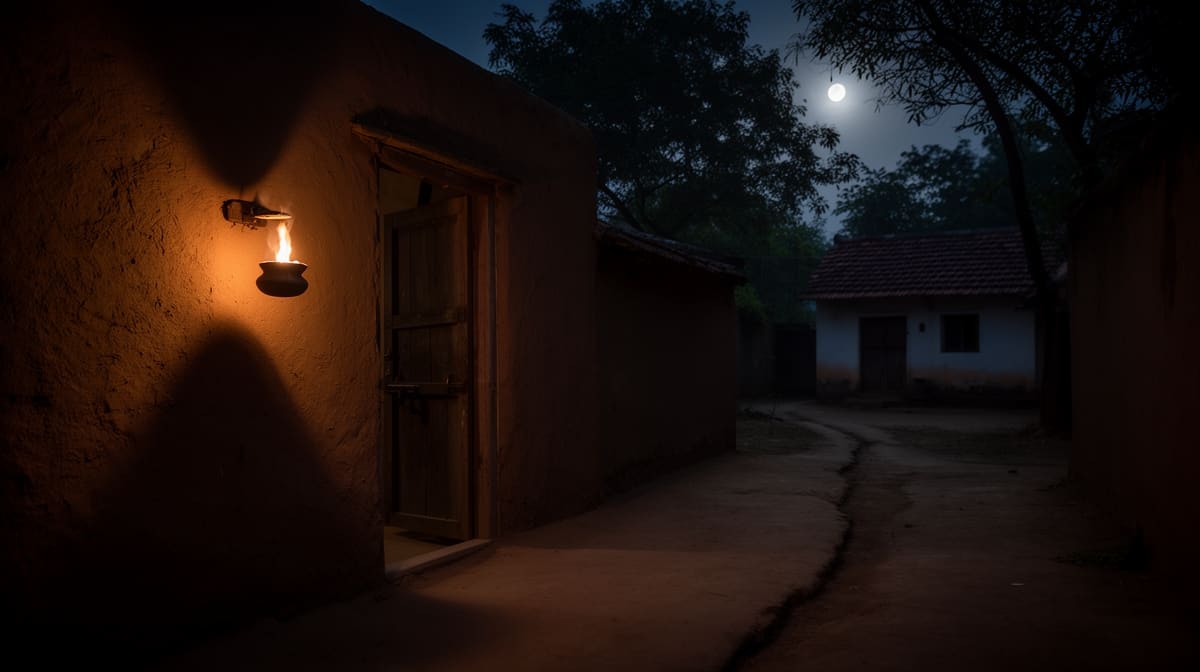
- The only source of light at the scene was an earthen lamp, which was not seized or exhibited by the police.
- The prosecution claimed that Daya Devi witnessed the entire incident from her verandah, including the assault on her father-in-law, despite the distance between her location and the deceased’s room.
- The deceased’s body was found lying outside the western door of his own house, not in the courtyard where Daya Devi claimed to be.
- The prosecution recovered blood-stained earth from the scene but did not send it for chemical analysis.
- The accused were charged under Sections 302, 148, 149, 380, and 448 of the IPC.
Procedural History
- 22.02.1995: Occurrence took place.
- 23.02.1995: FIR (Ext. 2) registered at Jama Police Station under Sections 302/380/34 IPC.
- 24.02.1995: Postmortem conducted by Dr. Subhan Murmu (P.W.-10).
- 28.07.1998: Judgment of conviction delivered by the 6th Additional Sessions Judge, Dumka.
- 29.07.1998: Sentencing order passed.
- Cr. Appeal (D.B.) No. 474 of 1998 (P): Filed by Nundeo Mehra against conviction under Section 302 IPC.
- Cr. Appeal (D.B.) No. 477 of 1998 (P): Filed by Naresh Mehra, Shankar Mehra, and Jai Kant Mehra against conviction under Section 148 IPC.
- 05.02.2026: Appeal No. 477 of 1998 abated against five deceased appellants.
- 12.03.2026: Judgment delivered by the Jharkhand High Court.
The Parties' Positions
Appellants (Defence):
- Contended that the prosecution case was built on the testimony of a single eyewitness, Daya Devi, whose credibility was compromised by prior enmity, inconsistent statements, and implausible conduct.
- Argued that the location of the assault contradicted the physical layout of the house as described by the investigating officer.
- Highlighted that the husband of the informant, Kisto Mehra (P.W.-5), was found wet and in undergarments after the incident, suggesting he had bathed - inconsistent with his claim of hiding in a tree out of fear.
- Relied on defense witnesses (D.W.-1 and D.W.-2) who corroborated that Kisto Mehra returned home after bathing.
- Pointed out that the earthen lamp, the only source of light, was not seized.
Respondent (State):
- Defended the trial court’s conviction, asserting that Daya Devi’s testimony was consistent and corroborated by medical evidence and inquest reports.
- Argued that discrepancies were minor and did not affect the core narrative.
- Maintained that the presence of multiple accused at the scene and the recovery of stolen items supported the prosecution version.
Relief Sought
The appellants sought acquittal and discharge from all charges, arguing that the conviction was based on unreliable evidence and violated the principle of proof beyond reasonable doubt.
The Legal Issue
Can a conviction under Section 302 IPC and Section 148 IPC be sustained solely on the testimony of an eyewitness whose account contains material contradictions, lacks corroboration, and is undermined by the implausible conduct of a key prosecution witness?
Arguments Presented
For the Appellant
The learned Amicus Curiae argued that:
- The testimony of P.W.-6, Daya Devi, was the sole direct evidence linking the appellants to the crime.
- Her account of the assault - that it occurred at the door of the deceased’s room while she watched from her verandah - was physically impossible given the layout of the houses, as confirmed by the investigating officer.
- The deceased’s body was found outside his own house, not in the courtyard, making her claim of witnessing the assault implausible.
- The informant’s statement in the FIR (fardbayan) claimed the deceased was dragged out of his room, while her trial testimony said he came out on her call - a material contradiction.
- The husband’s conduct - returning home wet and in undergarments - was inconsistent with his claim of fleeing and hiding in fear.
- The prosecution failed to seize the earthen lamp, the only source of light, undermining the claim of clear visibility.
- The evidence of hostile and defense witnesses corroborated the implausibility of the prosecution narrative.
For the Respondent
The State counsel contended that:
- The trial court rightly relied on the informant’s testimony, which was consistent in describing the manner of assault and the weapons used.
- Medical evidence confirmed injuries consistent with a sharp weapon like a bhujali.
- The inquest report and recovery of stolen items supported the prosecution’s version.
- Minor inconsistencies in witness statements were common in criminal trials and did not invalidate the core narrative.
- The presence of multiple accused and the motive of prior enmity strengthened the case.
The Court's Analysis
The Court undertook a meticulous review of the evidence, focusing on the reliability of P.W.-6, the sole eyewitness. It noted that while Section 134 of the Evidence Act, 1872 permits conviction on the testimony of a single witness, such testimony must be trustworthy and inspire confidence.
"The time-honored principle is that evidence has to be weighed and not counted. The test is whether the evidence has a ring of truth, is cogent, credible and trustworthy, or otherwise."
The Court found that the informant’s account was irreconcilable with the physical layout of the scene. The investigating officer (P.W.-7) testified that the deceased’s house was a separate structure to the west of the courtyard, with the body found outside its western door. Yet, the informant claimed to have witnessed the assault from her verandah in the courtyard - a location from which she could not have seen the deceased’s room.
Further, the Court highlighted a critical contradiction: the FIR stated the deceased was dragged out of his room, while her trial testimony claimed he came out voluntarily. This was not a minor inconsistency but a material discrepancy regarding the very act of violence.
The conduct of Kisto Mehra (P.W.-5), the informant’s husband, was also deemed highly suspicious. He claimed to have fled and hidden in a tree, yet multiple witnesses - including hostile P.W.-1 and defense witnesses D.W.-1 and D.W.-2 - stated he returned home wet and wearing only undergarments, suggesting he had bathed. The Court observed: "It is beyond imagination that a person fearing for his life would go to bathe."
The Court also noted the failure to seize the earthen lamp, the only source of light, and the absence of chemical analysis of the blood-stained earth. These lapses, while not fatal in isolation, cumulatively eroded the prosecution’s credibility.
The Court emphasized the principle from Sharad Birdhichand Sarda v. State of Maharashtra: when two views are possible - one pointing to guilt and the other to innocence - the benefit must go to the accused. Here, the evidence permitted a reasonable view that the prosecution case was fabricated due to prior enmity.
"The golden thread which runs through the web of administration of justice in criminal case is that if two views are possible on the evidence adduced in the case, one pointing to the guilt of the accused and the other to his innocence, the view which is favourable to the accused should be adopted."
The Court concluded that the prosecution had not discharged its burden of proving guilt beyond reasonable doubt.
The Verdict
The appeals were allowed. The convictions and sentences under Section 302 IPC against Nundeo Mehra and under Section 148 IPC against Naresh Mehra, Shankar Mehra, and Jai Kant Mehra were set aside. The appellants were acquitted of all charges and discharged from their bail bonds. The Court held that the prosecution failed to establish the case beyond reasonable doubt due to material contradictions, implausible conduct, and lack of corroboration.
What This Means For Similar Cases
Sole Eyewitness Testimony Must Inspire Absolute Confidence
- Practitioners must scrutinize the consistency, physical plausibility, and behavioral credibility of sole eyewitnesses.
- A conviction cannot rest on an eyewitness whose account is contradicted by the physical layout of the scene or by the conduct of other witnesses.
- Courts will not tolerate reliance on testimony that requires stretching logic to accept.
Material Contradictions Invalidate Core Prosecution Narrative
- Contradictions between FIR and trial testimony on the manner of occurrence - especially regarding the victim’s position and the location of the assault - are fatal if they go to the root of the crime.
- Even minor inconsistencies may be excusable, but contradictions on the actus reus (the act itself) cannot be overlooked.
Conduct of Key Witnesses Is Evidentiary Evidence
-
The behavior of prosecution witnesses - such as returning home wet after claiming to flee - can be used to challenge credibility.
-
Defense witnesses, even if related to the accused, are entitled to equal weight; their testimony cannot be dismissed as inherently biased.
-
Courts must evaluate all evidence holistically, not selectively.
-
Always request forensic verification of lighting conditions in night-time incidents.
-
Challenge the seizure of physical evidence (e.g., lamps, weapons, clothing) that could corroborate or contradict testimonies.
-
Highlight inconsistencies between initial statements and trial testimony as grounds for reasonable doubt.