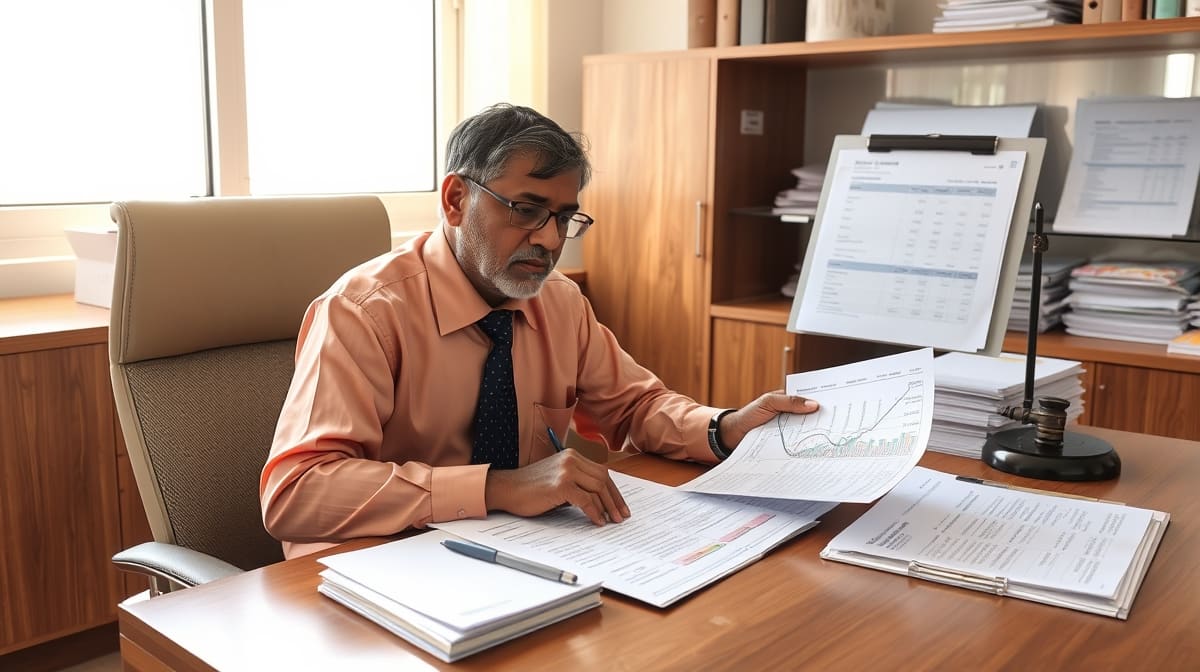
The Income Tax Appellate Tribunal, Mumbai, has reaffirmed that under Section 68 of the Income Tax Act, an assessee must establish not only the identity and genuineness of a loan transaction but also the creditor’s creditworthiness. Failure to do so renders the addition sustainable, regardless of documentary submissions. This ruling clarifies the non-negotiable nature of the three-pronged test under Section 68.
Background & Facts
The Dispute
The Income Tax Officer made an addition of Rs. 90,00,000 under Section 68 of the Income Tax Act, 1961, in respect of an unsecured loan received by the assessee, Babulal Umedmal Munot, from M/s Sanyam Gems Pvt. Ltd. for the assessment year 2013-14. Additionally, an amount of Rs. 2,47,500 was added as unexplained commission. The assessee claimed that the loan was genuine and supported by bank statements and confirmations from the lender.
Key Facts
- The assessee received Rs. 90,00,000 as an unsecured loan from M/s Sanyam Gems Pvt. Ltd. on 12.04.2013
- The loan was credited to the assessee’s bank account on 12.04.2013
- The assessee submitted a confirmation letter from M/s Sanyam Gems Pvt. Ltd. dated 15.05.2013
- Bank statements showed the receipt of Rs. 90,00,000 and subsequent utilization
- The assessee claimed no knowledge of the lender’s business or financial status
- The Assessing Officer raised doubts regarding the creditworthiness of the lender and the genuineness of the transaction
- The Ld. CIT(A) deleted both additions on the basis of the documents submitted
Procedural History
- 31.03.2014: Notice under Section 142(1) issued by Assessing Officer
- 15.07.2014: Show cause notice issued under Section 68
- 20.09.2014: Assessee submitted documents including bank statements and lender’s confirmation
- 10.12.2014: Assessment order passed under Section 143(3) making additions of Rs. 90,00,000 and Rs. 2,47,500
- 15.01.2015: Appeal filed before Ld. CIT(A)
- 15.10.2025: Ld. CIT(A) deleted both additions, holding that the assessee had discharged the burden under Section 68
- 15.11.2025: Revenue filed appeal before ITAT Mumbai
- 16.03.2026: Hearing held; no appearance by assessee
- 23.03.2026: ITAT pronounced order ex parte
The Parties' Positions
For the Revenue
The Revenue contended that the Ld. CIT(A) erred in accepting the assessee’s claim without verifying the financial capacity of M/s Sanyam Gems Pvt. Ltd. to lend Rs. 90,00,000. The submission that the assessee was unaware of the lender’s activities was deemed implausible and contrary to business norms.
For the Assessee
No appearance was made by the assessee despite notice. No written submissions were filed.
Relief Sought
The Revenue sought to set aside the order of the Ld. CIT(A) dated 15.10.2025 and restore the addition of Rs. 90,00,000 under Section 68 and Rs. 2,47,500 as commission.
The Legal Issue
The central question was whether the assessee has discharged the burden under Section 68 of the Income Tax Act by merely submitting bank statements and a confirmation letter, or whether the creditworthiness of the lender must be independently established and verified.
Arguments Presented
For the Appellant/Revenue
The Revenue relied on the settled legal position that Section 68 requires the assessee to prove three cumulative ingredients: identity of the creditor, genuineness of the transaction, and creditworthiness of the creditor. It argued that the Ld. CIT(A) failed to examine the financial position of M/s Sanyam Gems Pvt. Ltd., despite the substantial sum involved. The Revenue cited CIT v. Ravi Prakash Gupta and CIT v. M/s. Sree Ramakrishna Enterprises to emphasize that mere documentary evidence is insufficient without verification of the lender’s capacity.
For the Respondent/Assessee
No arguments were presented by the assessee, as no representative appeared despite notice.
The Court's Analysis
The Tribunal observed that while the assessee had submitted bank statements and a confirmation letter, these alone do not satisfy the requirements of Section 68. The Ld. CIT(A) had accepted the claim without addressing the critical element of creditworthiness. The Tribunal noted that the lender company had advanced a sum of Rs. 90,00,000, which, in the absence of any financial statements or audit reports, raised serious questions about its ability to make such a loan.
"It is against normal human conduct and business prudence that a person would receive a huge loan without knowing the financial background or activities of the lender."
The Tribunal held that the assessee’s claim of ignorance regarding the lender’s affairs could not be accepted as a valid defense. The burden to establish creditworthiness lies squarely on the assessee, and the Ld. CIT(A) erred in overlooking this essential component. The Tribunal further held that the deletion of the addition was based on incomplete reasoning and could not be sustained.
The Tribunal emphasized that the three ingredients under Section 68 are cumulative and interdependent. Failure to establish any one of them justifies the addition. The absence of any evidence regarding the lender’s balance sheet, net worth, or prior lending history rendered the transaction suspect.
The Verdict
The appeal of the Revenue is allowed for statistical purposes. The order of the Ld. CIT(A) dated 15.10.2025 is set aside. The matter is remanded to the Ld. CIT(A) for fresh adjudication. The Ld. CIT(A) is directed to examine the creditworthiness of M/s Sanyam Gems Pvt. Ltd. afresh, after giving the assessee a reasonable opportunity to produce relevant documents such as audited financial statements, bank statements of the lender, or any other evidence demonstrating the lender’s capacity to advance Rs. 90,00,000. The assessee is also directed to furnish such evidence within four weeks of receipt of the order.
What This Means For Similar Cases
Creditworthiness Cannot Be Assumed
- Practitioners must now ensure that in all Section 68 cases involving loans above Rs. 50 lakhs, the assessee produces audited financials or bank statements of the lender
- Merely submitting a confirmation letter or bank credit entry is no longer sufficient
- The burden to prove creditworthiness is non-delegable and must be actively discharged by the assessee
Ignorance of Lender’s Affairs Is Not a Defense
- Claims of being a passive recipient of funds will be viewed with skepticism, especially in high-value transactions
- Tax authorities and appellate forums will expect reasonable due diligence by the assessee
- In cases involving related parties or shell companies, the onus is even higher
Remand Is the Preferred Remedy Over Direct Addition
- Tribunals are increasingly inclined to remand rather than directly uphold additions where procedural fairness is compromised
- This provides a procedural safeguard for assessees while upholding substantive compliance
- Practitioners should prepare for remand proceedings by collecting lender’s financials proactively