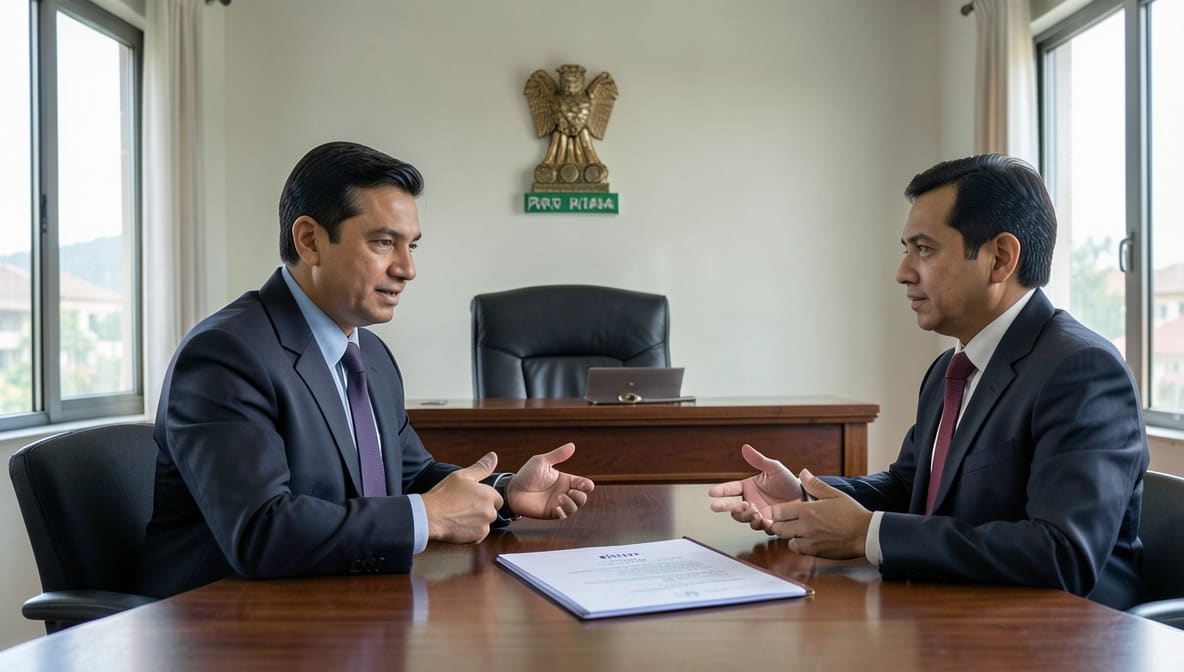
The Himachal Pradesh High Court has affirmed that even when offences are committed against a public servant, criminal proceedings may be quashed upon mutual compromise if the acts do not constitute heinous or socially harmful crimes. This decision reinforces the nuanced application of inherent powers under Section 528 of the Bharatiya Nagarik Suraksha Sanhita, 2023, particularly where societal interest is not significantly compromised.
Background & Facts
The Dispute
The dispute arose from an alleged altercation on 31.12.2020 at approximately 11:15 AM in the office of Sh. Manoj Kumar, Additional Director, Department of Tourism, Shimla. The petitioner, Gaurav Sharma, accompanied by his wife, Smt. Priyanka, entered the complainant’s office and allegedly pulled him by the collar, threatened him, and accused him of corruption. The complainant further alleged that he was physically assaulted during the incident. Based on this complaint, FIR No. 122 of 2020 was registered at Police Station, East Shimla, under Sections 452, 353, 332, 504, 506 of the Indian Penal Code and Section 3 of the Prevention of Damage to Public Property Act, 1984 (PDP Act).
Key Facts
- The incident occurred on 31.12.2020 at the complainant’s official workplace.
- The complainant was discharging official duties at the time of the incident.
- The petitioner and his wife were identified as the alleged perpetrators.
- The complainant filed a formal complaint leading to the registration of FIR on the same day.
- The investigation was completed and a challan was filed before the competent court.
- No injuries or medical reports were cited in the FIR or challan.
- The alleged offences were non-violent in nature, involving threats, intimidation, and minor physical contact without serious bodily harm.
Procedural History
- 31.12.2020: FIR No. 122 of 2020 registered at East Shimla Police Station.
- Post-investigation: Challan submitted to the trial court.
- 2025: Petitioner filed Cr.MMO No. 806 of 2025 under Section 528 of BNSS seeking quashing of FIR and all proceedings.
- 24.03.2026: Hearing before the High Court of Himachal Pradesh, Shimla.
The Parties' Positions
For the Petitioner
The petitioner admitted to the incident, expressed remorse, and tendered an unconditional apology before the Court. He undertook on oath that neither he nor his wife would ever harass or misbehave with the complainant again. He submitted that the dispute was personal and had no broader societal implications.
For the Respondent/Complainant
The complainant, represented by Mr. Balwant Kukreja, appeared before the Court and stated that he had no grievance against the petitioner. He accepted the apology unconditionally, affirmed that the matter was settled amicably, and requested that the criminal proceedings be quashed. He emphasized that his decision was voluntary and free from external pressure.
Relief Sought
The petitioner sought quashing of FIR No. 122 of 2020 and all consequential proceedings pending before the trial court, along with acquittal of the charges framed against him.
The Legal Issue
Can the High Court exercise its inherent power under Section 528 of the Bharatiya Nagarik Suraksha Sanhita, 2023 to quash an FIR involving offences against a public servant, where the parties have compromised and the alleged acts do not amount to heinous or socially destructive crimes?
Arguments Presented
For the Petitioner
The petitioner relied on Narinder Singh v. State of Punjab and Gian Singh v. State of Punjab to argue that the Court’s inherent power under Section 528 BNSS is not confined to compoundable offences and may be invoked where the nature of the offence is personal, non-heinous, and the parties have reached a genuine settlement. He emphasized that the alleged acts - threats, minor pulling, and verbal abuse - were not indicative of moral turpitude or grave criminality. He further submitted that continuing proceedings would serve no public purpose and would amount to abuse of process.
For the Respondent/State
The Additional Advocate General acknowledged the compromise but cautioned that the complainant was a public servant discharging official duties, and offences under Sections 353 and 332 IPC involve assault on public servants, which may have a deterrent dimension. He urged the Court to impose conditions rather than quash the FIR outright, to preserve the sanctity of public office and deter future misconduct.
The Court's Analysis
The Court undertook a detailed review of the Supreme Court’s jurisprudence on the exercise of inherent powers under Section 482 CrPC (now Section 528 BNSS). It noted that while the power to quash is broad, it is not unfettered. The Court emphasized the distinction between offences that are inherently public in nature - such as murder, rape, dacoity, or corruption - and those that are personal, private, and devoid of societal impact.
"The power conferred under Section 482 of the Code (now Section 528 of BNSS) is to be distinguished from the power which lies in the Court to compound the offences under Section 320 of the Code."
The Court observed that the offences alleged - Sections 452 (trespass), 353 (assault to deter public servant), 332 (voluntarily causing hurt to deter public servant), 504 (intentional insult), 506 (criminal intimidation), and Section 3 PDP Act - are not offences of moral depravity or grave social consequence. The absence of serious injury, medical evidence, or prior history of violence supported the characterization of the incident as a personal dispute.
The Court further relied on Dimpey Gujral v. Union Territory, Chandigarh, which held that continuation of proceedings in such cases would amount to abuse of process, particularly when the parties have resolved their differences. The Court noted that the complainant’s voluntary acceptance of the apology and his explicit request for quashing weighed heavily in favor of settlement.
The Court rejected the State’s argument that the victim’s status as a public servant automatically rendered the offence non-compoundable. It held that while public servants deserve protection, the nature of the act - not the status of the victim - determines whether the offence is heinous. Here, the conduct was transient, non-violent, and resolved without coercion.
The Verdict
The petition was allowed. The Court quashed FIR No. 122 of 2020 registered under Sections 452, 353, 332, 504, 506 of IPC and Section 3 of the PDP Act. All consequential proceedings pending before the trial court were set aside. The petitioner was acquitted of all charges. The Court directed that the petitioner and his wife shall not harass or misbehave with the complainant in future, and any violation shall invite strict legal action.
What This Means For Similar Cases
Compromise Can Override Public Servant Status
- Practitioners may now argue that the status of the victim as a public servant does not automatically bar quashing if the underlying act is minor and personal.
- The focus must shift from the victim’s profession to the nature, gravity, and social impact of the alleged offence.
- In cases involving threats, minor scuffles, or verbal abuse during personal disputes, settlement should be considered a valid ground for quashing.
Judicial Restraint in Applying Narinder Singh
- Narinder Singh does not create a blanket bar on quashing in cases involving public servants; it prohibits quashing only in cases of heinous, socially destructive crimes.
- Courts must conduct a fact-specific analysis: Was the act violent? Was there intent to intimidate the institution? Was the compromise genuine?
- The absence of injury reports, prior criminal history, or systemic misconduct supports a finding of non-heinous character.
Settlement Must Be Genuine and Voluntary
- A compromise must be recorded on oath and free from coercion or undue influence.
- Courts should not accept settlements that appear to be tactical delays or attempts to evade accountability.
- Undertakings to behave in future, when given on oath, may serve as sufficient safeguards without requiring continued prosecution.