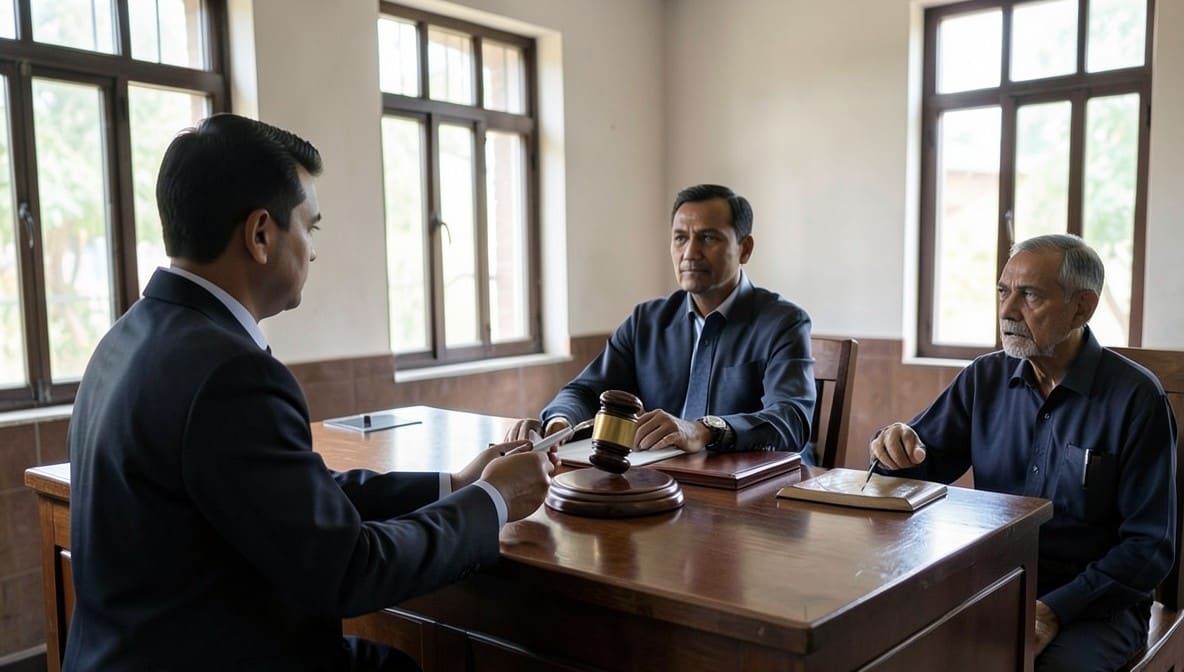
The Allahabad High Court has reaffirmed that bail, once granted, cannot be cancelled on the mere basis of a subsequent First Information Report unless there is concrete evidence of misuse of liberty, interference with investigation, or threat to witnesses. The judgment underscores the constitutional imperative to protect personal liberty under Article 21 and sets a strict threshold for revocation of bail.
Background & Facts
The Dispute
The applicant, Vishal Rajbhar, was named in a First Information Report (FIR) dated 01.02.2023, Case Crime No. 41 of 2023, lodged at Police Station Sarnath, District Varanasi, under Sections 363, 366, 376 IPC and Section 3/4 of the POCSO Act. The complainant alleged that his 17-year-old daughter had left home on 31.01.2023 and married the applicant in a temple ceremony. The applicant claimed to be a juvenile, citing his high-school certificate showing a date of birth of 01.01.2006.
Key Facts
- The victim’s high-school certificate recorded her date of birth as 02.04.2006, making her 16 years old at the time of the alleged incident.
- The Juvenile Justice Board (JJB) conducted an age determination inquiry and declared the applicant a juvenile on 27.03.2023.
- Bail was granted to the applicant by the JJB on 06.04.2023, following interim bail granted on 22.02.2023.
- The charge-sheet was filed on 24.01.2024 in the POCSO Court after framing of charges.
- On 27.06.2024, a second FIR, Case Crime No. 290 of 2024, was lodged by the victim’s father under Sections 384, 386, 506 IPC, alleging extortion and threats by the applicant.
- The investigation into the second FIR revealed that the co-accused, Golu, was exonerated; charges under Sections 384 and 386 IPC were dropped; only Section 506 IPC and Section 67-A of the Information Technology Act were pursued.
- The victim’s statement under Section 161 Cr.P.C. and Section 164 Cr.P.C. in the first case contained no allegations against the applicant.
- The victim, examined as PW-1 on 28.02.2025 in the trial court, made no reference to the allegations in the second FIR.
- The District Probation Officer’s report (Annexure-10) confirmed no criminal antecedents and positive social conduct by the applicant.
- The second FIR was lodged eight days after the alleged incident, with no satisfactory explanation for the delay.
Procedural History
- 01.02.2023: FIR No. 41 of 2023 lodged under IPC and POCSO Act.
- 27.03.2023: JJB declared applicant a juvenile.
- 22.02.2023: Interim bail granted by JJB.
- 06.04.2023: Bail made absolute by JJB.
- 24.01.2024: Charges framed in POCSO Court.
- 27.06.2024: Second FIR (No. 290 of 2024) lodged under Sections 384, 386, 506 IPC.
- 01.07.2024: Bail cancellation application filed by victim’s father.
- 21.04.2025: Trial Court cancelled bail, citing the second FIR.
- 20.05.2025: Application under Section 528 BNSS filed before the Allahabad High Court.
Relief Sought
The applicant sought setting aside of the bail cancellation order dated 21.04.2025, restoration of his bail, and quashing of any coercive process issued thereafter.
The Legal Issue
The central question was whether the registration of a subsequent FIR, without proof of actual violation of bail conditions or supervening misconduct, constitutes sufficient ground for cancellation of bail previously granted by the Juvenile Justice Board.
Arguments Presented
For the Applicant
The applicant’s counsel argued that the second FIR was fabricated to create a pretext for bail cancellation. He emphasized that the victim had retracted her initial allegations, the investigation into the second FIR was incomplete, charges under Sections 384 and 386 IPC were dropped, and the co-accused was exonerated. He cited Godson v. State of Kerala and Dolat Ram v. State of Haryana to assert that cancellation of bail requires cogent evidence of misuse, not mere accusation. He further contended that the applicant, being a juvenile with no criminal antecedents, had not violated any bail condition and posed no threat to witnesses or investigation.
For the Respondent
The State and complainant’s counsel argued that the second FIR disclosed a pattern of criminal conduct - extortion and threats - and thus justified cancellation. They contended that the applicant’s continued liberty endangered the trial and that the mere registration of a non-bailable offence was sufficient to warrant revocation. They relied on the trial court’s finding that the applicant was absconding and had violated the spirit of bail.
The Court's Analysis
The Court undertook a comprehensive review of the legal principles governing bail cancellation, drawing extensively from Supreme Court precedents. It emphasized that bail is not a privilege to be revoked on suspicion or procedural convenience, but a constitutional right protected under Article 21.
"Bail once granted should not be cancelled in a mechanical manner without considering whether any supervening circumstances have rendered it no longer conducive to a fair trial to allow the accused to retain his freedom by enjoying the concession of bail during the trial."
The Court noted that the trial court had relied solely on the registration of the second FIR, without examining its veracity, the delay in lodging it, the withdrawal of key charges, or the victim’s testimony in court. The Court observed that the victim, who was the sole witness to the alleged extortion, had not made any such allegation during her examination as PW-1.
The Court distinguished between the grounds for rejecting bail initially and those for cancelling it. While the former involves a prima facie assessment, the latter demands proof of actual misconduct. The Court held that the second FIR, even if prima facie credible, did not establish that the applicant had interfered with the investigation, threatened witnesses, or absconded.
"The absence of any post-release misconduct is a compelling reason to reject an application for cancellation of bail."
The Court further observed a troubling trend where complainants lodge fresh FIRs to circumvent the grant of bail, calling such practices an abuse of process. It held that the trial court’s order was perverse, based on irrelevant considerations, and ignored the JJB’s prior determination of the applicant’s juvenile status and conduct.
The Court also underscored that Section 528 BNSS provides an independent remedy to challenge illegal bail cancellation orders, rejecting the preliminary objection that the applicant must surrender first.
The Verdict
The applicant succeeded. The Allahabad High Court set aside the bail cancellation order dated 21.04.2025 and restored the bail granted by the Juvenile Justice Board on 06.04.2023. The Court quashed all consequential coercive orders issued against the applicant, including any non-bailable warrant. No costs were awarded.
What This Means For Similar Cases
Bail Cancellation Requires Concrete Evidence, Not Allegations
- Practitioners must challenge bail cancellation orders that rely solely on unproven or uninvestigated FIRs.
- The burden lies on the prosecution to demonstrate actual misuse of bail, not merely allege new offences.
- A fresh FIR, even under non-bailable sections, cannot be the sole basis for revocation unless linked to conduct that threatens the trial process.
Juvenile Status and Absence of Antecedents Are Critical Factors
- Courts must give weight to prior juvenile board findings and probation reports when assessing bail cancellation.
- A clean social record and lack of criminal history significantly strengthen the case against cancellation.
- The age determination process under the Juvenile Justice Act must be respected and not undermined by subsequent procedural manipulation.
Courts Must Resist Procedural Abuse Through Strategic FIRs
- Lawyers should flag and seek judicial notice of patterns where complainants file delayed or inconsistent FIRs post-bail to trigger cancellation.
- Delay in lodging FIRs without explanation, coupled with selective prosecution of co-accused, may indicate mala fide intent.
- Courts are now on notice that such tactics will be treated as abuse of process under Section 482 Cr.P.C. / Section 528 BNSS.