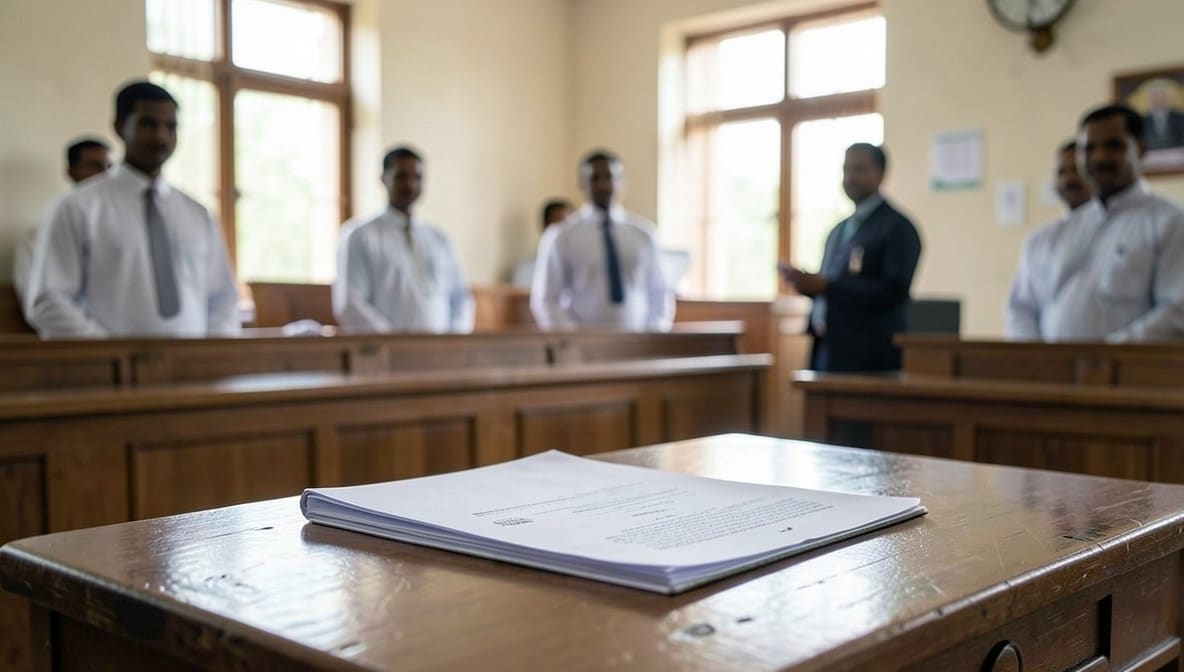
The Allahabad High Court has granted bail to an accused in a POCSO case despite serious allegations, emphasizing that procedural irregularities and evidentiary gaps cannot be ignored at the pre-trial stage. The order underscores that bail is not a denial of guilt but a recognition of the accused’s right to liberty pending fair trial, particularly where the prosecution’s case is marred by delay and inconsistency.
Background & Facts
The Dispute
The applicant, Aditya Singh, is accused in Case Crime No. 67 of 2026 registered at Police Station Mangalpur, District Kanpur Dehat, under Sections 74, 77, 115(2), 308(5), 351(3) of the Bharatiya Nagarik Suraksha Sanhita, 2023 (BNS), and Sections 7 and 8 of the Protection of Children from Sexual Offences Act, 2012 (POCSO Act). The allegations center on the claim that the applicant recorded obscene photographs of the minor victim, made them viral, and coerced her into transferring money to his bank account.
Key Facts
- The victim is the daughter of the first informant.
- The FIR was lodged on a date more than one and a half years after the alleged incident.
- No obscene photographs or videos of the victim were recovered from the applicant’s mobile phone or any digital device.
- The prosecution relies solely on the statements of the victim recorded under Sections 180 and 183 of the Bharatiya Nagarik Suraksha Sanhita, 2023.
- Material contradictions are alleged to exist between these statements.
- A co-accused, Shyam Gupta @ Shubham Gupta, has already been granted bail by a coordinate bench of the same High Court.
- The applicant has been in judicial custody since 24.03.2026.
Procedural History
- Date of alleged incident: Not specified in judgment, but inferred to be prior to 24.09.2024 (one and a half years before FIR filing).
- FIR registration date: Not explicitly stated, but filed after a delay of one and a half years from the incident.
- 24.03.2026: Applicant arrested and taken into custody.
- 27.05.2026: Bail application filed under Section 483 of BNSS before the Allahabad High Court.
The Parties' Positions
For the Applicant
- The applicant has been falsely implicated.
- The FIR is unduly delayed, undermining the credibility of the prosecution’s case.
- There is no digital evidence - no obscene photographs or videos recovered from the applicant’s phone.
- The victim’s statements under Sections 180 and 183 BNSS contain material contradictions.
- The applicant undertakes to comply with all bail conditions and will not interfere with the investigation or trial.
- The trial is unlikely to conclude soon due to heavy pendency.
For the Respondent/State
- The applicant used obscene photographs to extort money from the victim.
- The allegations under POCSO Act are grave and warrant continued custody.
- The delay in filing FIR does not automatically invalidate the case.
- The nature of the offence demands strict scrutiny and denial of bail.
Relief Sought
The applicant sought release on bail during the pendency of trial, with conditions to ensure non-interference with the judicial process.
The Legal Issue
Can bail be granted in a POCSO case where the prosecution lacks digital evidence, the FIR is delayed by over a year and a half, and the victim’s statements contain material contradictions, without prejudicing the trial?
Arguments Presented
For the Appellant/Petitioner
The applicant’s counsel relied on the absence of corroborative evidence, particularly the non-recovery of any obscene photographs or videos, to challenge the prima facie case. He cited Arnesh Kumar v. State of Bihar to argue that gravity of offence alone cannot override the presumption of innocence. He emphasized that contradictions in statements recorded under Sections 180 and 183 BNSS - meant to capture the victim’s version at the earliest - undermine the reliability of the prosecution’s narrative. The delay in filing the FIR, he argued, raises serious questions about the spontaneity and truthfulness of the allegations. He further noted that a co-accused had already been granted bail, making denial of bail to the applicant arbitrary.
For the Respondent/State
The State and the first informant’s counsel contended that offences under POCSO are heinous and require stringent measures. They argued that the nature of the crime - sexual exploitation and extortion of a minor - demands that the accused remain in custody to prevent tampering with evidence or witnesses. They maintained that delay in FIR does not automatically entitle the accused to bail, especially where the victim’s testimony remains the cornerstone of the case. They also asserted that the absence of digital evidence does not negate the possibility of deletion or destruction of data.
The Court's Analysis
The Court undertook a careful review of the record without expressing any opinion on the merits of the case. It acknowledged the seriousness of allegations under the POCSO Act but emphasized that bail jurisprudence must balance the rights of the accused with the interests of justice. The Court noted that the prosecution had not produced any physical or digital evidence to substantiate the claim that obscene photographs were taken or disseminated. The Court observed:
"There is no evidence regarding any obscene photograph or video of the victim being clicked by the applicant from his mobile phone and there appears to be material contradictions in the statements of the victim recorded under sections 180 and 183 BNSS."
The Court further highlighted that the delay of one and a half years in lodging the FIR, without any plausible explanation, casts doubt on the immediacy and credibility of the allegations. It also took note of the fact that a co-accused had already been granted bail by a coordinate bench, making differential treatment unjustified in the absence of distinguishing factors. The Court reiterated that bail is the rule and jail the exception, particularly where the trial is likely to be protracted due to judicial pendency. The Court explicitly clarified that its decision was confined to the bail stage and did not prejudge the outcome of the trial.
The Verdict
The bail application is allowed. The applicant, Aditya Singh, shall be released on bail upon furnishing a personal bond of Rs. 50,000 with two sureties each in the like amount. He must comply with five strict conditions: (i) no intimidation or inducement of witnesses; (ii) no pressure on prosecution witnesses; (iii) personal appearance before the trial court for opening of case, framing of charge, and recording of statement under Section 351 BNSS; (iv) no request for adjournments when witnesses are present; and (v) presence before the court on all dates, personally or through counsel. Breach of any condition shall lead to immediate cancellation of bail. The Court clarified that its order does not affect the trial court’s independent evaluation of evidence.
What This Means For Similar Cases
Delayed FIR and Lack of Digital Evidence Can Support Bail in POCSO Cases
- Practitioners may now argue that delay in FIR, especially exceeding one year, without explanation, weakens the prosecution’s case at the bail stage.
- Absence of recovered digital evidence (photos, videos, messages) must be raised as a material defect in the prima facie case.
- Courts are increasingly willing to grant bail where the prosecution’s case rests solely on the victim’s statement with no corroboration.
Contradictions in BNSS Sections 180/183 Statements Are Material
- Statements recorded under Sections 180 and 183 BNSS are critical for early case assessment; contradictions here can undermine credibility.
- Defence counsel should systematically compare these statements with later testimonies and highlight inconsistencies in bail applications.
- Prosecution must now anticipate challenges to the reliability of early victim statements even in sensitive cases.
Co-Accused Bail Creates Presumption of Equal Treatment
- When a co-accused is granted bail on similar facts, denial of bail to another accused without distinguishing grounds may be viewed as arbitrary.
- This principle reinforces the doctrine of equal protection under Article 14 and may be invoked in other multi-accused cases under POCSO or BNSS.
Bail Conditions Are Non-Negotiable and Strictly Enforceable
- The Court imposed precise, non-negotiable conditions - especially regarding adjournments and witness contact.
- Practitioners must advise clients to strictly comply; any violation will result in automatic cancellation, regardless of intent.
- Undertakings must be filed in writing and signed before the court.