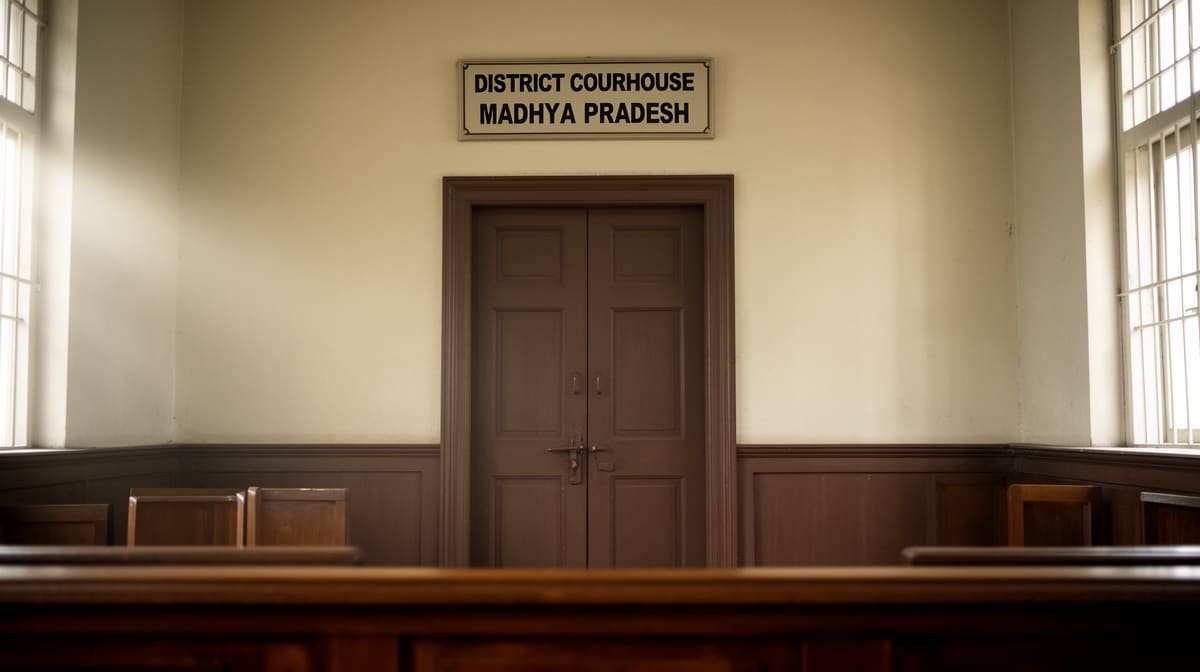
The Madhya Pradesh High Court has reaffirmed that the inherent powers under Section 482 of the Code of Criminal Procedure cannot be used to override statutory appellate remedies or to quash convictions for serious non-compoundable offences merely because the parties have reached a compromise after trial. This ruling reinforces the principle that societal interests outweigh private settlements in cases involving dowry-related cruelty.
Background & Facts
The Dispute
The petitioners, including Sunil Jatav, were convicted by the Trial Court under Section 498-A IPC, Section 324 IPC, and Section 4 of the Dowry Prohibition Act for subjecting the complainant, his wife Vidya, to cruelty and physical assault over dowry demands. The conviction followed a full trial with evidence recorded. During the pendency of their appeal before the Additional Sessions Judge, the parties filed a compromise application, asserting they had reconciled and were living together.
Procedural History
- 2020: Crime No. 18/2020 registered at Police Station Pichhore, Shivpuri
- 2025: Trial Court convicted petitioners on all charges
- 2026: Appeal filed before Additional Sessions Judge; compromise application submitted
- 27/01/2026: Appellate Court acquitted petitioners on minor charges under Sections 323/34 and 506 Part-II IPC but upheld conviction under Sections 498-A IPC, 324 IPC, and Section 4 of the Dowry Prohibition Act
- Petition filed: Under Section 482 CrPC seeking quashment of remaining conviction
Relief Sought
The petitioners sought quashing of the conviction under Sections 498-A IPC, 324 IPC, and Section 4 of the Dowry Prohibition Act on grounds of compromise, arguing that continuation of conviction would jeopardize Sunil Jatav’s service as a Sub-Inspector.
The Legal Issue
The central question was whether Section 482 CrPC permits a High Court to quash a conviction recorded after trial and upheld in part by the Appellate Court, solely on the basis of a post-conviction compromise in cases involving non-compoundable offences with societal implications.
Arguments Presented
For the Petitioner
Counsel relied on Ramgopal & Anr. v. State of M.P., Naveen v. State of M.P., and Hasib Khan v. State of M.P. to argue that the Court’s inherent powers under Section 482 CrPC can be exercised even at the post-conviction stage when the offence is essentially private and parties have reconciled. They contended that the social purpose of the Dowry Prohibition Act is fulfilled once the victim-wife is reconciled with her husband, and continued prosecution serves no public interest.
For the Respondent/State
The Government Advocate argued that Section 482 CrPC cannot be used as a substitute for appellate review. Once a conviction is recorded and an appeal is pending, the statutory remedy under Chapter XXIX CrPC is the exclusive avenue for relief. Invoking inherent jurisdiction at this stage would undermine the appellate structure and convert the High Court into a parallel forum.
The Court's Analysis
The Court examined the scope of Section 482 CrPC in light of binding precedents from the Supreme Court. It emphasized that while the High Court possesses inherent power to quash proceedings, such power must be exercised sparingly and never to circumvent statutory appellate mechanisms.
"The inherent jurisdiction under Section 482 Cr.P.C. cannot be exercised as a substitute for appellate jurisdiction."
The Court distinguished the petitioners’ case from Ramgopal and Gopal, noting that in those cases, the Supreme Court exercised powers under Article 142 of the Constitution to do complete justice, not under Section 482. Moreover, those cases involved appeals challenging the conviction itself, whereas here, the petitioners had not challenged the legality of the conviction but merely sought quashing on compromise.
The Court held that Section 498-A IPC and Section 4 of the Dowry Prohibition Act are not mere private disputes but offences with grave societal consequences. The Dowry Prohibition Act is a social welfare legislation aimed at eradicating a deep-rooted evil, and allowing quashing on compromise would dilute its deterrent effect.
The Court also rejected the argument that service consequences to the petitioner justified interference. It held that collateral consequences of conviction, however severe, cannot override the statutory scheme of criminal justice. The Appellate Court had already considered the compromise and made a reasoned decision to uphold the core convictions - a decision that must be respected.
The Verdict
The petition was dismissed. The Court held that Section 482 CrPC cannot be invoked to quash convictions under Section 498-A IPC and Section 4 of the Dowry Prohibition Act after trial and during pendency of appeal, even in the presence of a compromise. The statutory appellate process remains the exclusive remedy.
What This Means For Similar Cases
Post-Conviction Compromise Is Not a Ground for Quashing
- Practitioners must advise clients that reconciliation after conviction does not automatically entitle them to quashment under Section 482 CrPC
- Courts will scrutinize whether the offence has societal impact before considering compromise
- In dowry, domestic violence, or sexual offence cases, compromise alone is insufficient to override public interest
Appellate Remedy Is Exclusive
- A petition under Section 482 CrPC filed during pendency of appeal will be dismissed as an abuse of process
- Parties must exhaust statutory remedies before seeking extraordinary relief
- High Courts will not act as parallel appellate forums
Service Consequences Are Collateral
- Threats to employment, promotions, or service status cannot be grounds for quashing criminal convictions
- Legal practitioners must separate civil consequences from criminal liability in advice to clients
- Courts will not entertain petitions framed as service protection tools disguised as criminal quashment applications