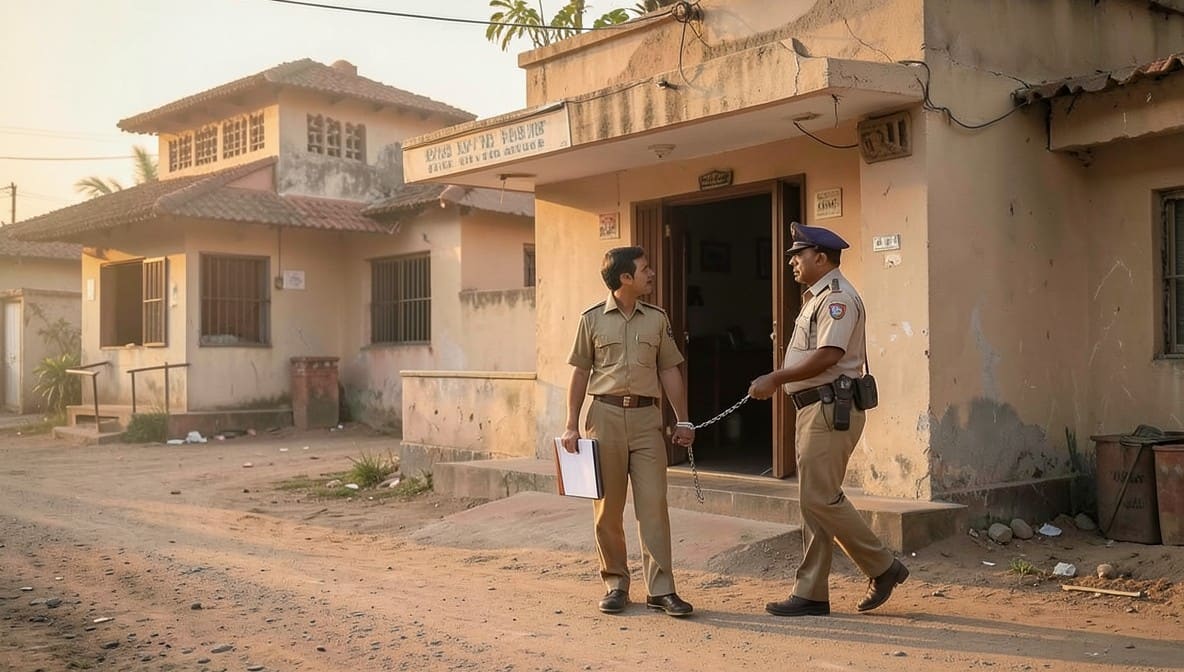
The Kerala High Court has clarified that pre-arrest bail may be granted even in serious non-bailable offences when the accused is not named in the original complaint and no material connects them to the alleged criminal conspiracy. This ruling reinforces the principle that arrest is not automatic and custodial interrogation must be genuinely necessary.
Background & Facts
The Dispute
The applicant, Subeesh, aged 45, is accused in Crime No. 401/2024 registered at Kunnamkulam Police Station, Thrissur, under Sections 406, 420, 464, 465, 467, 468 and 471 read with Section 34 of the Indian Penal Code, 1860. The prosecution alleges that Subeesh, along with four other accused, conspired to cheat the de facto complainant by forging property documents and mortgaging the complainant’s land to a financial institution to obtain a loan of Rs. 65,00,000.
Key Facts
- The alleged offence occurred nine years prior to the registration of the crime, on or around 2015.
- The case was initiated through a private complaint filed before the Judicial First Class Magistrate Court, Kunnamkulam.
- The private complaint does not name Subeesh as an accused.
- The primary allegations are directed against the wife of the de facto complainant and bank officials.
- Subeesh has no prior criminal record.
- The case diary and complaint documents contain no specific allegations or evidence directly linking Subeesh to the forgery, conspiracy, or financial transaction.
- The applicant was not named in the FIR or any charge sheet at the time of the bail application.
Procedural History
- 2015: Alleged fraudulent mortgage and loan availing.
- 2024: Crime No. 401/2024 registered by Kunnamkulam Police Station.
- 2026: Bail Application No. 1948 of 2026 filed under Section 482 of the Bharatiya Nagarik Suraksha Sanhita, 2023.
- 03.06.2026: Hearing before the High Court of Kerala at Ernakulam.
The Parties' Positions
For the Applicant: The counsel argued that Subeesh is falsely implicated, with no material on record connecting him to the alleged conspiracy. The absence of his name in the private complaint and FIR, coupled with the lapse of nine years, undermines the prosecution’s case. Custodial interrogation is unnecessary and disproportionate.
For the Respondent/State: The Senior Public Prosecutor contended that the nature of the offences - forgery, cheating, and criminal conspiracy - warrants custodial interrogation to unravel the full extent of the conspiracy and prevent evidence tampering. Release on pre-arrest bail may impede the investigation.
Relief Sought
The applicant sought pre-arrest bail under Section 482 BNSS, seeking protection from arrest until further orders, subject to reasonable conditions.
The Legal Issue
The central question was whether pre-arrest bail under Section 482 BNSS can be granted to an accused who is not named in the original private complaint and against whom no specific allegations or material evidence have been adduced, despite the gravity of the alleged offences.
Arguments Presented
For the Appellant/Petitioner
The learned counsel relied on the principle that arrest is not a rule but an exception, as affirmed in Arnesh Kumar v. State of Bihar. He emphasized that the absence of the applicant’s name in the private complaint and FIR, the long delay of nine years, and the lack of any direct evidence linking him to the forgery or financial transaction render custodial interrogation unnecessary. He cited State of Haryana v. Bhajan Lal to argue that the court must examine whether the complaint discloses a prima facie case against the applicant.
For the Respondent/State
The Senior Public Prosecutor argued that the offences under Sections 467 and 468 IPC involve serious forgery of documents and are non-bailable. The involvement of a financial institution and a substantial loan amount of Rs. 65,00,000 indicates a well-planned conspiracy. The State contended that release on bail at this stage may allow the accused to influence witnesses or destroy evidence, especially given the complexity of document verification.
The Court's Analysis
The Court examined the nature of the complaint and the procedural posture of the case. It noted that the private complaint, which initiated the investigation, made no mention of the applicant. The FIR, while naming him as an accused, did not contain any specific averments regarding his role, actions, or involvement in the alleged forgery or loan transaction.
"The applicant has not been named in the private complaint. There is no allegation against him. The main allegation was against the wife of the de facto complainant and also against the bank officials."
The Court observed that the prosecution had not placed any material on record to establish a prima facie connection between the applicant and the alleged criminal conspiracy. The lapse of nine years since the alleged incident further weakened the urgency for custodial interrogation.
The Court distinguished this case from those where the accused is a central conspirator or where the complaint explicitly names the individual. It held that in the absence of any direct allegation or incriminating material, the requirement of custodial interrogation is not established. The Court also noted the applicant’s clean record and the fact that he had not fled or attempted to obstruct justice.
The Court emphasized that Section 482 BNSS empowers the High Court to grant pre-arrest bail where the circumstances indicate that arrest is not necessary for the purposes of investigation. The Court found that the applicant’s cooperation could be secured through non-custodial conditions without compromising the investigation.
The Verdict
The application for pre-arrest bail was allowed. The applicant shall be released on bail upon arrest, subject to the following conditions: (i) execution of a personal bond of Rs. 1,00,000 with two solvent sureties of the like amount; (ii) cooperation with investigation including deemed police custody for discovery; (iii) appearance before the investigating officer every Saturday between 10.00 a.m. and 11.00 a.m. and as otherwise required; (iv) no commission of similar offences; (v) no contact with prosecution witnesses or tampering with evidence; (vi) no departure from the State of Kerala without court permission; and (vii) any application for modification or cancellation of bail shall be filed in the jurisdictional court.
What This Means For Similar Cases
Absence in Complaint Is a Critical Factor
- Practitioners must now argue that if an accused is not named in the original private complaint or FIR, the prosecution bears a higher burden to establish a prima facie link.
- Courts are likely to scrutinize whether the inclusion of an accused in the FIR is based on independent evidence or mere inclusion by association.
Custodial Interrogation Must Be Justified
- The judgment reinforces that custodial interrogation is not automatic even in serious non-bailable offences.
- Delay in registration of FIR, absence of direct allegations, and lack of incriminating material are valid grounds to deny custody.
Pre-Arrest Bail as a Proportionate Remedy
- Pre-arrest bail under Section 482 BNSS is a viable remedy where the accused is peripheral to the alleged conspiracy.
- Courts may impose strict non-custodial conditions (e.g., weekly appearances, travel restrictions) to ensure investigation integrity without detention.
Documentary Evidence Trumps Allegations
- The judgment underscores that allegations without supporting documentation or direct linkage are insufficient to justify arrest.
- Practitioners should request production of the original complaint and FIR at the earliest stage to challenge the basis of inclusion.