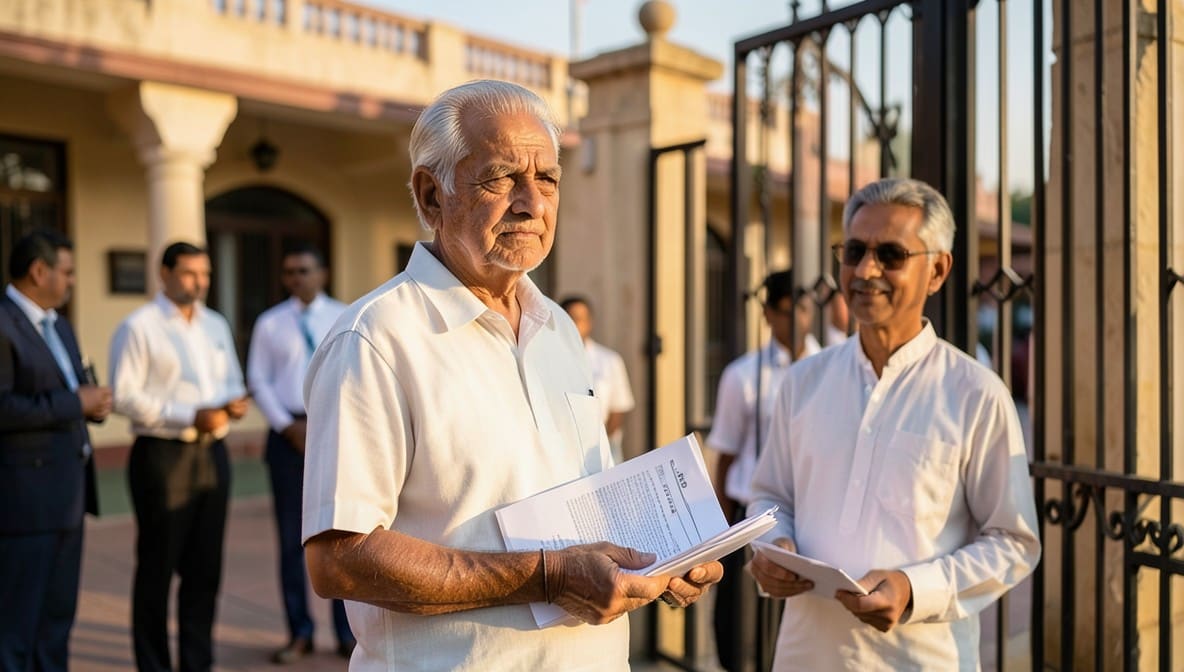
The Rajasthan High Court has clarified that suspension of sentence under Section 389 CrPC is not contingent upon a conclusive finding of innocence, but on the prima facie arguability of grounds raised in appeal. This ruling reinforces the principle that prolonged incarceration during pendency, especially when not attributable to the accused, constitutes a denial of justice.
Background & Facts
The Dispute
The appellant, Raja Ram, aged approximately 68 years, was convicted and sentenced on 21.04.2026 by the Special Judge, NDPS Case, District Hanumangarh, in Sessions Case No. 83/2019. He was found guilty under Section 8 and Section 15 of the Narcotic Drugs and Psychotropic Substances Act, 1985, and sentenced to two years' rigorous imprisonment and a fine of Rs. 20,000.
Key Facts
- The appellant was arrested and remained on bail during trial.
- He did not misuse his liberty while on bail.
- The conviction was based on evidence collected during a drug seizure operation.
- The appellant has filed a criminal appeal challenging the conviction on grounds of improper appreciation of evidence and procedural irregularities.
- The appeal (S.B. Criminal Appeal No. 824/2026) remains pending before the High Court.
Procedural History
- 21.04.2026: Trial Court convicted the appellant and imposed sentence of 2 years RI + Rs. 20,000 fine.
- 29.04.2026: Application for suspension of sentence filed under Section 389 CrPC before the Rajasthan High Court.
- 29.04.2026: Hearing conducted and order passed on the same day.
Relief Sought
The appellant sought suspension of his sentence pending disposal of his criminal appeal, and release on bail with appropriate conditions.
The Legal Issue
The central question was whether the appellate court may suspend a sentence under Section 389 of the Code of Criminal Procedure when the appeal raises substantial and arguable grounds, even if the conviction has not been finally set aside.
Arguments Presented
For the Appellant
Learned counsel for the appellant submitted that the trial court failed to properly evaluate the evidence, and the conviction is vulnerable to reversal on appeal. He emphasized that the appellant has remained on bail throughout the trial without any breach, and the appeal involves complex questions of evidence appreciation. He relied on Muna Bisoi v. State of Odisha and Kashmira Singh v. State of Punjab to argue that prolonged pendency of appeals, not caused by the accused, warrants suspension of sentence to prevent undue incarceration.
For the Respondent
The Public Prosecutor opposed the application, contending that the gravity of the offence under the NDPS Act and the finality of conviction militate against suspension. He argued that suspension should be granted only in exceptional cases and that the appellant had not demonstrated a clear likelihood of success on appeal.
The Court's Analysis
The Court emphasized the distinction between bail under Section 439 CrPC and suspension of sentence under Section 389 CrPC. While the former applies pre-conviction, the latter operates post-conviction and requires the appellate court to assess whether the appeal discloses a prima facie substantial and arguable case.
"While the presumption of innocence stands displaced upon conviction, the appellate court is required to evaluate whether the grounds raised in appeal disclose a substantial and arguable case."
The Court held that it is not required to make a final determination on the merits at this stage, as doing so would prejudice the final adjudication. The appellate jurisdiction, being a continuation of the trial, permits re-appreciation of evidence. The Court noted that the Supreme Court in Muna Bisoi recognized prolonged pendency as a valid ground for suspension, particularly when delay is not attributable to the convict.
The Court further cited Kashmira Singh to underscore that continued incarceration during lengthy appeals amounts to a travesty of justice. It observed that the High Court’s own backlog renders early disposal uncertain, and denying suspension in cases with arguable grounds would perpetuate systemic injustice.
The Court concluded that the issues raised in the appeal - particularly concerning evidence appreciation and procedural compliance - warrant re-examination and present a fair possibility of success. The nature of the offence, while serious, does not preclude suspension where the appeal is not frivolous.
The Verdict
The application for suspension of sentence was allowed. The sentence of two years' rigorous imprisonment and fine of Rs. 20,000 imposed by the trial court is suspended pending final disposal of the appeal. The appellant is released on bail upon executing a personal bond of Rs. 50,000 with two sureties of Rs. 25,000 each, to be approved by the trial judge. He must appear before the trial court every January until the appeal is decided, notify the court and High Court counsel of any change in residence, and ensure sureties report address changes in writing. Failure to appear will result in cancellation of bail, to be reported by the trial court to the High Court.
What This Means For Similar Cases
Suspension Is Not a Privilege But a Remedy for Prolonged Pendency
- Practitioners may now invoke Muna Bisoi to argue suspension in any criminal appeal where delay is systemic and not caused by the accused.
- Courts must treat prolonged pendency as a substantive ground, not merely a procedural inconvenience.
- Suspension should be the norm, not the exception, in appeals raising arguable grounds.
Prima Facie Arguability Trumps Gravity of Offence
- The seriousness of the offence under NDPS Act does not automatically disqualify suspension.
- Courts must focus on the quality of the appeal’s grounds, not the nature of the crime.
- A conviction based on disputed evidence or procedural flaws is sufficient to justify suspension, even if acquittal is not guaranteed.
Conditions on Bail Must Be Practical and Enforceable
- The Court’s conditions - annual appearance, address reporting - are model provisions for future orders.
- Trial courts must maintain separate files for suspended sentence cases, excluding them from pendency statistics to avoid disincentives for granting suspension.
- Non-compliance triggers automatic reporting to the High Court, ensuring accountability without requiring fresh applications.