The Bombay High Court has clarified that mere employment as a driver of a vehicle transporting contraband, without evidence linking the accused to the conspiracy or benefit, does not justify denial of bail under the stringent provisions of the NDPS Act. This ruling reinforces the principle that statutory bars under Section 37 must be strictly construed and cannot be applied mechanically.
Background & Facts
The Dispute
The applicant, Pramod s/o Suhas Kshetre, was named as Accused No. 9 in Crime No. 574 of 2025 registered at Kotwali Police Station, District Ahilyanagar, under Sections 8(c), 22, 29, and 20(b)(ii)(c) of the Narcotic Drugs and Psychotropic Substances Act, 1985 (NDPS Act). He seeks regular bail, contending he was falsely implicated as a mere driver with no involvement in the contraband trade.
Key Facts
- The incident occurred on 20.06.2025, when police conducted a raid based on secret information near Kedgaon, close to a toll naka.
- A stationary truck was found parked at the location, and four gunny bags containing suspected ganja were recovered from it.
- The driver of the truck, the applicant, was questioned and allegedly named Akshay Bapu Dahane of Pimpalgaon as the consignee.
- Shortly thereafter, two vehicles - a Swift (MH 16 CV 2786) and a Honda (MH 12 CD 3127) - arrived at the scene, carrying seven individuals, including the applicant.
- All seven were apprehended and taken into custody.
- The inventory report prepared by the Magistrate did not indicate that the seized substance consisted of flowering or fruiting tops of the cannabis plant - the only parts legally classified as "ganja" under the NDPS Act.
- The applicant has no prior criminal record.
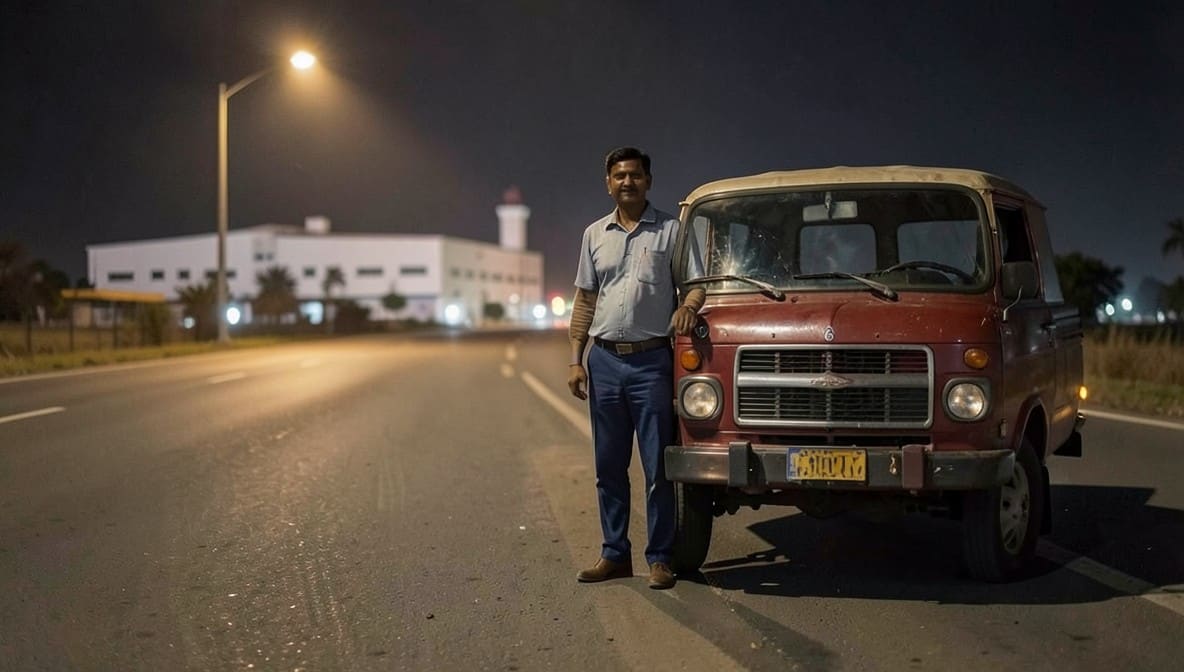
- The applicant claims he was hired as a driver and had no knowledge of the contraband or its destination.
- The prosecution’s case relies on tower location data suggesting the applicant had traveled to Orissa, but no direct evidence links him to procurement or distribution.
- The charge sheet was filed on 09.12.2025, but charges have not yet been framed, and no trial has commenced.
Procedural History
- 20.06.2025: FIR registered at Kotwali Police Station, District Ahilyanagar.
- 09.12.2025: Charge sheet filed by police.
- 24.06.2026: Bail application heard and reserved.
- 02.07.2026: Order pronounced granting bail.
The Parties' Positions
For the Applicant
- The applicant was only the driver of the truck and had no role in the transportation, procurement, or sale of contraband.
- He is not a beneficiary of the transaction.
- The substance recovered was not proven to be "ganja" as defined under the NDPS Act, since it lacked flowering or fruiting parts.
- He has no criminal antecedents.
- The charge sheet is filed but charges are not framed, indicating the investigation is not conclusive.
- There is no material evidence connecting him to Akshay or the alleged conspiracy.
For the Respondent (State)
- The applicant was part of a group that arrived at the scene in two vehicles alongside the truck.
- Tower location data suggests his presence in Orissa, implying involvement in procurement.
- The applicant cannot be treated as a mere driver without independent corroboration.
- Section 37 of the NDPS Act imposes a statutory bar to bail unless both conditions - (a) reasonable grounds to believe innocence, and (b) no likelihood of committing offence while on bail - are satisfied.
- The applicant has not discharged the burden under Section 37.
Relief Sought
The applicant seeks release on regular bail in connection with Crime No. 574 of 2025, with a personal bond of Rs. 15,000 and one surety of like amount, subject to standard bail conditions.
The Legal Issue
Whether the statutory bar under Section 37 of the NDPS Act applies to an accused who is only a driver of a vehicle containing contraband, with no evidence of participation in the conspiracy, no criminal antecedents, and where the seized substance does not meet the legal definition of "ganja"?
Arguments Presented
For the Appellant/Petitioner
The applicant’s counsel argued that Section 37 of the NDPS Act, while stringent, cannot be invoked to deny bail where the accused’s role is peripheral and unconnected to the offence. He relied on State of Punjab v. Baldev Singh and Rajesh Sharma v. State of U.P. to emphasize that bail is the rule and jail the exception. He submitted that the substance recovered was not flowering or fruiting cannabis, and therefore did not constitute "ganja" under Section 2 of the NDPS Act. He further argued that tower location data alone, without corroborative evidence of communication, payment, or intent, is insufficient to establish active participation. The absence of charge framing after seven months indicated the investigation lacked strength.
For the Respondent/State
The Additional Public Prosecutor contended that Section 37 mandates a higher threshold for bail in NDPS cases. He argued that the applicant’s presence at the scene, arrival in a companion vehicle, and travel to Orissa via tower data collectively suggest complicity. He maintained that the applicant’s claim of being a mere driver is self-serving and uncorroborated. He emphasized that the statutory bar under Section 37 is not a procedural formality but a substantive legislative intent to deter drug trafficking, and that the applicant had not met the twin conditions required for bail.
The Court's Analysis
The Court carefully examined the evidence on record and found no material linking the applicant to the conspiracy or the contraband beyond his role as a driver. The Court noted that the inventory report, prepared by the Magistrate, did not classify the seized substance as flowering or fruiting cannabis, thereby raising serious doubt as to whether the offence under Sections 8(c) and 20(b)(ii)(c) was even made out. The Court observed that the prosecution’s reliance on tower location data was speculative and lacked corroboration from call records, financial transactions, or witness testimony.
"There is no evidence on record to show that the applicant was an associate of the main accused Akshay or that he had any knowledge of the contraband in the truck."
The Court further held that the statutory bar under Section 37 cannot be applied in a mechanical manner. Where the accused’s role is minimal and the evidence is weak, the court must still apply the principles of natural justice and the presumption of innocence. The Court distinguished this case from those involving couriers with prior links to drug networks or those found in possession of large quantities with intent to distribute. Here, the applicant was apprehended in a vehicle that was parked, not in motion, and no contraband was found on his person.
The Court also noted that the charge sheet had been filed for over six months without charges being framed - a fact that indicated the prosecution’s case was not yet substantiated. The absence of any criminal antecedents further weighed in the applicant’s favor.
The Verdict
The applicant succeeded. The Court allowed the bail application and directed his release on personal bond of Rs. 15,000 with one surety of like amount. The applicant must: (a) not tamper with prosecution evidence; (b) cooperate with the trial and attend all court dates unless exempted; and (c) not leave the jurisdiction of the trial court until conclusion of the trial. The application is disposed of accordingly.
What This Means For Similar Cases
Mere Driving Role Does Not Automatically Trigger Section 37
- Practitioners may now argue that Section 37 of the NDPS Act does not apply to individuals whose involvement is limited to transportation without evidence of knowledge, intent, or benefit.
- Bail applications should highlight the absence of direct links - such as financial transactions, prior associations, or possession of contraband - to challenge the application of Section 37.
- Tower location data alone is insufficient to establish participation; corroboration through communication records or eyewitness testimony is required.
Substantive Definition of "Ganja" Must Be Scrutinized
- Defence counsel must insist on forensic or Magistrate’s inventory reports to confirm whether seized material meets the statutory definition of "ganja" (i.e., flowering or fruiting tops).
- If the substance is leaves or seeds only, the charge under Sections 8(c) or 20(b)(ii)(c) may not be sustainable, weakening the prosecution’s case at the bail stage.
- This opens a strategic avenue to challenge the very foundation of the offence in bail hearings.
Delay in Framing Charges Supports Bail
- Where charges remain unframed for over six months, courts may view this as an indicator of weak evidence, justifying release on bail even under NDPS Act.
- This precedent supports arguments for early bail in cases where investigation is protracted and no prima facie link exists between the accused and the offence.