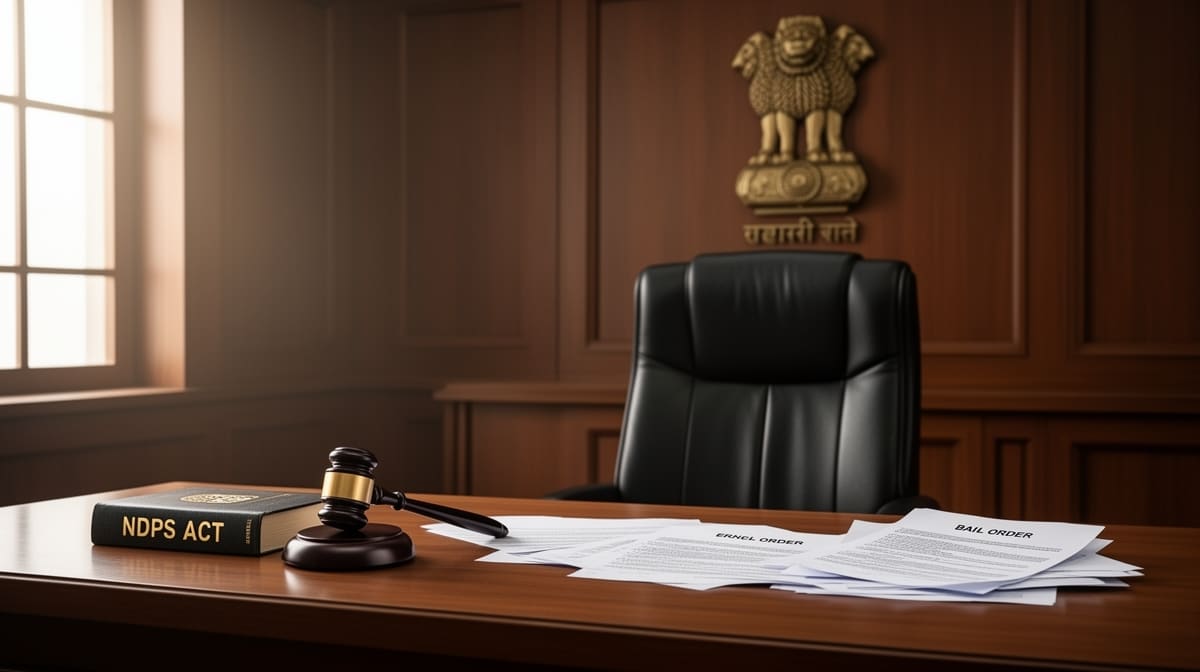
The Allahabad High Court has clarified that mere association with a co-accused who possesses large quantities of narcotics does not, by itself, justify denial of bail under the NDPS Act when the applicant is not in actual possession of contraband. This decision reinforces the principle that bail under Section 37 of the NDPS Act must be assessed on the specific evidentiary posture of each accused, not on the aggregate scale of the offence.
Background & Facts
The Dispute
The applicant, Ravindra, was arrested and charged under Sections 8 and 21 of the Narcotic Drugs and Psychotropic Substances Act, 1985, in connection with Case Crime No. 169 of 2026 registered at Police Station Bhamaura, District Bareilly. The case involves the alleged manufacture and trafficking of heroin (smack). The applicant has been in judicial custody since 31.03.2026.
Key Facts
- No contraband was recovered from the applicant’s person or possession.
- Two mobile phones were recovered from the applicant’s possession.
- 1750 grams of smack were recovered from the possession of co-accused Parmanand, who is the applicant’s father.
- Rs. 86,530/- were recovered from the possession of co-accused Yashvir.
- The State alleges that manufacturing materials for smack were recovered from the house shared by the applicant and Parmanand.
- The applicant has no prior criminal record under the NDPS Act.
- The applicant has undertaken to comply with all bail conditions and not to misuse liberty if granted.
Procedural History
- 31.03.2026: Applicant arrested and taken into custody.
- 15.04.2026: Chargesheet filed by Police Station Bhamaura.
- 28.04.2026: Criminal Misc. Bail Application No. 14508 of 2026 filed under Section 483 of the Bharatiya Nagarik Suraksha Sanhita, 2023.
- 30.04.2026: Hearing before the High Court; order passed on the same day.
Relief Sought
The applicant sought regular bail pending trial, arguing that his involvement was minimal, no contraband was found in his possession, and the trial is likely to be protracted due to heavy court pendency.
The Legal Issue
Whether the applicant, who was not in possession of any contraband and whose only connection to the offence is familial association and presence at the residence where drugs were found, can be denied bail under Section 37 of the NDPS Act solely on the basis of the large quantity recovered from a co-accused.
Arguments Presented
For the Appellant
Learned counsel argued that Section 37 of the NDPS Act imposes a stringent condition for bail, but it is not an absolute bar. The applicant was not found in possession of any narcotic substance. Recovery of mobile phones does not establish active participation in trafficking or manufacturing. The applicant has no prior record and has offered to comply with strict bail conditions. The pendency of trial makes prolonged incarceration unjust. Reliance was placed on Union of India v. Shiv Shanker Kesari and Nadeem Ahmad v. State of West Bengal to show that bail must be granted where the accused’s role is not substantiated by direct possession or incriminating evidence.
For the Respondent
The Additional Government Advocate contended that the recovery of manufacturing materials from the applicant’s residence, coupled with the large quantity of smack recovered from his father, indicates active participation in the drug trade. The applicant’s presence at the scene and familial link, they argued, justify continued custody under Section 37, which mandates strict scrutiny in cases involving commercial quantities.
The Court's Analysis
The Court examined the evidentiary record and noted that while Section 37 of the NDPS Act creates a high threshold for bail, it does not eliminate the requirement of a prima facie case linking the accused to the offence. The Court emphasized that the applicant was not found in possession of any narcotic substance, nor was there any evidence of direct involvement in the manufacture or distribution.
"No contraband is said to have been recovered from the possession of the applicant but two mobile phones are said to have been recovered from his possession."
The Court distinguished between mere presence or association and active participation. It held that the recovery of manufacturing materials from the shared residence, without direct evidence tying the applicant to their use or control, is insufficient to invoke the stringent conditions of Section 37. The Court further relied on Union of India v. Shiv Shanker Kesari, which holds that bail under Section 37 must be considered on the individual role and evidence against each accused, and Nadeem Ahmad v. State of West Bengal, which underscores that the burden under Section 37 lies on the prosecution to show reasonable grounds to believe the accused is guilty.
The Court also noted the absence of any prior conviction or flight risk, and accepted the applicant’s undertaking to comply with bail conditions. It observed that the trial’s prolonged nature due to court pendency further supports the need to avoid undue pre-trial detention.
The Verdict
The bail application was allowed. The applicant, Ravindra, is released on bail upon furnishing a personal bond of Rs. 50,000/- with two sureties each in the like amount. He must comply with five conditions: (i) no intimidation of witnesses or tampering with evidence; (ii) no pressure on prosecution witnesses; (iii) personal appearance at key trial stages (opening, framing of charge, Section 351 statement); (iv) no adjournment requests when witnesses are present; and (v) presence before the trial court on all dates, personally or through counsel. Breach of any condition shall result in cancellation of bail. The Court clarified that this order expresses no opinion on the merits of the case.
What This Means For Similar Cases
Association Alone Is Not Sufficient for Denial of Bail
- Practitioners must challenge bail denials under Section 37 NDPS Act where the accused lacks direct possession or incriminating evidence linking them to the contraband.
- Merely being a family member of the primary accused or residing at the location of recovery does not satisfy the "reasonable grounds to believe" standard under Section 37.
Mobile Phones and Residence Recovery Require Corroboration
- Recovery of mobile phones alone cannot be treated as evidence of drug trafficking without proof of communication, transaction records, or location data linking them to the offence.
- Manufacturing materials found in a shared residence must be tied to the accused’s personal use or control; circumstantial evidence must be concrete, not speculative.
Procedural Fairness Over Aggregate Offence Scale
- Courts must assess each accused individually, even in multi-accused NDPS cases.
- The quantity of drugs recovered from co-accused cannot be automatically imputed to others without independent evidence of participation.
- Bail applications must be decided on the accused’s specific role, not the overall scale of the crime.