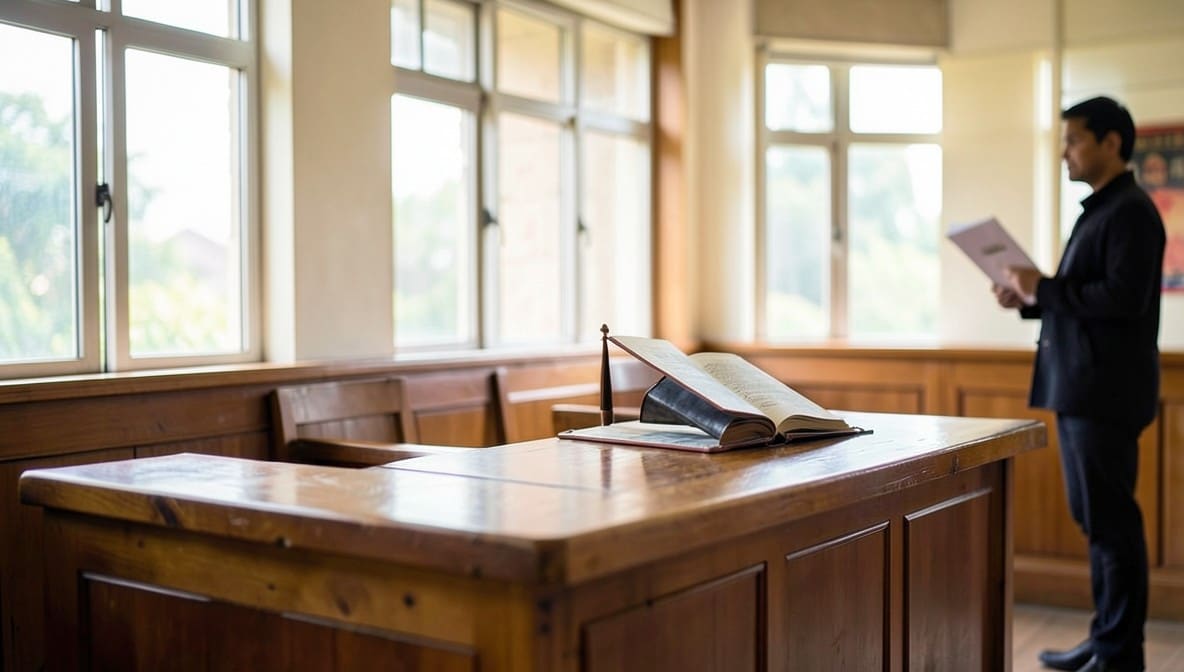
The Allahabad High Court has clarified that even where Section 360 of the CrPC is inapplicable due to state-specific legislation, courts are under a mandatory duty to record special reasons for denying the benefit of probation under the Uttar Pradesh First Offenders' Probation Act, 1938. This judgment reinforces procedural fairness in sentencing and establishes a clear doctrinal requirement for judicial reasoning when rejecting rehabilitative alternatives.
Background & Facts
The Dispute
The appellants - Girendra, Jamadar, and Ram Gulam - were convicted under Section 307 read with Section 34 IPC for attempting to murder Brij Lal, the complainant, by opening fire with firearms on 28.11.1995 at approximately 09:00 a.m. in Behta Gokul, District Hardoi. The incident arose from a dispute over possession of agricultural land, during which the complainant’s brother, Ram Baran, had earlier chased the appellants away. The appellants allegedly returned to the complainant’s residence and fired upon him, causing injuries.
Key Facts
- The incident occurred on 28.11.1995 at approximately 09:00 a.m.
- The complainant, Brij Lal, was the sole eyewitness and testified as the injured victim.
- The medical evidence, recorded through PW5 (the examining doctor), indicated that the firearm injuries were "simple" in nature.
- Ram Baran, who was present during the initial confrontation, was not examined as a witness by the prosecution.
- The trial court convicted the appellants on 03.09.2004 and sentenced them to six years rigorous imprisonment with a fine of Rs. 2,000 each, with six months additional imprisonment in default.
- The appellants had no prior criminal convictions at the time of sentencing, except for appellant No. 2, Jamadar, whose subsequent case (Crime No. 391 of 2021 under Sections 323, 504, 506 IPC) was registered after the impugned judgment.
- The appellants raised the plea for benefit under the Probation of Offenders Act, 1958 and Section 360 CrPC during trial, but the trial court did not address it.
- The appeal was filed on 03.09.2004 against the conviction and sentence.
Procedural History
- 28.11.1995: Incident occurred at Behta Gokul, District Hardoi.
- 1995: Crime No. 132 registered at Police Station Behta Gokul.
- 1998: Sessions Trial No. 435 of 1998 commenced.
- 03.09.2004: Trial Court convicted appellants under Section 307 IPC and imposed sentence.
- 2004: Criminal Appeal No. 1946 of 2004 filed before the Allahabad High Court under Section 374(2) CrPC.
- 30.04.2026: Judgment delivered by the Division Bench of the Allahabad High Court, Lucknow Bench.
The Parties' Positions
For the Appellants
- The conviction was based on surmises, as the main witness Ram Baran was not examined.
- The injuries were classified as "simple" by the doctor, undermining the severity required for Section 307 IPC.
- The trial court failed to consider the applicability of the Probation of Offenders Act, 1958 or Section 360 CrPC.
- The appellants had no prior criminal record at the time of sentencing.
- The court’s failure to record reasons for denying probation violated Section 361 CrPC.
For the Respondent/State
- The conviction was supported by the unchallenged testimony of the injured complainant and corroborated by medical evidence.
- Non-examination of Ram Baran was immaterial as the injured’s testimony was sufficient.
- The State admitted that appellants No. 1 and 3 had no prior criminal history.
- The State conceded that the High Court may consider granting probation under applicable law.
Relief Sought
The appellants sought modification of the sentence to grant them the benefit of probation under the Uttar Pradesh First Offenders' Probation Act, 1938, or Section 3 or 4 of the Probation of Offenders Act, 1958, and requested that the trial court’s failure to record reasons for denial be rectified.
The Legal Issue
The central question was whether the trial court’s failure to record special reasons for denying the benefit of probation under the Uttar Pradesh First Offenders' Probation Act, 1938, constitutes a violation of Section 361 of the CrPC, and whether the appellate court may rectify such omission by granting probation at the appellate stage.
Arguments Presented
For the Appellant
The appellants relied on Uttar Pradesh v. Misri Lal and others (1982 CrLJ 1420) to argue that Section 360 CrPC is inapplicable in Uttar Pradesh due to the continued operation of the Uttar Pradesh First Offenders' Probation Act, 1938. They further cited Sitaram Paswan v. State of Bihar (AIR 2005 SC 3534) and Mohd. Hashim v. State of U.P. (AIR 2017 SC 660) to assert that courts must consider the offender’s age, character, antecedents, and the nature of the offence before denying probation. They emphasized that Section 361 CrPC mandates recording of special reasons whenever a court declines to apply any rehabilitative statute, and that failure to do so renders the sentence illegal. The appellants argued that their lack of prior convictions and the "simple" nature of injuries made them eligible for probation.
For the Respondent
The State did not contest the legal principle that Section 361 CrPC requires reasons for denying probation. It acknowledged that the appellants had no criminal history at the time of sentencing and conceded that the High Court could exercise its powers under Section 361 CrPC to grant probation. The State maintained that the conviction was legally sound based on the injured’s testimony and medical evidence, but did not oppose modification of the sentence.
The Court's Analysis
The Court undertook a detailed analysis of the statutory framework governing probation in Uttar Pradesh. It held that while Section 360 CrPC does not apply in the State due to the continued operation of the Uttar Pradesh First Offenders' Probation Act, 1938, Section 361 CrPC remains fully applicable. The Court relied on the Division Bench decision in Uttar Pradesh v. Misri Lal and others, which clarified that Section 361 requires the court to record special reasons for not granting benefit under the State’s own probation law.
"It follows from this provision read with clause (e) of S.484 mentioned above, the Court is required to record special reasons for not extending the benefit of the provisions of the Uttar Pradesh First Offenders' Probation Act, 1938."
The Court further examined the Supreme Court’s rulings in Sitaram Paswan and Mohd. Hashim, which affirmed that probation is not a matter of right but a discretionary power to be exercised with due regard to the nature of the offence, the character of the offender, and the overall circumstances. The Court noted that the offence under Section 307 IPC, though serious, was not one punishable with death or life imprisonment, making the appellants eligible for consideration under Section 4 of the U.P. Act.
The Court observed that the trial court had not addressed the probation plea at all, and the judgment contained no reasoning for rejecting it. This omission was held to be a violation of Section 361 CrPC, which is mandatory and not directory. The Court emphasized that the absence of prior criminal history, the passage of over three decades since the incident, and the medical evidence indicating "simple" injuries all pointed toward the appropriateness of probation.
The Court also noted that the subsequent criminal case against appellant No. 2 (Jamadar) was registered in 2021, long after the conviction and sentencing, and therefore could not be considered at the time of the original judgment.
The Verdict
The appeal was partly allowed. The conviction under Section 307 IPC was upheld, but the sentence was modified. The appellants are granted the benefit of Section 4 of the Uttar Pradesh First Offenders' Probation Act, 1938, and are released on probation for a period of one year from the date of this order. Each appellant shall file personal bonds and two sureties of Rs. 20,000 each before the District Probation Officer, Hardoi, within one month. They must undertake to maintain peace and good conduct during the probation period. In case of breach, they shall serve the original sentence of six years rigorous imprisonment. A certified copy of this order shall be sent forthwith to the trial court and the District Probation Officer for compliance.
What This Means For Similar Cases
Probation Denial Requires Explicit Reasoning
- Practitioners must now insist that trial courts record specific reasons for denying probation under state-specific laws like the U.P. First Offenders' Probation Act, 1938.
- Failure to record reasons under Section 361 CrPC is a ground for appellate interference, even if the conviction is upheld.
- The burden shifts to the prosecution to justify why probation is inappropriate, particularly when the offender has no prior record.
Appellate Courts May Grant Probation Directly
- Appellate courts are not confined to remanding for reconsideration; they may exercise the power under Section 361 CrPC to grant probation directly, as done here.
- This applies even when the trial court did not consider the issue at all.
- The passage of time since the offence, absence of prior convictions, and nature of injuries are material factors favoring probation.
Statutory Frameworks Override General Provisions
- In states with special probation laws (e.g., U.P., Bihar, Maharashtra), Section 360 CrPC is inapplicable, and courts must apply the state law.
- However, Section 361 CrPC remains binding and requires reasons for denying benefit under the applicable state statute.
- Legal practitioners must identify the correct probation regime applicable in their jurisdiction before filing sentencing arguments.