The Income Tax Appellate Tribunal, Mumbai, has clarified that the right to receive annuity under a Design, Build, Finance, Operate and Transfer (DBFOT) highway contract constitutes an intangible asset eligible for depreciation under Section 32(1)(ii) of the Income Tax Act, 1961. This ruling resolves long-standing ambiguity for infrastructure developers and aligns tax treatment with commercial reality.
Background & Facts
The Dispute
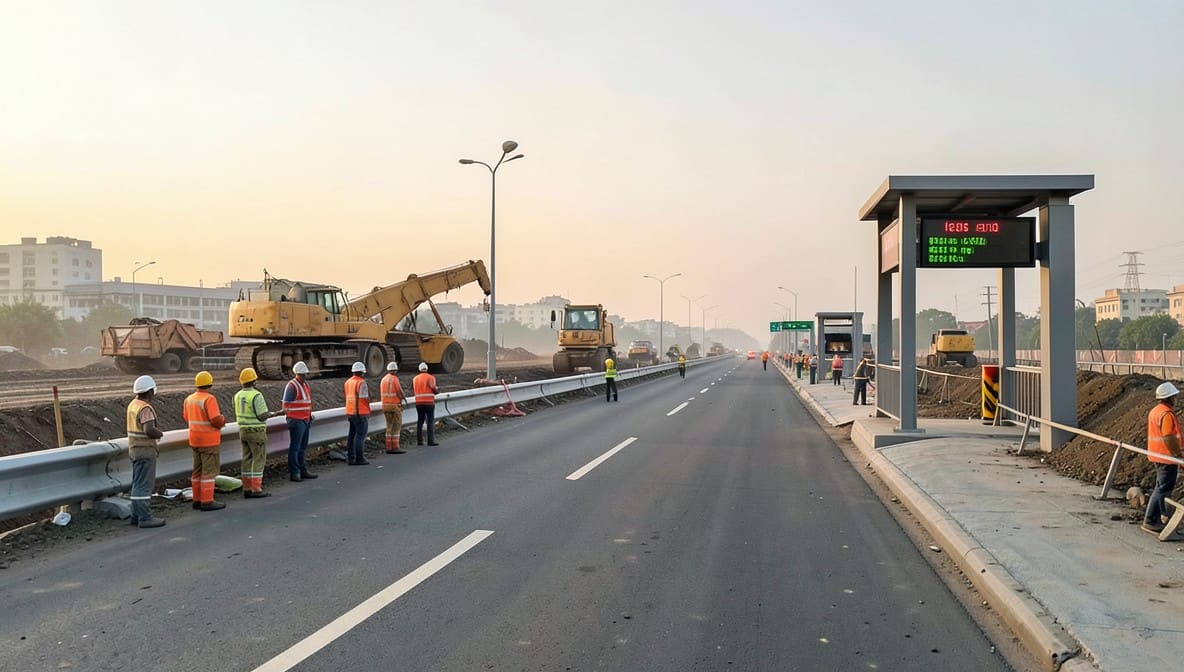
The appellant, Jorabat Shillong Expressway, is a corporate entity engaged in infrastructure development. It entered into a concession agreement with the National Highway Authority of India (NHAI) on 16.07.2010 for the design, construction, financing, operation, and maintenance of a 61.92-kilometre four-laning project on the Jorabat-Shillong (Barapani) Section of National Highway-40, spanning Assam and Meghalaya, on a DBFOT basis. The concession period is 20 years, commencing from the appointed date.
Key Facts
- The total project cost incurred by the assessee as of 31.03.2016 was Rs. 966,64,10,079/-, which was capitalized in its books as a fixed asset.
- The assessee funded the entire project independently, without any reimbursement from NHAI.
- Under the concession agreement, the assessee was granted exclusive rights to construct, operate, and maintain the highway for 20 years.
- In return, the assessee is entitled to receive annuity payments from NHAI at a fixed rate over the concession period, as per Article 27 of the agreement.
- The assessee does not own the highway land or infrastructure; ownership remains with NHAI.
- The assessee claimed depreciation at 25% on the opening written down value (WDV) of the capitalized cost, treating the right to receive annuity as an intangible asset under Section 32(1)(ii).
- The Assessing Officer disallowed the depreciation claim, arguing that the assessee was neither the owner nor the user of the toll road.
- However, the Assessing Officer allowed amortization of the project cost over the 20-year concession period under CBDT Circular No. 9/2014 dated 23.04.2014.
- The assessee filed appeals for assessment years 2017-18, 2018-19, 2020-21, and 2022-23, challenging the disallowance of depreciation.
Procedural History
- 16.07.2010: Concession agreement executed with NHAI for DBFOT project.
- 31.03.2016: Project cost capitalized at Rs. 966,64,10,079/-.
- 31.10.2017: Return of income filed for A.Y. 2017-18 declaring net loss of Rs. 205,14,15,414/-; claimed depreciation of Rs. 202,58,49,703/-.
- Revised return filed: Declared loss of Rs. 193,05,85,288/-.
- Assessment proceedings: Assessing Officer disallowed depreciation but allowed amortization under CBDT Circular No. 9/2014.
- Appeal to Commissioner (Appeals): Upheld the Assessing Officer’s order.
- ITA No. 1204/Mum/2026 (A.Y. 2017-18): Filed before ITAT Mumbai on or before 11.03.2026.
- ITA Nos. 6010-6012/Mum/2025 (A.Y. 2018-19, 2020-21, 2022-23): Filed subsequently.
- 11.03.2026: Hearing conducted before ITAT Mumbai.
- 23.04.2026: Judgment pronounced.
The Parties' Positions
For the Appellant
The appellant argued that:
- It did not claim depreciation on the physical toll road, which is owned by NHAI.
- It claimed depreciation on the intangible asset - the right to receive annuity over the 20-year concession period - which is a commercial right acquired through investment.
- This right falls squarely within the definition of intangible asset under Section 32(1)(ii) as a "business or commercial right of similar nature".
- The concession agreement grants a license to operate and maintain the highway, which is explicitly recognized as an intangible asset.
- Multiple ITAT decisions, including the Special Bench ruling in ACIT v. Progressive Construction Ltd., and decisions in ITO v. Andhra Pradesh Expressway Ltd. and JCIT v. ACP Tollways Pvt. Ltd., support this view.
- The Madras High Court decision in M/s. Narmada Infrastructure Construction Enterprises Ltd. is distinguishable as it addressed ownership of the toll road, not the right to annuity.
For the Respondent
The Department contended that:
- The toll road is owned by NHAI; the assessee has no ownership or possession of the physical asset.
- Depreciation under Section 32 requires ownership and use of the asset, which the assessee lacks.
- The right to receive annuity is merely a deferred consideration for construction, not an intangible asset.
- The term "license" under Section 32(1)(ii) must be interpreted under the Indian Easements Act, 1882, which does not cover rights to collect tolls or annuity.
- CBDT Circular No. 9/2014 provides the only permissible method of deduction - amortization over the concession period.
- Allowing depreciation would lead to double benefit or inconsistency with judicial precedents.
Relief Sought
The appellant sought:
- Allowance of depreciation at 25% on the opening WDV of the capitalized project cost.
- Setting aside of the orders of the Assessing Officer and Commissioner (Appeals).
- Rectification of inconsistent tax treatment across assessment years.
The Legal Issue
The central question was whether the right to receive annuity under a DBFOT highway concession agreement constitutes an intangible asset under Section 32(1)(ii) of the Income Tax Act, 1961, thereby entitling the assessee to claim depreciation.
Arguments Presented
For the Appellant
The appellant relied on the Special Bench decision in ACIT v. Progressive Construction Ltd. (2018) 92 taxmann.com 104 (Hyderabad), which held that the right to collect toll under a BOT contract is an intangible asset under Section 32(1)(ii). The appellant emphasized that the DBFOT model includes design and finance, making the investment more integral to the business than a pure BOT arrangement. It cited ITO v. Andhra Pradesh Expressway Ltd. (ITA No. 1522 and 1528/Mum/2023) and JCIT v. ACP Tollways Pvt. Ltd. [2025] 179 taxmann.com 660 (Lucknow Trib.), where co-ordinate benches allowed depreciation on the right to receive annuity. The appellant argued that the Madras High Court’s decision in M/s. Narmada Infrastructure Construction Enterprises Ltd. was distinguishable because it addressed ownership of the physical toll road, not the commercial right to annuity. It further contended that the principle of ejusdem generis does not restrict "any other business or commercial rights of similar nature" to only those akin to patents or trademarks, as confirmed by the Supreme Court in CIT v. Smifs Securities and the Delhi High Court in Areva T&D India Ltd.
For the Respondent
The Department argued that ownership of the asset is a sine qua non for depreciation under Section 32(1). It contended that the right to receive annuity is merely a revenue stream, not an asset, and that the concession agreement grants only a limited license under the Indian Easements Act, 1882, which does not qualify as an intangible asset under the Income Tax Act. It relied on the Bombay High Court’s decisions in North Karnataka Expressway Ltd. v. CIT [2015] 372 ITR 145 and West Gujarat Expressway Ltd. v. CIT [2017] 82 taxmann.com 224, which held that toll roads cannot be depreciated by non-owners. The Department maintained that CBDT Circular No. 9/2014 provides the exclusive mechanism for cost recovery - amortization - and that allowing depreciation would create double benefit and inconsistency.
The Court's Analysis
The Tribunal undertook a detailed analysis of the concession agreement, statutory provisions, and judicial precedents. It emphasized that the assessee did not claim depreciation on the physical toll road, but on the right to receive annuity - a commercial right acquired through capital investment. The Tribunal held that the right to receive annuity is not merely a revenue stream but an enduring business right, integral to the assessee’s business model.
"The expenditure incurred by the assessee of Rs. 966.64 crore for creating the project or project facilities has created an intangible asset in the form of right to operate the project facility and collect annuity."
The Tribunal rejected the Department’s reliance on the Indian Easements Act, 1882, noting that the Income Tax Act does not define "license" and that the term must be interpreted in its commercial context. It affirmed that the Supreme Court in CIT v. Smifs Securities and the Delhi High Court in Areva T&D India Ltd. had held that the phrase "any other business or commercial rights of similar nature" is expansive and not restricted by ejusdem generis to only those rights identical to patents or trademarks. The Tribunal cited Techno Shares and Stocks Ltd. v. CIT [2010] 327 ITR 323 (SC), where the Supreme Court held that a BSE membership card - a right to trade - qualifies as an intangible asset.
The Tribunal distinguished the Madras High Court’s decision in M/s. Narmada Infrastructure Construction Enterprises Ltd., noting that the question before that court was whether the toll road itself was a tangible or intangible asset - a question not raised in the present case. The Tribunal held that the Bombay High Court’s decisions in North Karnataka Expressway Ltd. and West Gujarat Expressway Ltd. were also inapplicable, as they did not address the claim of depreciation on the right to annuity.
The Tribunal further noted that the Department’s own conduct was inconsistent: in some years, depreciation was allowed; in others, only amortization was permitted. This inconsistency, the Tribunal held, warranted a uniform and fair resolution in favor of the assessee.
The Verdict
The appellant succeeded. The ITAT Mumbai allowed the claim of depreciation at 25% on the opening written down value of the capitalized project cost, treating the right to receive annuity as an intangible asset under Section 32(1)(ii) of the Income Tax Act, 1961. The Assessing Officer is directed to allow depreciation for all four assessment years - 2017-18, 2018-19, 2020-21, and 2022-23 - commencing from the date of commencement of commercial operations on 15.09.2006. The issue of amortization under CBDT Circular No. 9/2014 has become infructuous. The appeals are partly allowed.
What This Means For Similar Cases
Depreciation on Annuity Rights Is Permissible
- Practitioners can now confidently claim depreciation on the right to receive annuity under DBFOT/BOT infrastructure contracts, provided the asset is not the physical infrastructure.
- The claim must be clearly articulated as being on the intangible commercial right, not the road or bridge.
- Documentation must show capitalization of project cost and linkage to annuity receipts.
CBDT Circular No. 9/2014 Is Not Exclusive
- Amortization under the circular remains an alternative, but it does not preclude depreciation.
- Taxpayers may choose the method that best suits their financial reporting and tax planning.
- The Tribunal confirmed that the outcome is revenue-neutral - only the timing of deduction differs.
Judicial Precedents Must Be Distinguished Carefully
- Decisions like North Karnataka Expressway Ltd. and M/s. Narmada Infrastructure are not binding when the issue is the right to annuity, not ownership of the physical asset.
- Co-ordinate benches of ITAT and Special Bench rulings carry strong persuasive weight.
- Practitioners should cite ACIT v. Progressive Construction Ltd. and JCIT v. ACP Tollways Pvt. Ltd. as controlling authority.
Consistency in Tax Treatment Is Required
- Tax authorities must apply uniform treatment across assessment years.
- Inconsistent rulings - allowing depreciation in some years and amortization in others - are unsustainable and may be challenged.
- Taxpayers should document and preserve records of prior assessments to support claims of inconsistency.