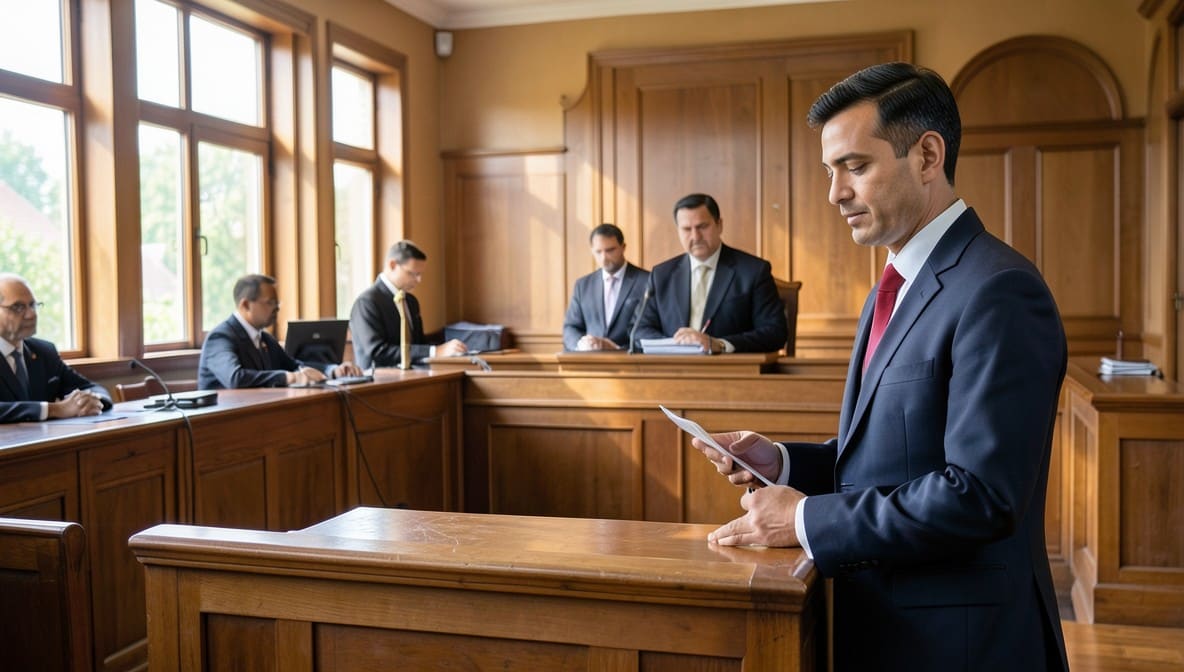
The Allahabad High Court has reaffirmed that courts cannot mechanically reject applications for withdrawal of prosecution under Section 321 CrPC merely because the Public Prosecutor has not independently expressed a view. The judgment underscores that judicial consent must be grounded in an objective assessment of whether withdrawal advances the interest of justice, not administrative convenience or political pressure.
Background & Facts
The Dispute
The dispute arose from a communal incident on 24.10.2012 in Rudauli, Ayodhya (then Faizabad), during an idol immersion procession. A large crowd gathered near the police station, leading to traffic congestion. The applicant, Ram Chander Yadav, then a Member of the Legislative Assembly, allegedly made inflammatory statements urging the crowd to halt the procession until those responsible for damaging an idol and abusing a boy from another community were punished. Subsequently, a mob of 250 - 300 persons, allegedly incited by Krishna Dutt Pathak, attacked a neighboring village, pelting stones and assaulting police personnel. An FIR was registered under multiple sections of the IPC and the Prevention of Damage to Public Property Act, 1984.
Key Facts
- The incident occurred on 24.10.2012 at approximately 1:00 p.m. near Police Station Rudauli.
- The FIR (No. 1015 of 2012) was lodged on the same day.
- The applicant was implicated based primarily on the confessional statements of co-accused persons.
- The applicant had previously been acquitted in FIR No. 254 of 2000 on 20.10.2020.
- The State Government, on 08.06.2020, issued written permission for withdrawal of prosecution under Section 321 CrPC.
- The Public Prosecutor filed an application for withdrawal on 08.06.2020, which was rejected by the trial court on 27.10.2021.
- The rejection was challenged under Section 482 CrPC (Application No. 3008 of 2022), which was allowed by this Court on 20.07.2022, directing the trial court to reconsider.
- The trial court again rejected the withdrawal application on 16.12.2022, citing that the Public Prosecutor had not independently expressed a view.
Procedural History
- 24.10.2012: FIR No. 1015 of 2012 registered at P.S. Rudauli.
- 08.06.2020: State Government granted written permission for withdrawal under Section 321 CrPC.
- 27.10.2021: Trial Court rejected application for withdrawal, holding Public Prosecutor had not independently expressed view.
- 20.07.2022: High Court allowed Section 482 application (No. 3008 of 2022), set aside the rejection, and remanded for fresh consideration.
- 16.12.2022: Trial Court again rejected withdrawal application on same grounds.
- 16.12.2022: Application under Section 482 CrPC (No. 9838 of 2022) filed to quash the order and proceedings.
- 16.12.2022: Criminal Revision No. 367 of 2023 filed challenging the same order.
- 04.05.2026: High Court delivered common judgment on both matters.
The Parties' Positions
For the Applicant
- Argued that his involvement was based solely on the uncorroborated confessional statements of co-accused.
- Highlighted his prior acquittal in a politically motivated case (FIR No. 254 of 2000).
- Relied on Rahul Agrawal v. Rakesh Jain and other Supreme Court precedents to argue that withdrawal is permissible when it prevents harassment and promotes social harmony.
- Contended that the trial court’s rejection was mechanical and ignored the State Government’s clear directive and the Public Prosecutor’s compliance.
For the State
- Did not dispute the Government’s willingness to withdraw the prosecution.
- Acknowledged the prosecution was based on circumstantial and testimonial evidence, with no direct evidence linking the applicant to violence.
- Accepted that the Public Prosecutor had acted in accordance with the Government’s instructions.
Relief Sought
The applicant sought:
- Quashing of the trial court’s order dated 16.12.2022 rejecting withdrawal.
- Quashing of the charge-sheet and all proceedings in FIR No. 1015 of 2012.
- Permission for withdrawal of prosecution under Section 321 CrPC.
The Legal Issue
The central question was whether a trial court may reject an application for withdrawal under Section 321 CrPC solely on the ground that the Public Prosecutor did not independently articulate his reasons, when the State Government has granted written permission and the Public Prosecutor has filed the application in compliance.
Arguments Presented
For the Appellant/Petitioner
The applicant’s counsel relied on a series of Supreme Court judgments to argue that the Public Prosecutor is not a mere postbox but must act independently. However, independence does not require the Prosecutor to re-express reasons already considered by the State Government. Citing Rahul Agrawal v. Rakesh Jain (2005) 2 SCC 377, Bansi Lal v. Chandan Lal (1976) 1 SCC 421, and Sheonandan Paswan v. State of Bihar (1983) 1 SCC 438, counsel emphasized that withdrawal is permissible when it serves the broader interest of justice, particularly where prosecution is based on weak evidence and risks exacerbating communal tensions. The trial court’s mechanical rejection, they argued, ignored the Government’s policy decision and the Prosecutor’s compliance with statutory procedure.
For the Respondent/State
The State did not oppose withdrawal. The Government Advocate conceded that the Public Prosecutor had acted on the State’s written permission and that the application was filed in good faith. The State acknowledged that the applicant’s involvement was not substantiated by direct evidence and that the prosecution was largely based on the statements of co-accused, which had been previously discredited in another case. The State’s position was that the trial court’s refusal was legally unsustainable.
The Court's Analysis
The Court undertook a comprehensive review of the jurisprudence on Section 321 CrPC, emphasizing that while the Public Prosecutor must exercise independent judgment, this does not require him to originate reasons de novo when the State Government has provided a reasoned basis for withdrawal. The Court held that the Public Prosecutor’s filing of the application, accompanied by the Government’s written permission, constitutes sufficient compliance with statutory requirements.
"The statutory responsibility for deciding upon withdrawal squarely vests on the public prosecutor. It is non-negotiable and cannot be bartered away in favour of those who may be above him on the administrative side."
The Court noted that the trial court’s reasoning - that the Public Prosecutor had not expressed his own view - was legally flawed. The Prosecutor had not merely transmitted the Government’s order; he had filed the application under Section 321, thereby affirming his concurrence. The Court further observed that the prosecution’s evidentiary basis was weak, with no direct link between the applicant and the violent acts, and that the case had been pending for over a decade, causing undue harassment.
The Court also cited Sheonandan Paswan and Rahul Agrawal to affirm that withdrawal may be permitted not only for evidentiary reasons but also to promote social harmony, prevent communal polarization, and avoid misuse of criminal process for political vendetta. The Court held that the trial court’s refusal to grant consent was an abuse of discretion and failed to consider the broader public interest.
The Court rejected the notion that the Public Prosecutor must deliver a separate speech or affidavit articulating his reasons. The act of filing the application with the Government’s written permission, in the context of a case with questionable evidentiary foundation, satisfies the requirement of independent application of mind.
The Verdict
The applicant succeeded. The High Court set aside the trial court’s order dated 16.12.2022 and allowed the application for withdrawal of prosecution under Section 321 CrPC. The charge-sheet and all proceedings in FIR No. 1015 of 2012 are quashed. The record is directed to be handed over to the Law Department of the Government of Uttar Pradesh by the Bench Secretary in the presence of the Government Advocate. The applicant is discharged from all charges in the case.
What This Means For Similar Cases
Withdrawal Applications Cannot Be Rejected on Procedural Formalities Alone
- Practitioners must argue that compliance with Section 321 is satisfied when the Public Prosecutor files the application with the State’s written permission, even without a separate affidavit of reasons.
- Courts must not demand redundant procedural steps that undermine the statutory scheme.
Judicial Scrutiny Must Focus on Substance, Not Form
- The court’s duty is to ensure the application is made in good faith and serves justice - not to re-evaluate evidence or demand independent reasoning if the Government’s rationale is credible.
- Where prosecution is based on uncorroborated confessions or politically motivated charges, withdrawal may be justified even without evidentiary collapse.
Political Context Is a Legitimate Consideration Under Section 321
- Courts may consider whether a prosecution risks inflaming social tensions or is being used as a tool of political persecution.
- The judgment affirms that public justice includes social harmony, not merely conviction rates.
Prosecution Must Not Be Used as a Tool of Harassment
- Prolonged criminal proceedings against public figures based on weak evidence constitute harassment under Rahul Agrawal.
- Courts must act as a check against misuse of criminal process, even when the State seeks withdrawal.
The Public Prosecutor Is Not a Postbox, But Is Not Required to Be a Solo Analyst
- The Prosecutor must exercise independent judgment, but may rely on Government policy and material.
- Filing the application with Government permission, without objection, constitutes sufficient exercise of discretion.