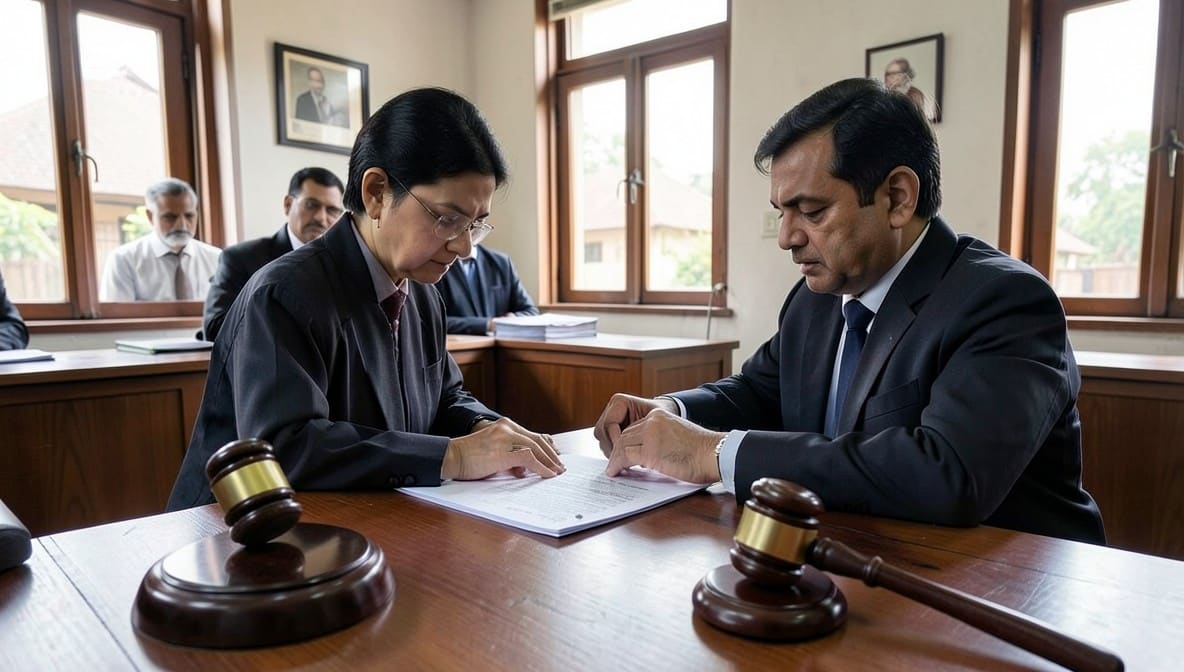
The Allahabad High Court has granted bail to an accused in a murder case under Sections 302 and 201 IPC, emphasizing that absence of eyewitnesses, delayed registration of FIR, and lack of conclusive forensic evidence weigh heavily in favor of liberty. The judgment reinforces the principle that bail is the rule and jail the exception, particularly where custodial interrogation is no longer required and the accused has no prior criminal record.
Background & Facts
The Dispute
The applicant, Ajay @ Lokesh, is accused in Crime No. 198 of 2025 at Police Station Jansath, Muzaffarnagar, for the alleged murder and destruction of evidence of the deceased, whose body was recovered on 09.06.2024. The prosecution claims the applicant was involved in the death, but the evidentiary foundation is critically weak.
Key Facts
- The deceased was reported missing on 08.06.2024 by his father, who did not mention any contact with the applicant in the missing report.
- The dead body was recovered on 09.06.2024.
- Postmortem examination conducted on 10.06.2024 could not determine the cause of death; viscera was preserved for chemical analysis.
- On 15.06.2024, the deceased’s father filed an affidavit before the police retracting his initial complaint, stating that his son had a history of threatening suicide by poison or hanging, and had likely committed suicide.
- The father confirmed the deceased had already been cremated and admitted he had wrongly named the applicant and co-accused.
- The viscera report, upon receipt, also failed to establish a definitive cause of death.
- No eyewitness to the incident or the last seen was produced by the prosecution.
- The FIR was registered on 22.10.2025, over four months after the body was recovered and six months after the alleged incident.
- The applicant has no prior criminal record.
- The charge sheet was filed prior to the bail application.
- The applicant has been in custody since 31.01.2026.
Procedural History
- 06.06.2024: Deceased reported missing (alleged date of incident).
- 08.06.2024: Missing report filed by father; no mention of applicant.
- 09.06.2024: Body recovered.
- 10.06.2024: Postmortem conducted; cause of death undetermined.
- 15.06.2024: Father files affidavit retracting accusation, stating suicide.
- 22.10.2025: FIR registered under Section 156(3) Cr.P.C. after considerable delay.
- 31.01.2026: Applicant arrested and taken into custody.
- Date unspecified prior to 17.04.2026: Charge sheet filed.
- 17.04.2026: Present bail application filed before the Allahabad High Court.
Relief Sought
The applicant seeks bail pending trial, arguing that custodial interrogation is unnecessary, the charge sheet is complete, and there is no evidence linking him to the crime.
The Legal Issue
The central question was whether bail can be granted in a non-bailable offence under Section 302 IPC where there is no eyewitness, no last seen testimony, a delayed FIR, a retracted complaint, and no conclusive forensic evidence establishing foul play.
Arguments Presented
For the Appellant/Petitioner
Learned counsel for the applicant argued that the prosecution’s case rests entirely on suspicion, with no direct or circumstantial evidence tying the applicant to the death. The absence of any mention of the applicant in the initial missing report, the father’s affidavit retracting the accusation, and the inconclusive viscera report undermine the prosecution’s narrative. The delay in filing the FIR - over four months after recovery of the body - further weakens the case. The applicant has no criminal antecedents, the charge sheet has been filed, and there is no need for further custodial interrogation. He has been in custody for over four months and is a law-abiding citizen who will not tamper with evidence or flee.
For the Respondent/State
The Additional Government Advocate opposed bail but did not dispute any of the factual assertions made by the applicant’s counsel. No counter-evidence was presented to challenge the affidavit of the deceased’s father, the delay in FIR, or the lack of forensic clarity. The State offered no substantive rebuttal to the legal arguments on bail jurisprudence.
The Court's Analysis
The Court examined the nature of the offence, the state of evidence, and the principles laid down in Kapil Wadhawan v. Central Bureau of Investigation (2025 SCC OnLine SC 3038) and Maya Tiwari v. State of U.P. (2024 SCC Online All 6765). It noted that while Section 302 IPC is a grave offence, bail is not automatically denied on the basis of gravity alone. The Court emphasized that the absence of eyewitnesses, the retraction of the complaint by the deceased’s father, and the failure of the postmortem and viscera reports to establish homicide are material factors.
"The prosecution has failed to establish any direct or circumstantial link between the applicant and the death of the deceased. The delay in lodging the FIR, coupled with the retraction by the first informant, casts serious doubt on the veracity of the allegations."
The Court further held that once the charge sheet is filed, the necessity for custodial interrogation ceases, and continued detention becomes unjustified. The applicant’s clean record and the absence of any allegation of threat or intimidation further support the grant of bail. The Court also took judicial notice of the overcrowding in jails and the pendency of criminal trials, reinforcing the constitutional mandate under Article 21 that liberty must be preserved unless there is a compelling reason to deny it.
The Verdict
The applicant, Ajay @ Lokesh, is granted bail. He shall be released upon furnishing a personal bond of Rs. 50,000 and two sureties each in the like amount, to the satisfaction of the trial court. The applicant must comply with conditions including: no tampering with evidence, no intimidation of witnesses, no commission of further offences, and full cooperation in trial proceedings. The trial court must issue the release order through the Bail Order Management System (BOMS) and ensure the applicant’s release within 24 hours of the order. The Jail Superintendent at Muzaffarnagar must transmit a copy of this order to the applicant via e-prison portal within 24 hours.
What This Means For Similar Cases
Delayed FIR and Retracted Complaints Undermine Prosecution
- Practitioners must challenge the credibility of FIRs filed after significant delays, especially when the first informant retracts the accusation.
- In cases where the complainant admits the victim died by suicide, the prosecution bears a heightened burden to prove otherwise.
No Custodial Interrogation After Charge Sheet = Strong Bail Ground
- Once the charge sheet is filed, courts must presume that custodial interrogation is no longer necessary.
- Continued detention post-charge sheet requires exceptional justification, not mere speculation.
Forensic Uncertainty Favors Liberty
-
When postmortem and viscera reports fail to establish foul play, courts should not presume guilt.
-
Absence of conclusive forensic evidence must be weighed in favor of the accused, particularly in non-bailable offences.
-
Always request production of the first informant’s affidavit and compare it with the FIR.
-
Argue for bail under Kapil Wadhawan where the prosecution’s case is built on suspicion, not evidence.
-
Cite Maya Tiwari to emphasize that overcrowded jails and delayed trials are legitimate considerations in bail decisions.