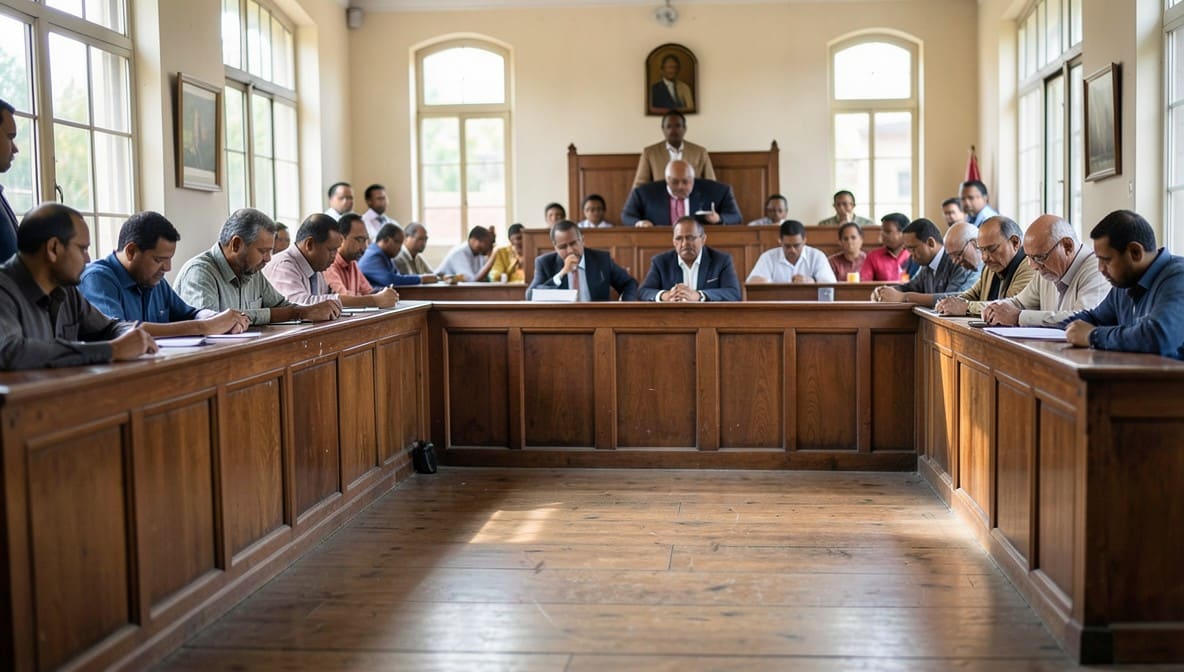
The Allahabad High Court has acquitted an appellant in a high-profile kidnapping and murder case, setting aside his conviction under Sections 364A, 302, and 201 IPC on the grounds that the prosecution failed to establish a reliable chain of circumstantial evidence. The judgment underscores the non-negotiable requirement of a recorded disclosure statement under Section 27 of the Indian Evidence Act and the critical importance of fair identification procedures.
Background & Facts
The Dispute
The case arose from the abduction and murder of Suresh Chand Gupta on 21.03.2002 near Bada Gaon, District Pilibhit. The complainant, Ramesh Chandra Gupta, reported that his brother was forcibly taken away by three men and a woman in a white Maruti van (UP 14/9119). The First Information Report (FIR) dated 21.03.2002 named no specific accused, describing only the vehicle and the unidentified individuals.
Key Facts
- The deceased was last seen returning home from a brick kiln on 21.03.2002 at approximately 4:30 p.m.
- FIR (Ex-ka-2) was lodged at 18:20 p.m. on the same day under Section 364A IPC against unknown persons.
- On 30.04.2002, three accused - Awadhesh Gujar, Harishankar Verma, and Kamini Kashyap - were arrested, and a Maruti van (UP 26A/8125) and a country-made pistol were recovered.
- On 06.05.2002, the body of Suresh Chand Gupta was recovered from Gadha Forest, Pilibhit, following a disclosure by accused Jugendra Gujar.
- From accused Ajaypal, a 12-bore country-made pistol (Ex-Ka-14) and Rs. 40,000 in cash were recovered on 06.05.2002.
- The deceased’s green kurta was recovered on 18.05.2002, allegedly on the indication of Ajaypal.
- Ransom letters (Ex-Kha/9/1 to 9/4) were recovered, demanding Rs. 15 lakh, later reduced to Rs. 8 lakh.
- Rs. 5,37,000 was paid by the complainant in two installments on 14.03.2002 and 01.04.2002, but the accused did not appear for the second payment.
- The post-mortem report (Ex-Kh-3A) dated 07.05.2002 revealed three firearm injuries and recovery of eight pellets from the body.
- The Forensic Science Laboratory (FSL) report (Ex-Ka-23) concluded it was "possible" but not certain that the pellets came from the recovered pistol.
- Independent witnesses Anil Kumar Gupta and Jitendra Kumar Gupta, mentioned in the recovery memos, were not examined.
- The appellant Ajaypal was not named in the FIR or any initial complaint.
Procedural History
- 21.03.2002: FIR lodged under Section 364A IPC at PS Deoria Kalan.
- 30.04.2002: Arrest of Awadhesh, Harishankar, and Kamini; recovery of vehicle and weapons.
- 06.05.2002: Recovery of body, Rs. 49,500 from Jugendra; Rs. 40,000 and pistol from Ajaypal; kurta recovered.
- 18.05.2002: Recovery of kurta from Ajaypal’s residence.
- 20.05.2002: Arrest of Omveer with Rs. 18,000.
- 29.07.2002: Magistrate took cognizance; cases committed to Sessions Court.
- 09.05.2003: Charges framed against Ajaypal, Awadhesh, Pawan, Jugendra, and Omveer under Sections 364A, 302, 201 IPC and Section 25 Arms Act.
- 06.05.2002 to 20.05.2002: Identification parades conducted at District Jail, Pilibhit, presided by S.D.M. Rajnish Sharma (PW-4) and S.D.M. Awadhesh Kumar Tiwari (PW-16).
- 28.02.2008: Trial Court convicted Ajaypal under Sections 364A, 302, 201 IPC and Section 25 Arms Act; sentenced to life imprisonment and fines.
- 29.04.2026: Judgment delivered by Division Bench of Allahabad High Court.
The Parties' Positions
The appellant, Ajaypal, contended he was falsely implicated, with no mention in the FIR, no recorded disclosure, and recovery of cash and weapon being fabricated. He challenged the identification process, alleging prior exposure to witnesses and failure to keep him veiled in custody.
The State defended the conviction, relying on recovery of the kurta, pistol, and cash, and identification by witnesses. It argued the FSL report’s "possible" link was sufficient and that the trial court rightly appreciated the evidence.
Relief Sought
The appellant sought acquittal on all charges, discharge of his bail bond, and costs. The State sought dismissal of the appeal and confirmation of the conviction.
The Legal Issue
The central question was whether the prosecution could sustain a conviction under Sections 364A, 302, and 201 IPC based on circumstantial evidence where the recovery of incriminating articles lacked a recorded disclosure statement under Section 27 of the Evidence Act, the forensic link was inconclusive, the identification process was vitiated by prior exposure, and independent witnesses to recovery were not examined.
Arguments Presented
For the Appellant
The appellant’s counsel argued that Section 27 of the Evidence Act requires a precise, recorded disclosure statement from an accused in police custody to render a recovery admissible. The absence of such a statement for the recovery of the kurta and pistol rendered them mere seizures, not discoveries. The FSL report’s vague conclusion that pellets "might" have come from the recovered pistol failed to establish a definitive link to the murder. The prosecution failed to prove the Rs. 40,000 was ransom money, as no serial numbers or unique markings were established. The identification parade was tainted because the Investigating Officer (PW-7) did not testify that the appellant was kept veiled (baparda) during custody, allowing witnesses to see him before the parade. The non-examination of two independent witnesses mentioned in the recovery memos further undermined the prosecution’s credibility.
For the Respondent
The State contended that the recovery of the kurta and pistol at the instance of the appellant, coupled with the identification by multiple witnesses, established a complete chain of circumstantial evidence. It argued that the FSL report’s "possible" conclusion was sufficient under precedent, and that the absence of a recorded disclosure statement was a procedural lapse, not a fatal defect. The State maintained that the trial court had correctly weighed the evidence and that the conviction was justified.
The Court's Analysis
The Court undertook a meticulous review of the prosecution’s case, emphasizing that conviction in a circumstantial evidence case requires a complete, unbroken chain of circumstances pointing exclusively to the guilt of the accused. The Court held that the absence of a recorded disclosure statement under Section 27 of the Evidence Act was fatal to the prosecution’s case.
"The statement accompanying the discovery was found to be vague to identify the authorship of concealment and it was held that pointing out of the weapon may, at the best, prove the appellant's knowledge as to where the weapon was kept."
The Court relied on Pulukuri Kotayya v. King Emperor and Bodhraj v. State of J&K to hold that only the specific information leading to discovery is admissible, not the mere act of leading police to an object. Since no disclosure statement was recorded, the recovery of the kurta and pistol could not be treated as a discovery under Section 27.
Regarding the FSL report, the Court cited Mahmood v. State of U.P., holding that an expert’s opinion stating only a "possibility" is legally insufficient to establish a link between the weapon and the crime. The Court noted that the prosecution failed to prove the Rs. 40,000 recovered was the ransom money, as currency notes are unidentifiable unless marked or recorded.
On identification, the Court emphasized Mulla v. State of U.P. and Gireesan Nair v. State of Kerala, stating that the prosecution bears the burden to prove the accused was kept veiled during custody to prevent prior exposure. The Investigating Officer’s silence on this critical point rendered the identification parade unreliable. The Court held that when witnesses have seen the accused before the parade, even court identification becomes meaningless.
The non-examination of independent witnesses Anil Kumar Gupta and Jitendra Kumar Gupta, who were named in the recovery memos, further weakened the prosecution’s case. The Court reiterated that failure to examine available independent witnesses creates a reasonable doubt.
The Court concluded that the chain of circumstances was incomplete, inconsistent, and riddled with material omissions. The prosecution failed to exclude every reasonable hypothesis of innocence.
The Verdict
The appellant Ajaypal succeeded. The Allahabad High Court set aside the conviction and sentence dated 28.02.2008. The appellant was acquitted of all charges under Sections 364A, 302, 201 IPC and Section 25 of the Arms Act. His bail bond was discharged. The Court directed that a copy of the judgment be sent to the concerned Chief Judicial Magistrate for compliance. The appellant’s counsel, Sri Abhishek Kumar Jaiswal, was awarded a professional fee of Rs. 15,000 to be paid within two weeks of submitting his bill.
What This Means For Similar Cases
Disclosure Statements Are Mandatory, Not Optional
- Practitioners must insist on the recording of exact disclosure statements under Section 27 of the Evidence Act before any recovery is relied upon.
- A mere verbal indication without a written or recorded statement renders the recovery inadmissible as a "discovery" under Section 27.
- Prosecution must produce the recording of the disclosure statement; failure to do so is fatal to the case.
Identification Parades Must Be Conducted with Strict Safeguards
- The prosecution must prove, through the Investigating Officer’s testimony, that the accused was kept veiled (baparda) from the moment of arrest until the identification parade.
- Any prior exposure - through photographs, media, or physical sighting - invalidates both the identification parade and subsequent court identification.
- Courts will not accept identification evidence if the prosecution fails to discharge its burden of proving procedural fairness.
Vague Forensic Opinions Are Insufficient for Conviction
- Expert reports stating "possible" or "likely" links between evidence and crime are legally inadequate.
- Prosecution must secure conclusive forensic reports (e.g., ballistic matching, DNA, fingerprint) to establish a direct connection.
- In the absence of conclusive forensic evidence, the benefit of doubt must go to the accused.
Independent Witnesses to Recovery Must Be Examined
- If recovery memos mention independent witnesses, their examination is mandatory.
- Failure to examine such witnesses creates a reasonable doubt and may lead to acquittal.
- This applies even if the witnesses are not eyewitnesses to the crime but only to the recovery process.