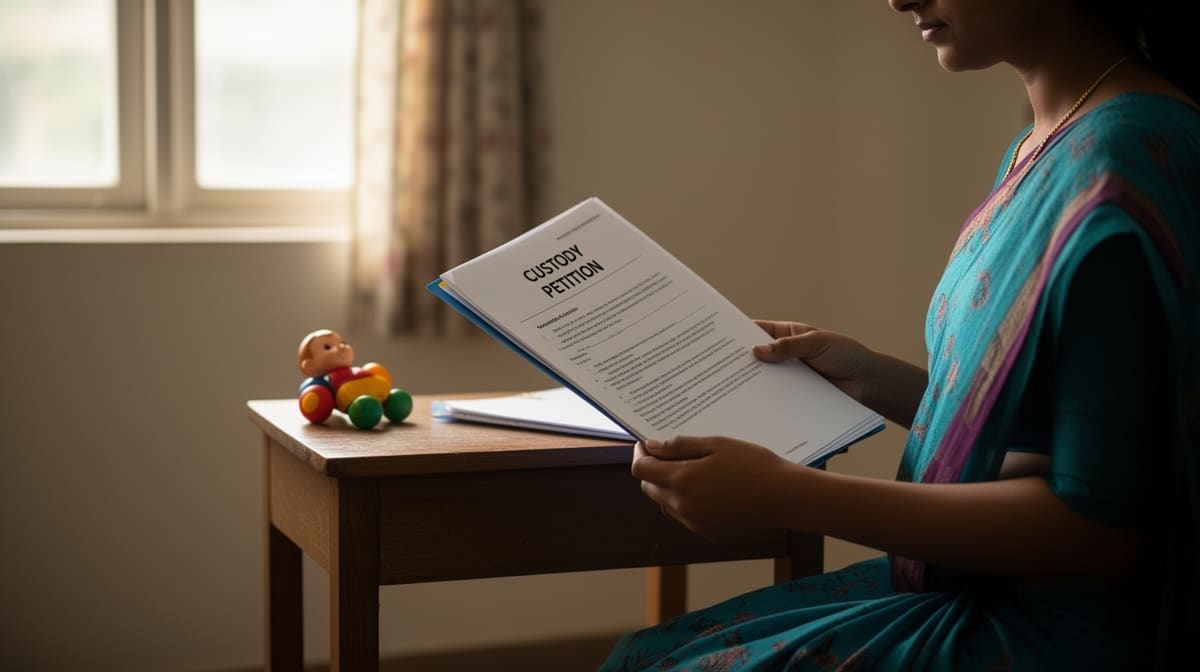
The Karnataka High Court has affirmed that the Protection of Women from Domestic Violence Act, 2005, empowers Magistrates to grant interim custody of young children to aggrieved mothers, prioritizing the child’s welfare over procedural technicalities. This ruling clarifies a critical intersection between domestic violence protections and child custody rights, offering immediate recourse to women in abusive households.
Background & Facts
The Dispute
The dispute centers on the interim custody of Likhit Dhananjay Relekar, a three-and-a-half-year-old boy, between his mother, the respondent Aishwarya W/o Dhananjay Relekar, and his paternal grandparents and father, the petitioners. The mother filed an application under Section 21 of the Protection of Women from Domestic Violence Act, 2005, seeking temporary custody of her child, alleging domestic violence and emotional abuse within the paternal household.
Key Facts
- The child, Likhit Dhananjay Relekar, was born on or about 15.08.2022
- The respondent, Aishwarya, is the biological mother and primary caregiver since birth
- The petitioners are the father (Petitioner No.1), mother-in-law (Petitioner No.2), and father-in-law (Petitioner No.3)
- The respondent alleges physical and psychological abuse by the petitioners, including isolation and denial of medical care
- The child has been residing with the petitioners since early 2024, following a marital breakdown
- No formal custody application was filed under the Guardians and Wards Act, 1890, prior to the PWDV Act application
Procedural History
- 15.01.2025: Respondent filed Crl.Misc.No.64/2025 before the JMFC-II, Belagavi, seeking interim custody under Section 21 of the PWDV Act
- 22.04.2025: JMFC-II granted visitation rights to the petitioners but denied interim custody to the respondent, citing lack of evidence of immediate harm
- 10.05.2025: Respondent filed Criminal Appeal No.144/2025 before the V Additional District and Sessions Judge, Belagavi
- 30.09.2025: Sessions Court allowed the appeal, reversed the JMFC’s order, and granted interim custody to the respondent while granting visitation rights to the petitioners
- 15.10.2025: Petitioners filed Criminal Revision Petition No.100460/2025 before the High Court of Karnataka at Dharwad
- 17.03.2026: Hearing concluded before Justice Hanchate Sanjeevkumar
Relief Sought
The petitioners sought to set aside the Sessions Court’s order dated 30.09.2025, restore the JMFC’s order dated 22.04.2025, and deny custody to the respondent. The respondent sought confirmation of the Sessions Court’s order and immediate handover of the child.
The Legal Issue
The central question was whether Section 21 of the Protection of Women from Domestic Violence Act, 2005, permits a Magistrate to grant interim custody of a child to the aggrieved mother, even when an alternative remedy under the Guardians and Wards Act, 1890, is available.
Arguments Presented
For the Appellant/Petitioner
The petitioners’ counsel argued that custody disputes involving minors must be governed exclusively by the Guardians and Wards Act, 1890, and that Section 21 of the PWDV Act was never intended to supplant or bypass the established framework for custody adjudication. Reliance was placed on Samiulla Saheb v. Mohammed Sameer and Smt. Raziya v. State of Karnataka, where courts held that custody matters under the PWDV Act are ancillary and cannot override the primary jurisdiction of civil courts under the Act of 1890. It was contended that the respondent’s failure to file under the Guardians and Wards Act rendered her application under Section 21 non-maintainable.
For the Respondent/State
The respondent’s counsel argued that Section 21 of the PWDV Act is a specific, standalone provision designed to provide immediate relief to women facing domestic violence, including custody of children. The provision explicitly states that it operates "notwithstanding anything contained in any other law," thereby creating an independent and complementary remedy. The respondent emphasized the child’s tender age and the mother’s role as primary caregiver, invoking the principle of the child’s best interest as paramount under both the PWDV Act and the Juvenile Justice Act.
The Court's Analysis
The Court undertook a purposive interpretation of Section 21 of the PWDV Act, emphasizing its legislative intent to provide swift, protective remedies to women in distress. The provision grants Magistrates explicit authority to grant temporary custody of a child to the aggrieved person, with or without visitation rights to the respondent, based on the child’s welfare.
"Notwithstanding anything contained in any other law for the time being in force, the Magistrate may, at any stage of hearing of the application for protection order or for any other relief under this Act grant temporary custody of any child or children to the aggrieved person..."
The Court held that the phrase "notwithstanding anything contained in any other law" is a clear legislative directive to override conflicting procedural norms. The reliance on Samiulla Saheb and Raziya was rejected as factually distinguishable: those cases involved custody disputes between parents in the absence of domestic violence allegations, whereas the present case arose directly from a PWDV Act application where abuse was alleged and the child’s safety was at stake.
The Court further noted that the Guardians and Wards Act is a civil, lengthy process requiring notice, investigation, and often expert reports, whereas the PWDV Act is designed for expeditious relief. At three-and-a-half years of age, the child’s emotional and physical dependence on the mother is well-established in developmental psychology and recognized in Indian jurisprudence. The Sessions Court’s decision to grant custody to the mother was therefore not only legally sound but also welfare-driven.
The Court also clarified that the availability of an alternative remedy does not bar the invocation of a special statutory provision meant for urgent protection. The PWDV Act is not an alternative - it is a parallel, protective mechanism.
The Verdict
The petition was dismissed. The High Court upheld the Sessions Court’s order dated 30.09.2025 granting interim custody of Likhit Dhananjay Relekar to the respondent mother. The petitioners were directed to hand over physical custody of the child to the respondent within one week from the date of judgment, i.e., by 24.03.2026. Visitation rights to the petitioners were confirmed as granted by the Sessions Court.
What This Means For Similar Cases
Custody Under PWDV Act Is an Independent Remedy
- Practitioners must now treat Section 21 of the PWDV Act as a standalone, urgent remedy - not a procedural afterthought
- Filing under the Guardians and Wards Act is not a prerequisite for invoking Section 21
- Courts cannot dismiss PWDV custody applications on grounds of "alternative remedy"
Tender Age Presumption in Favor of Mother
- For children under five years, courts must presume maternal custody is in the child’s best interest unless compelling evidence shows otherwise
- This presumption is reinforced by the PWDV Act’s welfare-oriented framework
- Opposing parties must present concrete evidence of maternal unfitness, not mere allegations
Procedural Urgency Overrides Formalism
- Applications under Section 21 must be heard expeditiously
- Delay in custody decisions can cause irreparable harm to young children
- Courts must prioritize the child’s immediate safety over procedural technicalities