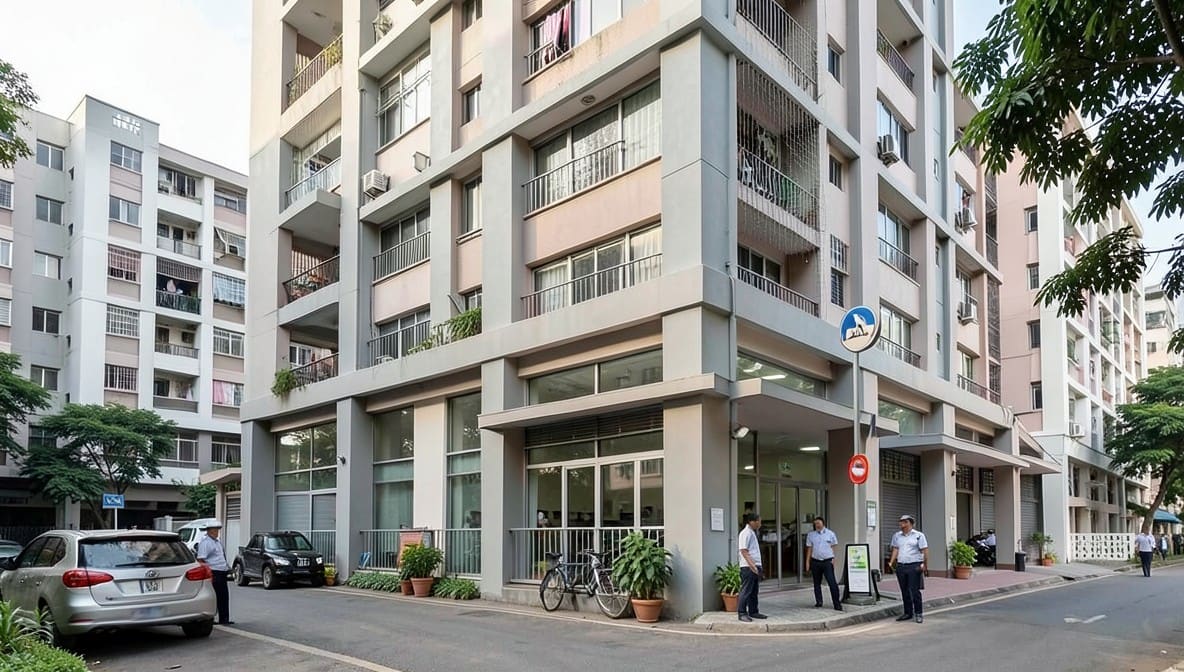
The Income Tax Appellate Tribunal, Bangalore, has clarified that a registered society under state societies legislation cannot be taxed at the maximum marginal rate merely because its members' shares are disclosed as zero. This ruling affirms the statutory exemption under Section 167B and reinforces the principle that legal form must align with substantive nature.
Background & Facts
The Dispute
The appellant, Ajmera Green Acres Apartment Owners Welfare Association, is a body registered under the Karnataka Societies Registration Act, 1960. It manages common amenities and services for residents of a residential complex in Bangalore. The association collects maintenance fees from its members, which are used exclusively for upkeep, repairs, and administrative expenses. There is no profit distribution, no dividend policy, and no mechanism for members to claim personal benefit from surplus income.
Key Facts
- The association filed its return of income for Assessment Year 2024-25 on 27.06.2024, declaring total income of Rs. 12,48,700
- The return disclosed members' shares as "zero", indicating no distributable income
- The association computed and paid income tax of Rs. 1,03,730 at the slab rates applicable to an Association of Persons
- The Central Processing Centre, Bengaluru, issued an intimation under Section 143(1) dated 28.12.2024, reassessing the tax liability at the maximum marginal rate
- The Commissioner of Income Tax (Appeals) upheld this adjustment on 29.01.2026, holding that the disclosure of "indeterminate shares" triggered Section 167B
- The appellant had previously been taxed at slab rates for Assessment Years 2010-11, 2011-12, and 2012-13, following remand and rectification by the Assessing Officer
Procedural History
- 27.06.2024: Original return filed for AY 2024-25
- 28.12.2024: CPC intimation issued under Section 143(1), applying maximum marginal rate
- 05.01.2025: Appeal filed before Commissioner of Income Tax (Appeals) - NFAC
- 29.01.2026: CIT(A) order dismissing appeal and upholding CPC’s adjustment
- 15.02.2026: Appeal filed before ITAT Bangalore (ITA No. 1423/Bang/2026)
- 26.05.2026: Hearing conducted
- 29.06.2026: Judgment pronounced
Relief Sought
The appellant sought: (1) setting aside of the CIT(A) order dated 29.01.2026, (2) deletion of the tax adjustment made under Section 167B, and (3) confirmation that its income is taxable at the slab rates applicable to an Association of Persons.
The Legal Issue
The central question was whether Section 167B of the Income-tax Act, 1961 applies to a society registered under the Karnataka Societies Registration Act, 1960, where the members' shares are disclosed as zero due to non-distribution of income.
Arguments Presented
For the Appellant
The appellant argued that Section 167B explicitly excludes societies registered under the Societies Registration Act, 1860, or any corresponding state law. The disclosure of "zero" shares was not an indication of indeterminacy but a factual representation that no income is distributable. The association’s constitution prohibits profit-sharing, and all surplus is reinvested in common facilities. The appellant relied on the coordinate bench decision in AME Harmony Apartment Owners Welfare Association (ITA No. 993/Bang/2018), which held that registered societies are not subject to MMR under Section 167B. Further, the Revenue had previously accepted this position for earlier years without challenge.
For the Respondent
The Department contended that the return disclosed members' shares as "indeterminate", triggering Section 167B. It argued that the term "indeterminate" includes situations where shares are not specified or are stated as zero. The CIT(A) had relied on this interpretation, and the Department maintained that the exemption under Section 167B applies only if the society is registered under the central Act, not state laws.
The Court's Analysis
The Tribunal examined the language of Section 167B, which states: "Where the individual shares of the members of an association of persons or body of individuals are indeterminate or unknown, tax shall be charged at the maximum marginal rate..." It further provides: "This section shall not apply to... any society registered under the Societies Registration Act, 1860, or under any corresponding law in force in any part of India."
The Tribunal noted that the appellant is registered under the Karnataka Societies Registration Act, 1960 - a "corresponding law" within the meaning of Section 167B. The disclosure of "zero" shares was not an omission or ambiguity but a deliberate statement reflecting the association’s non-profit character. The Tribunal held that equating "zero" with "indeterminate" is legally unsound and contradicts the plain meaning of the provision.
"The fact that the shares are shown as zero does not mean they are unknown or indeterminate. It means they are determinate - and zero."
The Tribunal further emphasized that the Revenue had, in prior years, accepted the same position after remand. This consistent administrative practice, unchallenged by higher authorities, formed a legitimate expectation. The coordinate bench decision in AME Harmony Apartment Owners Welfare Association was binding under the doctrine of consistency and judicial comity.
The Department’s attempt to distinguish state registration from central registration was rejected. The phrase "any corresponding law in force in any part of India" clearly encompasses state-level societies legislation.
The Verdict
The appeal is allowed. The order of the CIT(A) dated 29.01.2026 is set aside. The income of the appellant for Assessment Year 2024-25 shall be taxed at the slab rates applicable to an Association of Persons, and not at the maximum marginal rate. The tax adjustment of Rs. 1,03,730 already paid is deemed valid and no additional tax, interest, or penalty shall be levied. The CPC shall issue a revised intimation under Section 143(1) within 4 weeks.
What This Means For Similar Cases
Registered Societies Are Exempt from MMR by Statutory Design
- Practitioners representing housing societies, welfare associations, or resident welfare groups registered under state societies acts must now assert Section 167B’s exclusion as a matter of right
- Disclosure of "zero" or "nil" shares in the return is not a trigger for MMR - it is a factual representation of non-distributability
- Any reassessment applying MMR to such entities must be challenged on the ground of statutory exemption
Precedent and Consistency Are Binding on Revenue
- When the Revenue has accepted a legal position in prior years without appeal, it cannot unilaterally reverse it in subsequent years without compelling justification
- Coordinate bench decisions on identical facts are binding unless overruled by a larger bench
- Tax authorities must respect established administrative practice, especially where it benefits non-profit entities
Documentation Must Reflect Non-Profit Nature
- Associations should maintain constitutional documents explicitly prohibiting profit distribution
- Returns should clearly state that income is applied solely to objects of the society
- Maintain records of maintenance fund usage to substantiate non-distributive intent
- Use the phrase "shares are nil due to non-distribution of income" to preempt misinterpretation